

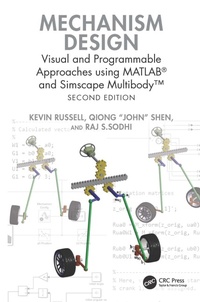
Mechanism Design
Visual and Programmable Approaches using MATLAB (R) and Simscape Multibody (TM)
2nd Edition
Published on 4. November 2025
472 pages
978-1-040-42795-8 (ISBN)
Description

This updated edition of Mechanism Design: Visual and Programmable Approaches using MATLAB (R) and Simscape Multibody (TM) offers a comprehensive introduction to kinematic synthesis, covering motion, path, and function generation techniques for a wide range of planar and spatial single- and multi-loop linkage systems.
This book presents foundational concepts alongside practical methodologies, making it an accessible resource for both students and practitioners in the field. In this revised edition, real-world application of the presented methods is supported through the integration of MATLAB (R) and its powerful simulation and visualization toolbox, Simscape Multibody (TM). These tools help bridge theory and practice, allowing readers to implement kinematic synthesis techniques and observe system behavior through dynamic visualizations. New content expands this book's scope, including topics such as geared five-bar kinematic synthesis and both forward and inverse kinematics for robotic systems.
Designed as a complete introduction to kinematic synthesis, this book is an essential resource for students in mechanical engineering and related disciplines seeking to master the principles and practicalities of mechanism design.
The new edition also includes a solution manual and MATLAB as an online resource for instructors to support the topics discussed in this book.
This book presents foundational concepts alongside practical methodologies, making it an accessible resource for both students and practitioners in the field. In this revised edition, real-world application of the presented methods is supported through the integration of MATLAB (R) and its powerful simulation and visualization toolbox, Simscape Multibody (TM). These tools help bridge theory and practice, allowing readers to implement kinematic synthesis techniques and observe system behavior through dynamic visualizations. New content expands this book's scope, including topics such as geared five-bar kinematic synthesis and both forward and inverse kinematics for robotic systems.
Designed as a complete introduction to kinematic synthesis, this book is an essential resource for students in mechanical engineering and related disciplines seeking to master the principles and practicalities of mechanism design.
The new edition also includes a solution manual and MATLAB as an online resource for instructors to support the topics discussed in this book.
More details
Edition
2nd edition
Language
English
Place of publication
London
United Kingdom
Publishing group
Taylor & Francis Ltd
Target group
College/higher education
Illustrations
166 Tables, black and white; 532 Line drawings, black and white; 31 Halftones, black and white; 563 Illustrations, black and white
File size
61,23 MB
ISBN-13
978-1-040-42795-8 (9781040427958)
Copyright in bibliographic data and cover images is held by Nielsen Book Services Limited or by the publishers or by their respective licensors: all rights reserved.
Schweitzer Classification
Other editions
Additional editions
Kevin Russell | Qiong "John" Shen | Raj S. Sodhi
Mechanism Design
Visual and Programmable Approaches using MATLAB (R) and Simscape Multibody (TM)
Book
11/2025
2nd Edition
CRC Press
€165.70
Shipment within 10-20 days
Previous edition
E-Book
12/2013
1st Edition
CRC Press
€231.99
Available for download
Persons
Kevin Russell, Ph.D., P.E., is a member of the teaching faculty in the Department of Mechanical and Industrial Engineering at New Jersey Institute of Technology (NJIT). At NJIT, Dr. Russell teaches courses in computer-aided design, computer-aided simulation, kinematics, machine design, and mechanical design. Formerly, Dr. Russell was a Senior Mechanical Engineer at the U.S. Army Research, Development and Engineering Center (ARDEC) at Picatinny, New Jersey. His responsibilities at ARDEC included the utilization of computer-aided design and modeling and simulation tools for small- and medium-caliber weapon system improvement, concept development, and failure investigations. A Fellow of the American Society of Mechanical Engineers (ASME) and a registered Professional Engineer in New Jersey, Dr. Russell holds several patents for his design contributions relating to small- and medium-caliber weapon systems, linkage-based inspection systems, and human prosthetics. He has published extensively among mechanical engineering journals in areas such as kinematic synthesis, theoretical kinematics, and machine design.
Qiong "John" Shen, Ph.D., is the founder of Softalink LLC, New Jersey, a consulting company that applies cloud-computing and big data technologies to help automate and optimize business processes, and transform traditional marketing and strategic planning into a data-driven manner. Besides business activities, Dr. Shen is also active, as an adjunct professor at New Jersey Institute of Technology (NJIT), in preparing college students for ever-growing challenges in engineering and management. Dr. Shen received a Ph.D. degree from a joint program between Mechanical Engineering and Electrical Engineering Departments at NJIT. He has made substantial contributions to research in Robotics and Mechanism Synthesis by applying technologies from distributed parallel computing, machine learning, visualization, and simulation.
Raj S. Sodhi, Ph.D., P.E. is a professor in the Department of Mechanical and Industrial Engineering at NJIT. He has over 30 years of experience in research and education related to mechanical design, mechanisms synthesis, and manufacturing engineering. Dr. Sodhi is the author or co-author of over 100 refereed papers in scientific journals and conference proceedings. He was awarded the Society of Manufacturing Engineering's University Lead Award in recognition of leadership and excellence in the application and development of computer integrated manufacturing. He also received the N. Watrous Procter & Gamble Award from the Society of Applied Mechanisms and Robotics for significant contributions to the science of mechanisms and robotics and the Ralph R. Teetor New Engineering Educator Award from the Society of Automotive Engineers. Dr. Sodhi is a registered Professional Engineer in Texas.
Qiong "John" Shen, Ph.D., is the founder of Softalink LLC, New Jersey, a consulting company that applies cloud-computing and big data technologies to help automate and optimize business processes, and transform traditional marketing and strategic planning into a data-driven manner. Besides business activities, Dr. Shen is also active, as an adjunct professor at New Jersey Institute of Technology (NJIT), in preparing college students for ever-growing challenges in engineering and management. Dr. Shen received a Ph.D. degree from a joint program between Mechanical Engineering and Electrical Engineering Departments at NJIT. He has made substantial contributions to research in Robotics and Mechanism Synthesis by applying technologies from distributed parallel computing, machine learning, visualization, and simulation.
Raj S. Sodhi, Ph.D., P.E. is a professor in the Department of Mechanical and Industrial Engineering at NJIT. He has over 30 years of experience in research and education related to mechanical design, mechanisms synthesis, and manufacturing engineering. Dr. Sodhi is the author or co-author of over 100 refereed papers in scientific journals and conference proceedings. He was awarded the Society of Manufacturing Engineering's University Lead Award in recognition of leadership and excellence in the application and development of computer integrated manufacturing. He also received the N. Watrous Procter & Gamble Award from the Society of Applied Mechanisms and Robotics for significant contributions to the science of mechanisms and robotics and the Ralph R. Teetor New Engineering Educator Award from the Society of Automotive Engineers. Dr. Sodhi is a registered Professional Engineer in Texas.
Content
Preface. About the Authors. Chapter 1: Introduction to Kinematics. Chapter 2: Mathematical Concepts in Kinematics. Chapter 3: Fundamental Concepts in Kinematics. Chapter 4: Kinematic Analysis of Planar Mechanisms. Chapter 5: Analytical Planar Four-Bar, Geared Five-Bar, and Stephenson III Motion Generation. Chapter 6: Planar Four-Bar, Geared Five-Bar, and Stephenson III Path and Motion Generation. Chapter 7: Planar Four-Bar Function Generation. Chapter 8: Spatial Mechanism Kinematics and Dimensional Synthesis. Chapter 9: Adjustable Planar and Spherical Four-Bar Mechanism Dimensional Synthesis. Chapter 10: Introduction to Robotic Manipulators. Appendices. Index.
