

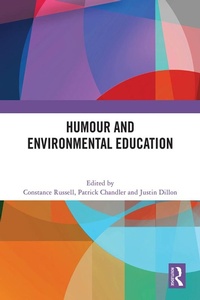
Humour and Environmental Education
1st Edition
Published on 23. December 2024
202 pages
978-1-040-30364-1 (ISBN)
Description

This book illustrates how humour can be a powerful tool for environmental education. Hailing from eight different countries, the authors' inquiries are grounded in a range of sites of learning and focus on different comedic forms, offering a variety of perspectives on the ways humour features, or could feature, in environmental education.
The chapters adopt an array of methodological approaches and theoretical frames, drawing not only on environmental education research and humour studies, but also scholarship in affect theory, antiracist and Indigenous education, climate change communication, critical pedagogy, ecocriticism and language arts education, feminist theory, human- animal relations, media studies, new materialisms, philosophy, psychology, public pedagogy, science education, and social movement studies. Many of the topics discussed in this volume necessitated multi- or interdisciplinary inquiries and pedagogies.
Delving into humour led the authors to push beyond the boundaries of their own disciplines and, for some, to form creative collaborations that took them not only into new academic fields but also outside their professions to work with actors, cartoonists, comedians, and game developers. This book was originally published as a special issue of Environmental Education Research.
The chapters adopt an array of methodological approaches and theoretical frames, drawing not only on environmental education research and humour studies, but also scholarship in affect theory, antiracist and Indigenous education, climate change communication, critical pedagogy, ecocriticism and language arts education, feminist theory, human- animal relations, media studies, new materialisms, philosophy, psychology, public pedagogy, science education, and social movement studies. Many of the topics discussed in this volume necessitated multi- or interdisciplinary inquiries and pedagogies.
Delving into humour led the authors to push beyond the boundaries of their own disciplines and, for some, to form creative collaborations that took them not only into new academic fields but also outside their professions to work with actors, cartoonists, comedians, and game developers. This book was originally published as a special issue of Environmental Education Research.
More details
Edition
1. Auflage
Language
English
Place of publication
London
United Kingdom
Publishing group
Taylor & Francis Ltd
Target group
College/higher education
ISBN-13
978-1-040-30364-1 (9781040303641)
Copyright in bibliographic data and cover images is held by Nielsen Book Services Limited or by the publishers or by their respective licensors: all rights reserved.
Schweitzer Classification
Other editions
Additional editions
Constance Russell | Patrick Chandler | Justin Dillon
Humour and Environmental Education
Book
05/2026
1st Edition
Routledge
€56.00
Shipment within 10-20 days
Constance Russell | Patrick Chandler | Justin Dillon
Humour and Environmental Education
Book
12/2024
1st Edition
Routledge
€197.20
Shipment within 10-20 days
Persons
Constance Russell is Professor in the Faculty of Education, Lakehead University, Canada where she teaches courses in environmental education, animal-focused education, and food education. She was given the 2017 Outstanding Contributions to Research in Environmental Education award by the North American Association for Environmental Education.
Patrick Chandler is an education specialist for the Climate Literacy Energy Awareness Network (CLEAN) and the Cooperative Institute for Environmental Sciences (CIRES), University of Colorado, Colorado, USA. He has over fifteen years of experience working in, developing, and researching environmental education, art, stewardship, and science programs and is an expert on climate change and plastic pollution education .
Justin Dillon is professor of science and environmental education in University College London's Centre for Climate Change and Sustainability Education. He taught in London schools for ten years before working at King's College London, the University of Bristol, and the University of Exeter. Justin was President of the European Science Education Research Association from 2007 to 2011.
Patrick Chandler is an education specialist for the Climate Literacy Energy Awareness Network (CLEAN) and the Cooperative Institute for Environmental Sciences (CIRES), University of Colorado, Colorado, USA. He has over fifteen years of experience working in, developing, and researching environmental education, art, stewardship, and science programs and is an expert on climate change and plastic pollution education .
Justin Dillon is professor of science and environmental education in University College London's Centre for Climate Change and Sustainability Education. He taught in London schools for ten years before working at King's College London, the University of Bristol, and the University of Exeter. Justin was President of the European Science Education Research Association from 2007 to 2011.
Content
Introduction: Humour and environmental education 1. The generativity of feminist and environmental cartoons for environmental education research and teaching 2. Learning with student climate strikers' humour: Towards critical affective climate justice literacies 3. "It was funny at first": Exploring tensions in human-animal relations through internet memes with university students 4. When students write comedy scripts: Humor as an experiential learning method in environmental education 5. Is climate change a laughing matter? 6. From The Fresh Prince to The Politician: Climate change frames in American scripted television comedy 1990-2020 7. The cranky uncle game: Combining humor and gamification to build student resilience against climate misinformation 8. Humor and humility for inclusive nature education 9. I am not a camper: Confessions of an Indigenous urban environmental educator 10. "A good hell": Absurdist insights for environmental education and research 11. Irony and environmental education: On the ultimate question of environmental education, the universe and everything
