

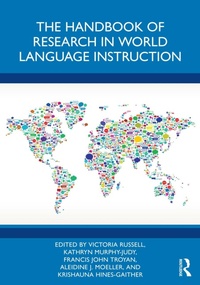
The Handbook of Research in World Language Instruction
Published on 5. June 2025
668 pages
978-1-040-34893-2 (ISBN)
Description

This seminal handbook provides a comprehensive overview of the research on world language education and how that research can transform into effective and daily instructional practices for K-16 language teachers.
With contributions from leading scholars in the field, the volume addresses cutting-edge research, trends, and practice. Covering key topics in language education, the volume is organized in six sections: Teaching Methods and Approaches; Culture, Pragmatics, and Intercultural Communicative Competence; Assessment and Program Evaluation; Diversity, Equity, and Inclusion in the World Language Classroom; Technology Integration and Online Language Teaching and Learning; and Key Issues in World Language Instruction, including advocacy, teacher recruitment and retention, and professional development.
This handbook is an essential text for all scholars, researchers, and educators in world languages.
With contributions from leading scholars in the field, the volume addresses cutting-edge research, trends, and practice. Covering key topics in language education, the volume is organized in six sections: Teaching Methods and Approaches; Culture, Pragmatics, and Intercultural Communicative Competence; Assessment and Program Evaluation; Diversity, Equity, and Inclusion in the World Language Classroom; Technology Integration and Online Language Teaching and Learning; and Key Issues in World Language Instruction, including advocacy, teacher recruitment and retention, and professional development.
This handbook is an essential text for all scholars, researchers, and educators in world languages.
More details
Language
English
Place of publication
London
United Kingdom
Publishing group
Taylor & Francis Ltd
Target group
College/higher education
Illustrations
33 Tables, black and white; 12 Line drawings, black and white; 2 Halftones, black and white; 14 Illustrations, black and white
File size
7,18 MB
ISBN-13
978-1-040-34893-2 (9781040348932)
Copyright in bibliographic data and cover images is held by Nielsen Book Services Limited or by the publishers or by their respective licensors: all rights reserved.
Schweitzer Classification
Other editions
Additional editions
Victoria Russell | Kathryn Murphy-Judy | Francis John Troyan
The Handbook of Research in World Language Instruction
Book
06/2025
1st Edition
Routledge
€145.00
Shipment within 10-20 days
Victoria Russell | Kathryn Murphy-Judy | Francis John Troyan
The Handbook of Research in World Language Instruction
Book
06/2025
1st Edition
Routledge
€377.70
Shipment within 10-20 days

Book
05/2025
Routledge
Unfortunately, price unknown
Available (delivery time upon request)
Persons
Victoria Russell, PhD, is Professor of Spanish and World Language Education and Coordinator of Online Programs in the Department of Modern and Classical Languages at Valdosta State University, USA. She served as President of ACTFL in 2022.
Kathryn Murphy-Judy, PhD, is a Professor Emerita and a Career Distinguished Professor at Virginia Commonwealth University, USA, retiring after 50 years in world languages and computer-assisted language learning.
Francis John Troyan, PhD, is Professor of Multilingual Language Education and Coordinator of World Language Education Programs at The Ohio State University, USA. He is the co-editor of Foreign Language Annals.
Aleidine J. Moeller, PhD, is the Edith S. Greer Professor Emerita at the University of Nebraska-Lincoln. Her scholarly interests include world language education and intercultural communication. She served as President of ACTFL in 2018.
Krishauna Hines-Gaither, PhD, is Vice President for Equity, Diversity, and Justice at Mount Saint Mary's University in Los Angeles, USA, and a former Spanish professor. She is the 2025 President-Elect and 2026 President of ACTFL.
Kathryn Murphy-Judy, PhD, is a Professor Emerita and a Career Distinguished Professor at Virginia Commonwealth University, USA, retiring after 50 years in world languages and computer-assisted language learning.
Francis John Troyan, PhD, is Professor of Multilingual Language Education and Coordinator of World Language Education Programs at The Ohio State University, USA. He is the co-editor of Foreign Language Annals.
Aleidine J. Moeller, PhD, is the Edith S. Greer Professor Emerita at the University of Nebraska-Lincoln. Her scholarly interests include world language education and intercultural communication. She served as President of ACTFL in 2018.
Krishauna Hines-Gaither, PhD, is Vice President for Equity, Diversity, and Justice at Mount Saint Mary's University in Los Angeles, USA, and a former Spanish professor. She is the 2025 President-Elect and 2026 President of ACTFL.
Content
Part 1: Teaching Methods and Approaches
1. Teaching Approaches and Methods in World Language Instruction
Victoria Russell
2. ACTFL's Core Practices: The Six Pillars of Effective Language Teaching
Kate McCrea Francis and Celia Chomon Zamora
3. Target Language Comprehensibility in the World Language Classroom
Krista Chambless and Christina Huhn
4. Differentiated Instruction: Meeting Student Needs
Leslie Baldwin
5. Project-Based Language Learning: Evolution, Design Features, and Research Insights
Julio C. Rodriguez
6. Literacy-Based Approaches to World Language Instruction
Bruna Sommer-Farias and Myriam Abdel-Malek
7. Supporting Heritage Learners in the Classroom and Beyond
Maria M. Carreira
8. Early Language Learning in Dual Language Bilingual Education and Traditional Elementary Classrooms
Katherine Barko-Alva and Paola Mendizabal
9. Experiential Learning: Engaging Students in Real-World Language Use
Todd A. Hernandez with Paul A. Garcia
Part 2: Culture, Pragmatics, and Intercultural Communicative Competence
10. Navigating the Multifarious Waters of Intercultural Communication with Learner-Centered Classroom Tasks
Aleidine J. Moeller and Stephanie W. P. Knight
11. Centering Communication in ICC: Fostering Target Language Use with Critical Cultural Inquiry
Paula Garrett-Rucks
12. Embrace the Unknown: Interlanguage Pragmatics through Games and Play
Julie Sykes, Sebastien Dubreil, and Stephanie W. P. Knight
13. Assessing Intercultural Capability
Angela Scarino, Michelle Kohler, and Anthony J. Liddicoat
14. The Why and How of Teaching for Social Justice and Intercultural Citizenship: Experiences of Early Adopters
Manuela Wagner, Terry A. Osborn, and Violet Affleck
15. Developing Critical Cultural Awareness and Critical Consciousness in World Language Classrooms
Theresa Catalano and Inoussa Malgoubri
16. Intercultural Communicative Competence and Intercultural Citizenship
Dorie Conlon and Michael Byram
17. Perspective-Making and Its Potential in Intercultural Learning
Erin Kearney and Tasha Austin
Part 3: Assessment and Program Evaluation
18. Assessment Competence in World Language Education
Lynda Taylor and Beverly Baker
19. Proficiency Testing in World Language Education
J. Dylan Burton and Paula Winke
20. Performance Assessment in World Language Education
Francis John Troyan, Jason Martel, and Anna Zaitseva
21. Student Feedback and Uptake in World Language Education
Bobby Hobgood
22. Dynamic Assessment in World Language Education
Ali Kushki and Kristin J. Davin
23. Program Evaluation in World Language Education
Margaret E. Malone and Meg Montee
Part 4: Diversity, Equity, and Inclusion in the World Language Classroom
24. The Antiracist World Language Classroom in the Midst of Opposing DEI Legislations
Krishauna Hines-Gaither and Cecile Accilien
25. Educator Agency in World Language Education: A Movement toward Diversity, Equity and Inclusion
Cassandra Glynn and Beth Wassell
26. Transdisciplinary Curricular Frameworks for Justice-Centered Pedagogies in the World Language Classroom
L.J. Randolph Jr.
27. Teaching Towards Gender Justice: Considerations in Materials Design, Selection, and Use
Kris Aric Knisely
28. Making Invisible LGBTQIA+ Students Visible in World Language Curricula
Paul A. Garcia and James E. Coda
29. Supporting Neurodiverse Students in the Secondary World Language Classroom
Meredith McDonald White, Jenniffer Whyte, and Kimberly M. Winslow
30. An Antiracist Approach to World Language Assessment: Making the Invisible Visible
Trina Philpot-Montano
Part 5: Technology Integration and Online Language Teaching and Learning
31. Technology Integration in Europe: An Experiential Approach
Ursula Stickler and Regine Hampel
32. OER and OEP for Second Language Learning and Teaching
Carl S. Blyth and Joshua J. Thoms
33. Differentiation and Retention: How Flipped Lessons Support Student Needs
Lauren Rosen
34. Building Connections among World Language Learners with Virtual Exchange
Deniz Goekcora and Raymond Oenbring
35. Supporting Less Commonly Taught and Indigenous Languages through Technology Integration and Online Language Learning
Luca Giupponi, Emily Heidrich Uebel, Felix A. Kronenberg, and Danielle Steider
36. The Maker Movement in World Language Education
Gillian Lord
37. The Fine Line between Digital Literacy and Academic Dishonesty in Online World Language Instruction
Errol O'Neill
Part 6: Key Issues in World Language Instruction
38. Seal of Biliteracy Implementation in World Language Programs
Kristin J. Davin and Amy J. Heineke
39. Engaging World Language Educators in Continuing Professional Development
Rebecca Kanak Fox, Kelley E. Webb, and Joan Kang Shin
40. The World Language Teacher Shortage and Teacher Retention: Insight and Recommendations
Pete Swanson and Jason Fischbach
41. The World Language edTPA: Lessons Learned from a National Certification Assessment
Susan A. Hildebrandt
42. Indigenous Language Revitalization: Dual Language Immersion in Practice
Brandon T. Locke
43. Preparing Students for a Career in Languages: Why World Language Education Programs Matter
Patricia W. Cummins
Conclusion: Future Directions in World Language Instruction
Pamela M. Wesely, Celia Chomon Zamora, Pablo Muirhead, and Victoria Russell
1. Teaching Approaches and Methods in World Language Instruction
Victoria Russell
2. ACTFL's Core Practices: The Six Pillars of Effective Language Teaching
Kate McCrea Francis and Celia Chomon Zamora
3. Target Language Comprehensibility in the World Language Classroom
Krista Chambless and Christina Huhn
4. Differentiated Instruction: Meeting Student Needs
Leslie Baldwin
5. Project-Based Language Learning: Evolution, Design Features, and Research Insights
Julio C. Rodriguez
6. Literacy-Based Approaches to World Language Instruction
Bruna Sommer-Farias and Myriam Abdel-Malek
7. Supporting Heritage Learners in the Classroom and Beyond
Maria M. Carreira
8. Early Language Learning in Dual Language Bilingual Education and Traditional Elementary Classrooms
Katherine Barko-Alva and Paola Mendizabal
9. Experiential Learning: Engaging Students in Real-World Language Use
Todd A. Hernandez with Paul A. Garcia
Part 2: Culture, Pragmatics, and Intercultural Communicative Competence
10. Navigating the Multifarious Waters of Intercultural Communication with Learner-Centered Classroom Tasks
Aleidine J. Moeller and Stephanie W. P. Knight
11. Centering Communication in ICC: Fostering Target Language Use with Critical Cultural Inquiry
Paula Garrett-Rucks
12. Embrace the Unknown: Interlanguage Pragmatics through Games and Play
Julie Sykes, Sebastien Dubreil, and Stephanie W. P. Knight
13. Assessing Intercultural Capability
Angela Scarino, Michelle Kohler, and Anthony J. Liddicoat
14. The Why and How of Teaching for Social Justice and Intercultural Citizenship: Experiences of Early Adopters
Manuela Wagner, Terry A. Osborn, and Violet Affleck
15. Developing Critical Cultural Awareness and Critical Consciousness in World Language Classrooms
Theresa Catalano and Inoussa Malgoubri
16. Intercultural Communicative Competence and Intercultural Citizenship
Dorie Conlon and Michael Byram
17. Perspective-Making and Its Potential in Intercultural Learning
Erin Kearney and Tasha Austin
Part 3: Assessment and Program Evaluation
18. Assessment Competence in World Language Education
Lynda Taylor and Beverly Baker
19. Proficiency Testing in World Language Education
J. Dylan Burton and Paula Winke
20. Performance Assessment in World Language Education
Francis John Troyan, Jason Martel, and Anna Zaitseva
21. Student Feedback and Uptake in World Language Education
Bobby Hobgood
22. Dynamic Assessment in World Language Education
Ali Kushki and Kristin J. Davin
23. Program Evaluation in World Language Education
Margaret E. Malone and Meg Montee
Part 4: Diversity, Equity, and Inclusion in the World Language Classroom
24. The Antiracist World Language Classroom in the Midst of Opposing DEI Legislations
Krishauna Hines-Gaither and Cecile Accilien
25. Educator Agency in World Language Education: A Movement toward Diversity, Equity and Inclusion
Cassandra Glynn and Beth Wassell
26. Transdisciplinary Curricular Frameworks for Justice-Centered Pedagogies in the World Language Classroom
L.J. Randolph Jr.
27. Teaching Towards Gender Justice: Considerations in Materials Design, Selection, and Use
Kris Aric Knisely
28. Making Invisible LGBTQIA+ Students Visible in World Language Curricula
Paul A. Garcia and James E. Coda
29. Supporting Neurodiverse Students in the Secondary World Language Classroom
Meredith McDonald White, Jenniffer Whyte, and Kimberly M. Winslow
30. An Antiracist Approach to World Language Assessment: Making the Invisible Visible
Trina Philpot-Montano
Part 5: Technology Integration and Online Language Teaching and Learning
31. Technology Integration in Europe: An Experiential Approach
Ursula Stickler and Regine Hampel
32. OER and OEP for Second Language Learning and Teaching
Carl S. Blyth and Joshua J. Thoms
33. Differentiation and Retention: How Flipped Lessons Support Student Needs
Lauren Rosen
34. Building Connections among World Language Learners with Virtual Exchange
Deniz Goekcora and Raymond Oenbring
35. Supporting Less Commonly Taught and Indigenous Languages through Technology Integration and Online Language Learning
Luca Giupponi, Emily Heidrich Uebel, Felix A. Kronenberg, and Danielle Steider
36. The Maker Movement in World Language Education
Gillian Lord
37. The Fine Line between Digital Literacy and Academic Dishonesty in Online World Language Instruction
Errol O'Neill
Part 6: Key Issues in World Language Instruction
38. Seal of Biliteracy Implementation in World Language Programs
Kristin J. Davin and Amy J. Heineke
39. Engaging World Language Educators in Continuing Professional Development
Rebecca Kanak Fox, Kelley E. Webb, and Joan Kang Shin
40. The World Language Teacher Shortage and Teacher Retention: Insight and Recommendations
Pete Swanson and Jason Fischbach
41. The World Language edTPA: Lessons Learned from a National Certification Assessment
Susan A. Hildebrandt
42. Indigenous Language Revitalization: Dual Language Immersion in Practice
Brandon T. Locke
43. Preparing Students for a Career in Languages: Why World Language Education Programs Matter
Patricia W. Cummins
Conclusion: Future Directions in World Language Instruction
Pamela M. Wesely, Celia Chomon Zamora, Pablo Muirhead, and Victoria Russell
