

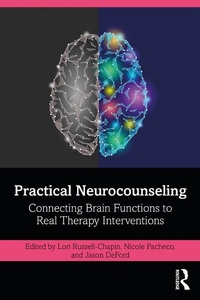
Practical Neurocounseling
Connecting Brain Functions to Real Therapy Interventions
1st Edition
Published on 29. December 2020
214 pages
978-1-000-34222-2 (ISBN)
Description

Practical Neurocounseling demonstrates the importance of considering brain health in counseling, showing mental health professionals how to understand and assess the functioning of different parts of the brain without sophisticated software or intensive training.
Chapters map out individual brain areas and give tips and guidance that therapists can use to tailor their approaches to meet specific cognitive, emotional, and behavioral needs. The interventions provided in each chapter are gender and culturally neutral, with easy-to-follow directions for application. LORETA brain maps for each of the 19 brain sites help identify brain locations to brain function and areas of dysregulation, and corresponding step-by-step interventions can be used to regulate sites and behaviors.
More than just a collection of techniques, Practical Neurocounseling is a valuable guide for clinicians interested in the relationship between brain activity and behavior. It's also an ideal book for professors and students in any neurocounseling course and for clinicians working in talk therapy.
Chapters map out individual brain areas and give tips and guidance that therapists can use to tailor their approaches to meet specific cognitive, emotional, and behavioral needs. The interventions provided in each chapter are gender and culturally neutral, with easy-to-follow directions for application. LORETA brain maps for each of the 19 brain sites help identify brain locations to brain function and areas of dysregulation, and corresponding step-by-step interventions can be used to regulate sites and behaviors.
More than just a collection of techniques, Practical Neurocounseling is a valuable guide for clinicians interested in the relationship between brain activity and behavior. It's also an ideal book for professors and students in any neurocounseling course and for clinicians working in talk therapy.
Reviews / Votes
"While practitioners, educators, and students have had a growing appreciation for the knowledge being generated in the field of neurocounseling, there has been a considerable call for clarification concerning its relevance in the everyday world of counseling professionals. By utilizing a thoroughly accessible, hands-on approach to the subject, Russell-Chapin, Pacheco and DeFord have answered the call by providing a much-needed text underscoring how systematic, well-conceived applications of neuroscience can provide a transformative approach to counseling practice." - Kathryn Z. Douthit, PhD, LMHC, professor of counseling and human development, University of Rochester"Russell-Chapin and colleagues have provided the field with an immensely useful and functional resource that supports individualized treatment and improved client outcomes. This innovative text skillfully links neuroscience-informed interventions with targeted brain-based changes. Counseling students and professionals alike will particularly appreciate the concise introductions to brain regions and functions and clear directions for applying various transtheoretical counseling techniques." - Raissa Miller, PhD, LCP, associate professor of counseling, Boise State University
"Russell-Chapin, Pacheco and DeFord deliver a well-crafted manual for clinicians that has been sorely missing. This seamless integration of research-informed neurocounseling techniques and state of the art neuroimaging helps clinicians connect presenting issues, neuroscience, therapeutic approaches and interventions quickly and efficiently. Clinicians should keep this book close at hand at all times!" - Allen Novian, PhD, LPC-S, LMFT-S, BCN, neurofeedback program coordinator, St. Mary's University
More details
Edition
1. Auflage
Language
English
Place of publication
London
United Kingdom
Publishing group
Taylor & Francis Ltd
Target group
College/higher education
Professional and scholarly
Product notice
Reflowable
Illustrations
1 Tables, black and white; 24 Line drawings, black and white; 18 Halftones, color; 1 Halftones, black and white; 42 Illustrations, black and white
ISBN-13
978-1-000-34222-2 (9781000342222)
Copyright in bibliographic data and cover images is held by Nielsen Book Services Limited or by the publishers or by their respective licensors: all rights reserved.
Schweitzer Classification
Other editions
Additional editions
Lori A. Russell-Chapin | Nicole C. Pacheco | Jason A. DeFord
Practical Neurocounseling
Connecting Brain Functions to Real Therapy Interventions
Book
12/2020
1st Edition
Routledge
€49.00
Shipment within 15-20 days
Lori A. Russell-Chapin | Nicole C. Pacheco | Jason A. DeFord
Practical Neurocounseling
Connecting Brain Functions to Real Therapy Interventions
Book
12/2020
1st Edition
Routledge
€167.13
Shipment within 15-20 days
Practical Neurocounseling
Connecting Brain Functions to Real Therapy Interventions
Book
12/2020
Routledge
Unfortunately, price unknown
Available (delivery time upon request)
Persons
Lori Russell-Chapin, PhD, LCPC, BCN, is an award-winning educator and researcher at Bradley University. She has a part-time private practice in neurofeedback in Peoria, Illinois.
Nicole Pacheco, PsyD, LCP, BCB, is a neurofeedback and EEG specialist, educator, and consultant in her own private practice in Springfield, Illinois.
Jason DeFord, LCPC, is a neurofeedback specialist, educator, and counselor in a private practice in Peoria, Illinois.
.
Nicole Pacheco, PsyD, LCP, BCB, is a neurofeedback and EEG specialist, educator, and consultant in her own private practice in Springfield, Illinois.
Jason DeFord, LCPC, is a neurofeedback specialist, educator, and counselor in a private practice in Peoria, Illinois.
.
Content
Part I. 1. Understanding The World of Neurocounseling and Chapter Summaries Lori A. Russell-Chapin and Nicole Pacheco 2. Demonstrating Neurocounseling and Neuroanatomy with the Case of Patrice: Struggling with Stability and Independence Lori A. Russell-Chapin 3. Integrating Neurocounseling with Assessments, Treatment Planning and Outcome Evaluation Theodore J. Chapin Part II. 4. Prefrontal Cortex (FP1 & FP2): Leading with the CEO of the Brain Christine Nave and Jason DeFord 5. Frontal Lobes (F3, FZ, F4, F7 & F8): Seeing the Trees and Seeing the Forest for the Trees Jason DeFord, Mary Bartido, and Tamika Lampkin 6. Sensory Motor (C3, CZ & C4): Helping the World Move Anna Resniak, Brooke Poling, and Leah Maloney 7. Temporal Lobes (T3, T4, T5 & T6): Integrating the World, Myself, and Others Karoline Pitts, Melissa Hodge, Donna Miller, and Nicole Pacheco 8. Parietal Lobes (P3, PZ, & P4): Making Sense of One's Experience and the World Around Me Nicole Pacheco and Maya Ladasky 9. Occipital Lobes (O1 & 02): Visualizing the World through Recognition and Patterns Parneet Sahota 10. Conclusions: Coming Full Circle Lori A. Russell-Chapin, Nicole Pacheco, and Jason DeFord
