
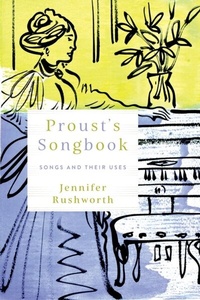
Proust's Songbook
Description
Alles über E-Books | Antworten auf Fragen rund um E-Books, Kopierschutz und Dateiformate finden Sie in unserem Info- & Hilfebereich.
In Proust's Songbook, Jennifer Rushworth analyzes and theorizes the presence and role of songs in Marcel Proust's novel À la recherche du temps perdu (In Search of Lost Time). Instead of focusing on instrumental music and large-scale forms such as symphonies and opera, as is common in Proust musical studies, Rushworth argues for the centrality of songs and lyrics in Proust's opus. Her work analyzes the ways in which the author inserted songs at key turning points in his novel and how he drew inspiration from contemporary composers and theorists of song. Rushworth presents detailed readings of five moments of song in À la recherche du temps perdu, highlighting the songs' significance by paying close attention to their lyrics, music, composers, and histories.
Rushworth interprets these episodes through theoretical reflections on song and voice, drawing particularly from the works of Reynaldo Hahn and Roland Barthes. She argues that songs in Proust's novel are connected and resonate with one another across the different volumes yet also shows how song for Proust is a solo, amateur, and intimate affair. In addition, she points to Proust's juxtapositions of songs with meditations on the notion of "mauvaise musique" (bad music) to demonstrate the existence of a blurred boundary between songs that are popular and songs that are art.
According to Rushworth, a song for Proust has a special relation to repetition and memory due to its typical brevity and that song itself becomes a mode of resistance in À la Recherche-especially on the part of characters in the face of family and familial expectations. She also defines the songs in Proust's novel as songs of farewell-noting that to sing farewell is a means to resist the very parting that is being expressed-and demonstrates how songs, in formal terms, resist the forward impetus of narrative.
All prices
More details
Other editions
Additional editions
Person
Content
- Intro
- CONTENTS
- Introduction
- 1. A Schubertian "Adieu" to the Duchesse de Guermantes
- 2. Singing in the Bath
- 3. Noisy Neighbors
- 4. Song in Venice
- 5. Saint-Loup's Schumannian Swansong
- Epilogue
- APPENDIX 1. Texts and Translations of the Pseudo-Schubertian "Adieu"
- APPENDIX 2. Weyrauch's Defense of His Authorship of "Nach Osten!" (1846)
- NOTES
- BIBLIOGRAPHY
- INDEX
- ACKNOWLEDGMENTS

System requirements
File format: ePUB
Copy protection: Adobe-DRM (Digital Rights Management)
System requirements:
- Computer (Windows; MacOS X; Linux): Install the free reader Adobe Digital Editions prior to download (see eBook Help).
- Tablet/smartphone (Android; iOS): Install the free app Adobe Digital Editions or the app PocketBook before downloading (see eBook Help).
- E-reader: Bookeen, Kobo, Pocketbook, Sony, Tolino and many more (not Kindle).
The file format ePub works well for novels and non-fiction books – i.e., „flowing” text without complex layout. On an e-reader or smartphone, line and page breaks automatically adjust to fit the small displays.
This eBook uses Adobe-DRM, a „hard” copy protection. If the necessary requirements are not met, unfortunately you will not be able to open the eBook. You will therefore need to prepare your reading hardware before downloading.
Please note: We strongly recommend that you authorise using your personal Adobe ID after installation of any reading software.
For more information, see our ebook Help page.
File format: PDF
Copy-Protection: Adobe-DRM (Digital Rights Management)
System requirements:
- Computer (Windows; MacOS X; Linux): Install the free reader Adobe Digital Editions prior to download (see eBook Help).
- Tablet/smartphone (Android; iOS): Install the free app Adobe Digital Editions or the app PocketBook before downloading (see eBook Help).
- E-reader: Bookeen, Kobo, Pocketbook, Sony, Tolino and many more (only limited: Kindle).
The file format PDF always displays a book page identically on any hardware. This makes PDF suitable for complex layouts such as those used in textbooks and reference books (images, tables, columns, footnotes). Unfortunately, on the small screens of e-readers or smartphones, PDFs are rather annoying, requiring too much scrolling.
This eBook uses Adobe-DRM, a „hard” copy protection. If the necessary requirements are not met, unfortunately you will not be able to open the eBook. You will therefore need to prepare your reading hardware before downloading.
Please note: We strongly recommend that you authorise using your personal Adobe ID after installation of any reading software.
For more information, see our eBook Help page.
File format: ePUB
Copy protection: Watermark-DRM (Digital Rights Management)
System requirements:
- Computer (Windows; MacOS X; Linux): Use a reading software that can process the file format ePUB: e.g., Adobe Digital Editions or FBReader – both free (see eBook Help).
- Tablet/Smartphone (Android; iOS): Before downloading, install the free app Adobe Digital Editions (see eBook Help).
- E-reader: Bookeen, Kobo, Pocketbook, Sony, Tolino and many more (not Kindle).
The file format ePUB works well for novels and non-fiction books – i.e., „flowing” text without complex layout. On an e-reader or smartphone, line and page breaks automatically adjust to fit the small displays.
This eBook uses Watermark-DRM, a „soft” copy protection. This means that there are no technical restrictions to prevent illegal distribution. However, there is a personalised watermark embedded in the eBook that can be used to identify the purchaser of the eBook in the event of misuse and to provide evidence for legal purposes.
For more information, see our eBook Help page.
