

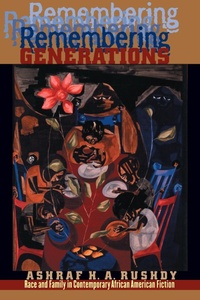
Remembering Generations
Race and Family in Contemporary African American Fiction
Published on 14. January 2003
224 pages
978-0-8078-7558-2 (ISBN)
Description

Slavery is America’s family secret, a partially hidden phantom that continues to haunt our national imagination. Remembering Generations explores how three contemporary African American writers artistically represent this notion in novels about the enduring effects of slavery on the descendants of slaves in the post–civil rights era.
Focusing on Gayl Jones’s Corregidora (1975), David Bradley’s The Chaneysville Incident (1981), and Octavia Butler’s Kindred (1979), Ashraf Rushdy situates these works in their cultural moment of production, highlighting the ways in which they respond to contemporary debates about race and family. Tracing the evolution of this literary form, he considers such works as Edward Ball’s Slaves in the Family (1998), in which descendants of slaveholders expose the family secrets of their ancestors.
Remembering Generations examines how cultural works contribute to social debates, how a particular representational form emerges out of a specific historical epoch, and how some contemporary intellectuals meditate on the issue of historical responsibility — of recognizing that the slave past continues to exert an influence on contemporary American society.
Focusing on Gayl Jones’s Corregidora (1975), David Bradley’s The Chaneysville Incident (1981), and Octavia Butler’s Kindred (1979), Ashraf Rushdy situates these works in their cultural moment of production, highlighting the ways in which they respond to contemporary debates about race and family. Tracing the evolution of this literary form, he considers such works as Edward Ball’s Slaves in the Family (1998), in which descendants of slaveholders expose the family secrets of their ancestors.
Remembering Generations examines how cultural works contribute to social debates, how a particular representational form emerges out of a specific historical epoch, and how some contemporary intellectuals meditate on the issue of historical responsibility — of recognizing that the slave past continues to exert an influence on contemporary American society.
More details
Other editions
Additional editions
Book
03/2001
The University of North Carolina Press
€46.90
Shipment within 15-20 days
Book
03/2001
The University of North Carolina Press
€80.66
Article exhausted; check different version
Person
Ashraf H. A. Rushdy is professor in the African American Studies Program and the English Department at Wesleyan University in Middletown, Connecticut. He is author of Neo-Slave Narratives: Studies in the Social Logic of a Literary Form.
