

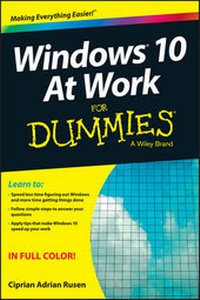
Windows 10 At Work For Dummies
Description

If you want to spend less time figuring out Windows and more time getting things accomplished, you've come to the right place. Covering Windows 10 and packed with time-saving tips to help you get the most out of the software, Windows 10 At Work For Dummies offers everything you need to get back precious hours of your work day and make Windows work for you, rather than against you.
This full-color, all-encompassing guide breaks down the most common Windows tasks into easily digestible parts, providing you with illustrated, step-by-step instructions on everything you'll encounter in Windows 10. From setting up your desktop with your favorite apps to finding the files and applications you need--and everything in between--this hands-on, friendly guide takes the headache out of working with Windows.
* Provides over 300 tasks broken into core steps
* Provides easy-to-follow answers to all of your Windows questions
* Illustrates the new features of Windows 10
* If you're a time-pressed professional looking to find answers to all of your Windows-related questions, this is the one-stop resource you'll turn to again and again.
All prices
More details
Other editions
Additional editions
Person
Content
Chapter 1: Getting Started with Windows 10 5
Chapter 2: Using the New Start Menu 25
Chapter 3: Using Touch and Touchpads 35
Chapter 4: Connecting to Wi-Fi Networks and the Internet 51
Chapter 5: Using Internet Explorer 65
Chapter 6: Managing Files and Folders 81
Chapter 7: Customizing File Explorer 115
Chapter 8: Customizing Windows 10 133
Chapter 9: Using Mail and Calendar 155
Chapter 10: Using Skype 165
Chapter 11: Using OneDrive 179
Chapter 12: Using OneNote 193
Chapter 13: Using Office Online and Office Apps 205
Chapter 14: Using Cortana 211
Chapter 15: Capturing Pictures, Screenshots, and Video 225
Chapter 16: Working with Apps 233
Chapter 17: Working with Devices 245
Chapter 18: Working on the Road 261
Chapter 19: Doing Your Job in Windows 10 279
Chapter 20: Protecting Your Data 291
Chapter 21: Personalizing User Accounts 303
Chapter 22: Sharing with Others on a Network 313
Chapter 23: Improving Your Privacy and Security 333
Chapter 24: Preventing Problems with Windows 10 357
Chapter 25: Fixing Common Problems with Windows 10 365
Chapter One
Getting Started with Windows 10
In This Chapter
Getting past the Lock Screen and signing in to Windows
Using the new Start Menu to start your apps
Using the hidden WinX menu
Accessing the Desktop
Accessing Settings and Control Panel
Performing simple searches
Using notifications
Working with multiple apps and Desktops at once
Closing apps and desktops
Signing out and locking your Windows 10 device
Shutting down and restarting Windows
Windows 10 is another revolution in the world of Microsoft operating systems. It's the first operating system to work on a huge number of devices, such as smartphones, tablets, traditional desktop PCs, consoles, and industrial devices. That also means it's designed to minimize hardware requirements. A Windows this slim and fast hasn't been built in a long time.
To make Windows 10 work on a variety of devices, with very different form factors, Microsoft developed a new user interface that's different from what you may have used with Windows 7 or Windows XP. Getting the first steps right when using Windows 10, goes a long way in having a pleasant user experience with this operating system. This chapter is your introduction to doing so.
Windows 10 uses concepts that may be new to you, such as the Lock Screen (introduced in Windows 8); a completely new Start Menu; the WinX menu (introduced in Windows 8); a new Settings panel that replaces the old Control Panel; the new Task View; and a new Action Center. Some items in this chapter are very simple, but you need to get them right in order to use Windows 10 productively. So, roll up your sleeves and arm yourself with a bit of patience. It's time to go to work!
Use the Lock Screen
The first screen you see after Windows 10 loads on your computer or device is the Lock Screen. This concept was introduced in Windows 8 and continues in Windows 10. The Lock Screen is basically a full-screen wallpaper. By default, it shows you the time and the date and whether you're connected to a network (see Figure 1-1). You can customize it to also show the detailed status of an app as well as small icons of your favorite apps so that you can see the status of those apps without leaving the Lock Screen. Along with all that, you can customize the Lock Screen's image.
Figure 1-1: The Lock Screen in Windows 10.
How you unlock the Lock Screen depends on the type of computer you're using:
- A Windows 10 desktop computer without touch:
- Press any key on the keyboard.
- Click the mouse anywhere on the screen.
- Drag upward from the bottom of the screen.
- A Windows 10 laptop with a touchpad:
- Press any key on the keyboard.
- Click the mouse or the left-click trackpad button anywhere on the screen.
- Hold down the left trackpad button and drag your cursor upward.
- Any Windows 10 device with a touchscreen (such as a tablet or a 2-in-1 device):
- Place your finger anywhere near the middle or bottom of the screen and flick upward.
Chapter 8 shows how to customize the Lock Screen.
Sign In to Windows 10
Once you get past the Lock Screen, you can sign in to Windows 10. You're asked to enter the password and click or tap the Sign In button for your user account (or the last account that was used on your device). The Sign In button is a right-pointing arrow (see Figure 1-2).
Figure 1-2: The Sign In screen in Windows 10.
If there are other user accounts on this computer, they're listed on the bottom-left side of the Sign In screen. To sign in with one of these other user accounts, click the account that you want, enter the password, and click or tap the Sign In button.
On the bottom right of the sign in screen, you see three accessible buttons:
- Network Connections
- Ease of Access options for starting such tools as the Narrator, Magnifier, and On-Screen keyboard
- Session-ending options (such as Sleep, Shut down, and Restart)
Chapter 21 covers the ins and outs of user accounts, passwords, and different ways of signing into Windows 10.
Use the Start Menu
After you sign in to Windows 10, the user interface of the operating system loads:
- On a classic PC, the Desktop loads.
- On a touch-enabled device that's set to work in Tablet mode, the Start Menu loads.
At the bottom of the screen you see the taskbar, a black bar with several buttons. If you click the button with the Windows logo (which is called the Start button), the Start Menu opens.
On classic PCs, the Start Menu covers only part of the screen and looks similar to what is shown in Figure 1-3.
Figure 1-3: The Start Menu on Windows 10 PCs.
On the right side of the Start Menu, you see several tiles of different sizes. Tiles are like shortcuts, and clicking them opens the app that they represent. However, some tiles can also display up-to-date information for the app they represent. These are interactive live tiles. You don't need to open the app to view the basic data a live tile offers. For example, after you configure the Weather app, it can show up-to-date weather information for a city, and the Photos app can show your pictures. This data appears on the Start Menu so that you have access to it without opening the app itself. The information is dynamic and changes as the information it represents does.
If you need to see more than a preview of the information, click the tile. The app opens in a window from which you can access all its features.
On the left side of the Start Menu, you see a column that contains your user account name, a list with your most used apps, a Power button and an All Apps button. Clicking an app's name opens that app.
If you're on a device that's working in Tablet mode, the Start Menu consumes the whole screen, so you don't see the Desktop (see Figure 1-4).
Figure 1-4: The Start Menu on a Windows 10 device working in Tablet mode.
The Start Menu displays a list with all your tiles, including the live tiles of apps that are pinned to the Start Menu. To access the column on the left with your user account name, the list of your Most Used apps, the Power button, and the All Apps button, you tap what's called a hamburger button (or just burger button) located at the top-left corner of the screen (the button is called a burger button because its three parallel lines look like a burger on a bun), which is found on the top-left corner of the screen. Tapping the burger button shows or hides this column, depending on its status.
Wherever you see the burger button, clicking or tapping it opens a menu.
From here on, navigating the Start Menu works just like it does on desktop PCs. The only difference is that instead of clicking, you tap with your finger or stylus.
Chapter 3 covers using Tablet mode and touch in Windows 10.
Use the All Apps List to Start Your Apps
All Apps is a list with all the apps that are installed on your Windows 10 device. Here's how to access it and start any app you want:
-
Sign in to Windows 10.
The Desktop appears.
-
Click the Windows logo.
The Start Menu appears.
-
In the Start Menu, click the All Apps button.
A list with all your apps appears.
- Scroll down the list of apps until you find the one that you want to start (see Figure 1-5).
- Click the app that you want to start.
Figure 1-5: The All Apps list in Windows 10.
On touch-enabled devices that work in Tablet mode, after Step 2, tap the burger button and then follow the instructions from Step 3 onward. Also, don't forget to replace the click with a tap.
Use the WinX Menu
In Windows 10, a hidden menu, the WinX menu, produces shortcuts to such useful tools and apps as Computer Management, the Control Panel, the Command Prompt, and the Task Manager. The menu's name comes from the keyboard shortcut that you press to open the menu: Windows+X (see Figure 1-6).
Figure 1-6: The WinX menu in Windows 10.
You can also open the WinX menu with the mouse or by using touch:
- With a mouse, right-click the Windows logo on the taskbar.
- With a touch-sensitive screen, press and hold the Windows logo until the WinX menu appears.
To start any of the tools available in the WinX menu, simply click or tap them.
Access the Desktop
On a computer or device that isn't set to work in Tablet mode, you can access the Desktop and its contents. If several apps are open and they completely cover the Desktop, just press Windows+D on the keyboard. All apps are minimized, and you can see the Desktop. Another solution is to minimize or close all apps, one by one.
