

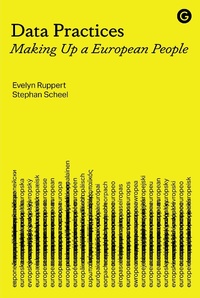
Data Practices
Making Up a European People
Published on 2. November 2021
244 pages
978-1-912685-86-8 (ISBN)
Description

How EU data practices establish and assign people to categories, and how this matters in enacting--"making up"--Europe as a population and people.
What is "Europe" and who are "Europeans"? Data Practices approaches this contemporary political and theoretical question by treating it as a practical problem of counting. Only through the myriad data practices that make up methods such as censuses can EU member states know their national populations, and this in turn is utilized by the EU to understand the population of Europe. But this volume approaches data practices not simply as reflecting populations but as performative in two senses: they simultaneously enact--that is, "make up"--a European population and, by so doing--intentionally or otherwise--also contribute to making up a European people.
The book develops a conception of data practices to analyze and interpret findings from collaborative ethnographic multisite fieldwork conducted by an interdisciplinary team of social science researchers as part of a five-year project, Peopling Europe: How Data Make a People. The book focuses on data practices that involve establishing and assigning people to categories and how this matters in enacting Europe as a population and people. Five core chapters explore key categories of people--usual residents, refugees, homeless people, migrants, and ethnic minorities--and how they come into being through specific data practices such as defining, estimating, recalibrating and inferring. Two additional chapters address two key subject positions that data practices produce and require: the data subject and the statistician subject.
What is "Europe" and who are "Europeans"? Data Practices approaches this contemporary political and theoretical question by treating it as a practical problem of counting. Only through the myriad data practices that make up methods such as censuses can EU member states know their national populations, and this in turn is utilized by the EU to understand the population of Europe. But this volume approaches data practices not simply as reflecting populations but as performative in two senses: they simultaneously enact--that is, "make up"--a European population and, by so doing--intentionally or otherwise--also contribute to making up a European people.
The book develops a conception of data practices to analyze and interpret findings from collaborative ethnographic multisite fieldwork conducted by an interdisciplinary team of social science researchers as part of a five-year project, Peopling Europe: How Data Make a People. The book focuses on data practices that involve establishing and assigning people to categories and how this matters in enacting Europe as a population and people. Five core chapters explore key categories of people--usual residents, refugees, homeless people, migrants, and ethnic minorities--and how they come into being through specific data practices such as defining, estimating, recalibrating and inferring. Two additional chapters address two key subject positions that data practices produce and require: the data subject and the statistician subject.
More details
Other editions
Additional editions
Book
11/2021
Goldsmiths, University of London
€60.89
Shipment within 3-4 weeks
Persons
Evelyn Ruppert is Professor in the Department of Sociology at Goldsmiths, University of London and Principal Investigator for Peopling Europe: How Data Make a People (ARITHMUS). Stephan Scheel is Junior Professor for Transnational Cooperation and Migration Research at Universität Duisburg-Essen in Hamburg.
Content
- Cover
- Half Title
- Title Page
- Copyright Page
- Contents
- Acknowledgements
- Biographies
- 1 Introduction: The Politics of Making up a European People
- What is 'Europe' and who are 'Europeans'?
- Data Practices
- Contribution
- Outline of the Chapters
- References
- 2 Data Practices
- What Are Data Practices?
- Classifying and Encoding Individuals into Categories: Making Up a People
- References
- 3 Usual Residents: Defining and Deriving
- Who Is Usually Resident?
- Defining Special Cases
- Cross-border Workers
- Circular Migration
- Deriving Usual Residents
- Catch-recatch: Deriving the Whole
- Micro-register: Deriving the Parts
- Sustaining the National
- Conclusions
- References
- 4 Refugees and Homeless People: Coordinating and Narrating
- Introduction
- Output Harmonisation: Making Data 'Good Enough'
- Coordinating Refugee Numbers
- Narrating Homeless People
- Narrating Through Categories
- Narrating Through Metadata
- Conclusion
- References
- 5 Migrants: Omitting and Recalibrating
- Introduction
- On the Production of Expertise and Ignorance in Fields of Practice
- Omitting I: Ignoring Methodological Differences and Limitations
- Omitting II: On the Dispersed Production of Non-knowledge
- Recalibrating: Enacting Migration as a Singular, Coherent Reality
- Conclusion
- References
- 6 Foreigners: Inferring and Assigning
- Introduction
- On the Performativity of Statistical Categories
- Conceptualising Categories: Three Aspects
- Enacting Foreignness, Nativeness, and Nationhood
- Estonia: Inferring Foreignness
- The Netherlands: Assigning Foreignness
- Conclusion
- References
- 7 Data Subjects: Calibrating and Sieving
- Introduction
- Calibrating Responses
- Producing New Problematic Subjects
- Sieving tweets
- Conclusion
- References
- 8 Statistician Subjects: Differentiating and Defending
- Introduction
- Shaping the Professional Subject in Relation to Big Data
- Recruiting Data Scientists
- Looking for Data Scientists
- Data Scientist As .
- Innovation Events: Brainstorming Workshop and the Data Camp
- From the Potential of a Job Candidate to the Potential of Big Data
- From Skills to Sensibilities
- Conferences: Defending by Differentiating
- Conclusion
- References
- 9 Conclusion: The Politics of Data Practices
- The Sedentary Bias of Population Statistics
- The Double Edge of Enumeration
- The Production of Non-Knowledge and the Performativity of What Is Absent
- The Production of Knowledge and the Performativity of Categories
- The Politics of Method in and Through Data Practices
- Different Futures for Official Statistics, Academic Research, and Citizen Data Rights
- Reimagining Categories
- Reimagining Knowledge and Non-Knowledge
- Reimaging Stakes
- References
- Notes
- Glossary
- Index
