

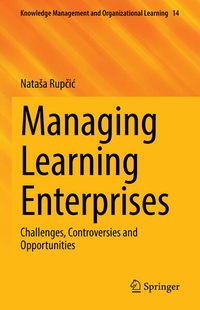
Managing Learning Enterprises
Description

This book provides an overview and a critical analysis of prior research and practice insights in the field of learning organizations and learning enterprises. However, it also represents the author's own findings and reflections on various dimensions and perspectives of a learning organization, offering solutions in response to previous findings and their critical evaluation. It reflects the time in which it was written, characterized by concerns about reaching the limits of growth and the potential collapse of the world under the burden of pollution and a growing population. Instead of advocating for greater control and regulation, this book presents a different perspective on the solution: the development and transformation of collective consciousness.
More details
Other editions
Additional editions
Person
Natasa Rupcic is a full professor at the Faculty of Economics and Business, University of Rijeka. She is the Editor-in-Chief of The Learning Organization Journal, published by Emerald, and a member of the editorial board of the Central European Business Review and the International Journal of Contemporary Management. She has authored several books and numerous scientific papers.
Content
Part 1: Characteristics of a Learning Enterprise.- 1. Managing human capital and learning - a key challenge of modern management.- 2. A modern enterprise as a learning organization.- 3 Learning disciplines of the learning organization.- 4. Management of a learning enterprise.- 5. Knowledge management - a modern core competence.- 6. Stakeholder orientation - the foundation of a learning enterprise.- Part 2: Challenges of Implementing a Learning Enterprise.- 7. Challenges of individual learning.- 8. Challenges of team learning.- 9. Challenges of organizational learning.- 10. Challenges of change: from adaptation to organizational transformation.- 11. Interorganizational learning and knowledge transfer.- 12. Learning - forgetting - unlearning - relearning: The learning dynamics of a learning organization.- 13. Intergenerational learning and knowledge transfer.- Part 3: Possibilities of Implementing the Concept of a Learning Organization and Enterprise.- 14. The learning organization as a technology for introducing the socio-economic paradigm and solving the so-called "wicked" problems.- 15. Possibilities of implementing the learning organization ideas with regard to cultural specificities.- 16. Complementarity of religious indoctrinations and spiritual practices and learning organizations.- 17. Critical review of the concept of the learning organization and the learning enterprise.- 18. A true learning organization - an organization of the people committed to spirituality.
