

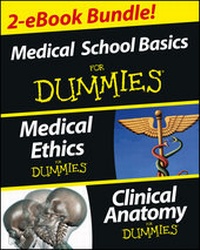
Medical Career Basics Course For Dummies, 2 eBook Bundle
Medical Ethics For Dummies & Clinical Anatomy For Dummies
Published on 7. January 2013
792 pages
978-1-118-59689-0 (ISBN)
Description

Two complete ebooks for one low price! Created and compiled bythe publisher, this medical school basics bundle bringstogether two of the bestselling For Dummies medical schooltitles in one, e-only bundle. With this special bundle,you'll get the complete text of the followingtitles:
Medical Ethics For Dummies
Succeeding in the healthcare field means more than just making adiagnosis and writing a prescription. Healthcare professionals areresponsible for convincing patients and their family members of thebest course of action and treatments to follow, while knowing howto make the right moral and ethical choices. Unlike daunting andexpensive texts, Medical Ethics For Dummies offers anaccessible and affordable course supplement for anyone studyingmedical or biomedical ethics and includes moral issues surroundingstem cell research, genetic engineering, euthanasia, and muchmore.
Clinical Anatomy For Dummies
Clinical anatomy is the study of human anatomy as it relates toclinical practice. Unlike a basic anatomy and physiology coursedesigned to teach general anatomical knowledge, clinical anatomyfocuses on specific structures and issues that people may encounterin a clinical setting. Loaded with clear definitions, conciseexplanations, and plenty of full-color illustrations, ClinicalAnatomy For Dummies presents a friendly, unintimidatingoverview of the material covered in a typical college-levelClinical Anatomy course.
About the Authors of Medical Ethics For Dummies
Jane Runzheimer, MD, is a family physician who has served on theEthics Committee of Methodist Hospital in St. Louis Park,Minnesota. Linda Johnson Larsen has written 24 books, many of whichhave an emphasis on health, and has been a patient advocate for herhusband and several family members.
About the Authors of Clinical Anatomy For Dummies
David Terfera, PhD, teaches biomedical sciences at theUniversity of Bridgeport College of Naturopathic Medicine. ShereenJegtvig, DC, MS, is a health and nutrition writer.
Medical Ethics For Dummies
Succeeding in the healthcare field means more than just making adiagnosis and writing a prescription. Healthcare professionals areresponsible for convincing patients and their family members of thebest course of action and treatments to follow, while knowing howto make the right moral and ethical choices. Unlike daunting andexpensive texts, Medical Ethics For Dummies offers anaccessible and affordable course supplement for anyone studyingmedical or biomedical ethics and includes moral issues surroundingstem cell research, genetic engineering, euthanasia, and muchmore.
Clinical Anatomy For Dummies
Clinical anatomy is the study of human anatomy as it relates toclinical practice. Unlike a basic anatomy and physiology coursedesigned to teach general anatomical knowledge, clinical anatomyfocuses on specific structures and issues that people may encounterin a clinical setting. Loaded with clear definitions, conciseexplanations, and plenty of full-color illustrations, ClinicalAnatomy For Dummies presents a friendly, unintimidatingoverview of the material covered in a typical college-levelClinical Anatomy course.
About the Authors of Medical Ethics For Dummies
Jane Runzheimer, MD, is a family physician who has served on theEthics Committee of Methodist Hospital in St. Louis Park,Minnesota. Linda Johnson Larsen has written 24 books, many of whichhave an emphasis on health, and has been a patient advocate for herhusband and several family members.
About the Authors of Clinical Anatomy For Dummies
David Terfera, PhD, teaches biomedical sciences at theUniversity of Bridgeport College of Naturopathic Medicine. ShereenJegtvig, DC, MS, is a health and nutrition writer.
All prices
More details
Person
Jane Runzheimer, MD, is a family physician who has served on the Ethics Committee of Methodist Hospital in St. Louis Park, Minnesota.
Linda Johnson Larsen has written 24 books, many of which have an emphasis on health, and has been a patient advocate for her husband and several family members.
David Terfera, PhD, teaches biomedical sciences at the University of Bridgeport College of Naturopathic Medicine.
Shereen Jegtvig, DC, MS, is a health and nutrition writer.
Content
- Clinical Anatomy For Dummies
- Table of Contents
- Title Page
- Introduction
- Part I: Medical Ethics, or Doing the Right Thing
- Chapter 1: What Are Medical Ethics?
- Chapter 2: Morality in Medicine
- Chapter 3: The Provider-Patient Relationship
- Chapter 4: Outside the Examining Room: Running an Ethical Practice
- Chapter 5: Learning from Mistakes: Disclosing Medical Errors
- Part II: A Patient's Right to Request, Receive, and Refuse Care
- Chapter 6: The Ethical Challenges in Distributing Basic Healthcare
- Chapter 7: When Spirituality and Cultural Beliefs Affect Care
- Chapter 8: Parental Guidance and Responsibilities
- Part III: Ethics at the Beginning and End of Life
- Chapter 9: Two Lives, One Patient: Pregnancy Rights and Issues
- Chapter 10: When Science Supersedes Sex: Reproductive Technology and Surrogacy
- Chapter 11: Walking a Fine Line: Examining the Ethics of Abortion
- Chapter 12: Determining Death: Not an Event, but a Process
- Chapter 13: Death with Dignity: The Right to Appropriate End-of-Life Care
- Part IV: Advancing Medical Knowledge with Ethical Clinical Research
- Chapter 14: Toward Trials without Error: The Evolution of Ethics in Clinical Research
- Chapter 15: Beyond Guinea Pigs: Anatomy of an Ethical Clinical Trial
- Chapter 16: Research in Special Populations
- Chapter 17: It's All in the Genes: The Ethics of Stem Cell and Genetic Research
- Part V: The Part of Tens
- Chapter 18: Ten Ethical Issues to Address with Your Patients
- Chapter 19: Ten High-Profile Medical Ethics Cases
- Chapter 20: Almost Ten Ethical Issues for the Future
- Title Page
- Introduction
- Part I: Beginning with Clinical Anatomy Basics
- Chapter 1: Entering the World of Clinical Anatomy
- Chapter 2: Getting a Grip on Terms Used in Clinical Anatomy
- Chapter 3: Examining the Integumentary, Musculoskeletal, and Nervous Systems
- Chapter 4: Moving Along with the Cardiovascular and Respiratory Systems
- Chapter 5: Looking at the Immune and Lymphatic Systems
- Chapter 6: Delving into the Digestive, Urinary, and Endocrine Systems
- Part II: Understanding the Thorax, Abdomen, and Pelvis
- Chapter 7: Checking Out the Thoracic Cage and Coverings
- Chapter 8: Assessing the Thoracic Organs
- Chapter 9: Bellying Up to the Abdominal Wall
- Chapter 10: Probing the Abdominal Organs
- Chapter 11: Seeing the Pelvis and the Perineum
- Part III: Looking at the Head, Neck, and Back
- Chapter 12: Head of the Class
- Chapter 13: Seeing, Smelling, Tasting, and Hearing
- Chapter 14: It's Neck and Neck
- Chapter 15: Back to Back
- Part IV: Moving to the Upper and Lower Extremities
- Chapter 16: Shouldering the Load: The Pectoral Girdle and the Arm
- Chapter 17: Bending the Elbow and Focusing on the Forearm
- Chapter 18: Shaking Hands and Grabbing the Wrist
- Chapter 19: Getting Hip to the Hip and the Thigh
- Chapter 20: Knowing the Knee and the Leg
- Chapter 21: Finding the Ankle and the Foot
- Part V: The Part of Tens
- Chapter 22: Ten Helpful Clinical Anatomy Mnemonics
- Chapter 23: Ten Ways to Look into the Body without Cutting It Open
- Cheat Sheet
