

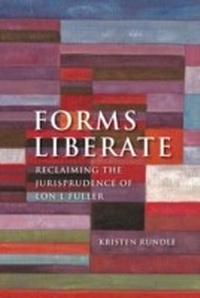
Forms Liberate
Reclaiming the Jurisprudence of Lon L Fuller
1st Edition
Published on 4. May 2012
222 pages
978-1-84731-938-8 (ISBN)
Description

Lon L Fuller's account of what he termed 'the internal morality of law' is widely accepted as the classic twentieth century statement of the principles of the rule of law. Much less accepted is his claim that a necessary connection between law and morality manifests in these principles, with the result that his jurisprudence largely continues to occupy a marginal place in the field of legal philosophy.
In 'Forms Liberate: Reclaiming the Jurisprudence of Lon L Fuller', Kristen Rundle offers a close textual analysis of Fuller's published writings and working papers to explain how his claims about the internal morality of law belong to a wider exploration of the ways in which the distinctive form of law introduces meaningful limits to lawgiving power through its connection to human agency. By reading Fuller on his own terms, 'Forms Liberate' demonstrates why his challenge to a purely instrumental conception of law remains salient for twenty-first century legal scholarship.
In 'Forms Liberate: Reclaiming the Jurisprudence of Lon L Fuller', Kristen Rundle offers a close textual analysis of Fuller's published writings and working papers to explain how his claims about the internal morality of law belong to a wider exploration of the ways in which the distinctive form of law introduces meaningful limits to lawgiving power through its connection to human agency. By reading Fuller on his own terms, 'Forms Liberate' demonstrates why his challenge to a purely instrumental conception of law remains salient for twenty-first century legal scholarship.
More details
Edition
1. Auflage
Language
English
Place of publication
London
United Kingdom
Publishing group
Bloomsbury Publishing PLC
Target group
Professional and scholarly
ISBN-13
978-1-84731-938-8 (9781847319388)
Copyright in bibliographic data and cover images is held by Nielsen Book Services Limited or by the publishers or by their respective licensors: all rights reserved.
Schweitzer Classification
Other editions
Additional editions
Book
08/2013
1st Edition
Hart Publishing
€49.10
Shipment within 15-20 days
Person
Content
1 Reclaiming Fuller
I Form and Agency
II What is Being 'Reclaimed'?
III About the Book: Method, Material and Structure
IV Outline of the Chapters
2 Before the Debate
I The Early Fuller: Positivism and Natural Law at Mid-century
II Eunomics: A 'Science or Theory of Good Order and Workable Social Arrangements'
III Navigating the Labels
IV Conclusion
3 The 1958 Debate
I Mapping the Debate
II Reclaiming Fuller through the Nazi Law Debate
III Fuller and Legal Validity
IV Conclusion
4 The Morality of Law
I Mapping The Morality of Law
II Hart's Review of The Morality of Law
III A Different Path?
IV Conclusion
5 The Reply to Critics
I Mapping the 'Reply to Critics'
II Generality, Efficacy and Agency: Insights from the Archive
III Reflections on the 'Reply to Critics'
IV Conclusion
6 Resituating Fuller I: Raz
I Fuller and Raz
II Raz on the Rule of Law
III Raz on Authority
IV Conclusion: Form, Agency and Authority
7 Resituating Fuller II: Dworkin
I Fuller and Dworkin
II The 1965 Essays
III Dworkin's Project
IV Fuller, Dworkin and Interpretation
V Fuller, Dworkin and Methodology
VI Fuller, Dworkin and the Value of Legality
VII Conclusion: Taking Form Seriously
8 Three Conversations
I Morality
II Instrumentalism
III Legality
Fuller and Shapiro: A New Conversation?
IV Conclusion
I Form and Agency
II What is Being 'Reclaimed'?
III About the Book: Method, Material and Structure
IV Outline of the Chapters
2 Before the Debate
I The Early Fuller: Positivism and Natural Law at Mid-century
II Eunomics: A 'Science or Theory of Good Order and Workable Social Arrangements'
III Navigating the Labels
IV Conclusion
3 The 1958 Debate
I Mapping the Debate
II Reclaiming Fuller through the Nazi Law Debate
III Fuller and Legal Validity
IV Conclusion
4 The Morality of Law
I Mapping The Morality of Law
II Hart's Review of The Morality of Law
III A Different Path?
IV Conclusion
5 The Reply to Critics
I Mapping the 'Reply to Critics'
II Generality, Efficacy and Agency: Insights from the Archive
III Reflections on the 'Reply to Critics'
IV Conclusion
6 Resituating Fuller I: Raz
I Fuller and Raz
II Raz on the Rule of Law
III Raz on Authority
IV Conclusion: Form, Agency and Authority
7 Resituating Fuller II: Dworkin
I Fuller and Dworkin
II The 1965 Essays
III Dworkin's Project
IV Fuller, Dworkin and Interpretation
V Fuller, Dworkin and Methodology
VI Fuller, Dworkin and the Value of Legality
VII Conclusion: Taking Form Seriously
8 Three Conversations
I Morality
II Instrumentalism
III Legality
Fuller and Shapiro: A New Conversation?
IV Conclusion
