

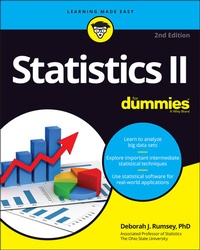
Statistics II For Dummies
2nd Edition
Published on 7. October 2021
448 pages
978-1-119-82740-5 (ISBN)
Description

Continue your statistics journey with this all-encompassing reference
Completed Statistics through standard deviations, confidence intervals, and hypothesis testing? Then you're ready for the next step: Statistics II. And there's no better way to tackle this challenging subject than with Statistics II For Dummies! Get a brief overview of Statistics I in case you need to brush up on earlier topics, and then dive into a full explanation of all Statistic II concepts, including multiple regression, analysis of variance (ANOVA), Chi-square tests, nonparametric procedures, and analyzing large data sets. By the end of the book, you'll know how to use all the statistics tools together to create a great story about your data.
For each Statistics II technique in the book, you get an overview of when and why it's used, how to know when you need it, step-by-step directions on how to do it, and tips and tricks for working through the solution. You also find:
* What makes each technique distinct and what the results say
* How to apply techniques in real life
* An interpretation of the computer output for data analysis purposes
* Instructions for using Minitab to work through many of the calculations
* Practice with a lot of examples
With Statistics II For Dummies, you will find even more techniques to analyze a set of data. Get a head start on your Statistics II class, or use this in conjunction with your textbook to help you thrive in statistics!
Completed Statistics through standard deviations, confidence intervals, and hypothesis testing? Then you're ready for the next step: Statistics II. And there's no better way to tackle this challenging subject than with Statistics II For Dummies! Get a brief overview of Statistics I in case you need to brush up on earlier topics, and then dive into a full explanation of all Statistic II concepts, including multiple regression, analysis of variance (ANOVA), Chi-square tests, nonparametric procedures, and analyzing large data sets. By the end of the book, you'll know how to use all the statistics tools together to create a great story about your data.
For each Statistics II technique in the book, you get an overview of when and why it's used, how to know when you need it, step-by-step directions on how to do it, and tips and tricks for working through the solution. You also find:
* What makes each technique distinct and what the results say
* How to apply techniques in real life
* An interpretation of the computer output for data analysis purposes
* Instructions for using Minitab to work through many of the calculations
* Practice with a lot of examples
With Statistics II For Dummies, you will find even more techniques to analyze a set of data. Get a head start on your Statistics II class, or use this in conjunction with your textbook to help you thrive in statistics!
More details
Other editions
Additional editions
Person
Deborah J. Rumsey, PhD, is a Statistics Education Specialist and Associated Professor in the Department of Statistics at The Ohio State University. She is also a Fellow of the American Statistical Association and has received the Presidential Teaching Award from Kansas State University. Dr. Rumsey has published numerous papers and given many professional presentations on the subject of statistics education.
Content
- Intro
- Title Page
- Copyright Page
- Table of Contents
- Introduction
- About This Book
- Foolish Assumptions
- Icons Used in This Book
- Beyond the Book
- Where to Go from Here
- Part 1 Tackling Data Analysis and Model-Building Basics
- Chapter 1 Beyond Number Crunching: The Art and Science of Data Analysis
- Data Analysis: Looking before You Crunch
- Nothing (not even a straight line) lasts forever
- Data snooping isn't cool
- No (data) fishing allowed
- Getting the Big Picture: An Overview of Stats II
- Population parameter
- Sample statistic
- Confidence interval
- Hypothesis test
- Analysis of variance (ANOVA)
- Multiple comparisons
- Interaction effects
- Correlation
- Linear regression
- Chi-square tests
- Chapter 2 Finding the Right Analysis for the Job
- Categorical versus Quantitative Variables
- Statistics for Categorical Variables
- Estimating a proportion
- Comparing proportions
- Looking for relationships between categorical variables
- Building models to make predictions
- Statistics for Quantitative Variables
- Making estimates
- Making comparisons
- Exploring relationships
- Predicting y using x
- Avoiding Bias
- Measuring Precision with Margin of Error
- Knowing Your Limitations
- Chapter 3 Having the Normal and Sampling Distributions in Your Back Pocket
- Recognizing the VIP Distribution - the Normal
- Characterizing the normal
- Standardizing to the standard normal (Z-) distribution
- Using the normal table
- Finding probabilities for the normal distribution
- Finally Getting Comfortable with Sampling Distributions
- The mean and standard error of a sampling distribution
- Sampling distribution of
- Sampling distribution of
- Heads Up! Building Confidence Intervals and Hypothesis Tests
- Confidence interval for the population mean
- Confidence interval for the population proportion
- Hypothesis test for population mean
- Hypothesis test for the population proportion
- Chapter 4 Reviewing Confidence Intervals and Hypothesis Tests
- Estimating Parameters by Using Confidence Intervals
- Getting the basics: The general form of a confidence interval
- Finding the confidence interval for a population mean
- What changes the margin of error?
- Interpreting a confidence interval
- What's the Hype about Hypothesis Tests?
- What Ho and Ha really represent
- Gathering your evidence into a test statistic
- Determining strength of evidence with a p-value
- False alarms and missed opportunities: Type I and II errors
- The power of a hypothesis test
- Part 2 Using Different Types of Regression to Make Predictions
- Chapter 5 Getting in Line with Simple Linear Regression
- Exploring Relationships with Scatterplots and Correlations
- Using scatterplots to explore relationships
- Collating the information by using the correlation coefficient
- Building a Simple Linear Regression Model
- Finding the best-fitting line to model your data
- The y-intercept of the regression line
- The slope of the regression line
- Making point estimates by using the regression line
- No Conclusion Left Behind: Tests and Confidence Intervals for Regression
- Scrutinizing the slope
- Inspecting the y-intercept
- Building confidence intervals for the average response
- Making the band with prediction intervals
- Checking the Model's Fit (The Data, Not the Clothes!)
- Defining the conditions
- Finding and exploring the residuals
- Using r2 to measure model fit
- Scoping for outliers
- Knowing the Limitations of Your Regression Analysis
- Avoiding slipping into cause-and-effect mode
- Extrapolation: The ultimate no-no
- Sometimes you need more than one variable
- Chapter 6 Multiple Regression with Two X Variables
- Getting to Know the Multiple Regression Model
- Discovering the uses of multiple regression
- Looking at the general form of the multiple regression model
- Stepping through the analysis
- Looking at x's and y's
- Collecting the Data
- Pinpointing Possible Relationships
- Making scatterplots
- Correlations: Examining the bond
- Checking for Multicolinearity
- Finding the Best-Fitting Model for Two x Variables
- Getting the multiple regression coefficients
- Interpreting the coefficients
- Testing the coefficients
- Predicting y by Using the x Variables
- Checking the Fit of the Multiple Regression Model
- Noting the conditions
- Plotting a plan to check the conditions
- Checking the three conditions
- Chapter 7 How Can I Miss You If You Won't Leave? Regression Model Selection
- Getting a Kick out of Estimating Punt Distance
- Brainstorming variables and collecting data
- Examining scatterplots and correlations
- Just Like Buying Shoes: The Model Looks Nice, But Does It Fit?
- Assessing the fit of multiple regression models
- Model selection procedures
- Chapter 8 Getting Ahead of the Learning Curve with Nonlinear Regression
- Anticipating Nonlinear Regression
- Starting Out with Scatterplots
- Handling Curves in the Road with Polynomials
- Bringing back polynomials
- Searching for the best polynomial model
- Using a second-degree polynomial to pass the quiz
- Assessing the fit of a polynomial model
- Making predictions
- Going Up? Going Down? Go Exponential!
- Recollecting exponential models
- Searching for the best exponential model
- Spreading secrets at an exponential rate
- Chapter 9 Yes, No, Maybe So: Making Predictions by Using Logistic Regression
- Understanding a Logistic Regression Model
- How is logistic regression different from other regressions?
- Using an S-curve to estimate probabilities
- Interpreting the coefficients of the logistic regression model
- The logistic regression model in action
- Carrying Out a Logistic Regression Analysis
- Running the analysis in Minitab
- Finding the coefficients and making the model
- Estimating p
- Checking the fit of the model
- Fitting the movie model
- Part 3 Analyzing Variance with ANOVA
- Chapter 10 Testing Lots of Means? Come On Over to ANOVA!
- Comparing Two Means with a t-Test
- Evaluating More Means with ANOVA
- Spitting seeds: A situation just waiting for ANOVA
- Walking through the steps of ANOVA
- Checking the Conditions
- Verifying independence
- Looking for what's normal
- Taking note of spread
- Setting Up the Hypotheses
- Doing the F-Test
- Running ANOVA in Minitab
- Breaking down the variance into sums of squares
- Locating those mean sums of squares
- Figuring the F-statistic
- Making conclusions from ANOVA
- What's next?
- Checking the Fit of the ANOVA Model
- Chapter 11 Sorting Out the Means with Multiple Comparisons
- Following Up after ANOVA
- Comparing cellphone minutes: An example
- Setting the stage for multiple comparison procedures
- Pinpointing Differing Means with Fisher and Tukey
- Fishing for differences with Fisher's LSD
- Separating the turkeys with Tukey's test
- Examining the Output to Determine the Analysis
- So Many Other Procedures, So Little Time!
- Controlling for baloney with the Bonferroni adjustment
- Comparing combinations by using Scheffé's method
- Finding out whodunit with Dunnett's test
- Staying cool with Student Newman-Keuls
- Duncan's multiple range test
- Chapter 12 Finding Your Way through Two-Way ANOVA
- Setting Up the Two-Way ANOVA Model
- Determining the treatments
- Stepping through the sums of squares
- Understanding Interaction Effects
- What is interaction, anyway?
- Interacting with interaction plots
- Testing the Terms in Two-Way ANOVA
- Running the Two-Way ANOVA Table
- Interpreting the results: Numbers and graphs
- Are Whites Whiter in Hot Water? Two-Way ANOVA Investigates
- Chapter 13 Regression and ANOVA: Surprise Relatives!
- Seeing Regression through the Eyes of Variation
- Spotting variability and finding an "x-planation"
- Getting results with regression
- Assessing the fit of the regression model
- Regression and ANOVA: A Meeting of the Models
- Comparing sums of squares
- Dividing up the degrees of freedom
- Bringing regression to the ANOVA table
- Relating the F- and t-statistics: The final frontier
- Part 4 Building Strong Connections with Chi-Square Tests and Nonparametrics
- Chapter 14 Forming Associations with Two-Way Tables
- Breaking Down a Two-Way Table
- Organizing data into a two-way table
- Filling in the cell counts
- Making marginal totals
- Breaking Down the Probabilities
- Marginal probabilities
- Joint probabilities
- Conditional probabilities
- Trying To Be Independent
- Checking for independence between two categories
- Checking for independence between two variables
- Demystifying Simpson's Paradox
- Experiencing Simpson's Paradox
- Figuring out why Simpson's Paradox occurs
- Keeping one eye open for Simpson's Paradox
- Chapter 15 Being Independent Enough for the Chi-Square Test
- The Chi-Square Test for Independence
- Collecting and organizing the data
- Determining the hypotheses
- Figuring expected cell counts
- Checking the conditions for the test
- Calculating the Chi-square test statistic
- Finding your results on the Chi-square table
- Drawing your conclusions
- Putting the Chi-square to the test
- Comparing Two Tests for Comparing Two Proportions
- Chapter 16 Using Chi-Square Tests for Goodness-of-Fit (Your Data, Not Your Jeans)
- Finding the Goodness-of-Fit Statistic
- What's observed versus what's expected
- Calculating the goodness-of-fit statistic
- Interpreting the Goodness-of-Fit Statistic Using a Chi-Square
- Checking the conditions before you start
- The steps of the Chi-square goodness-of-fit test
- Chapter 17 Rebels Without a Distribution - Nonparametric Procedures
- Arguing for Nonparametric Statistics
- No need to fret if conditions aren't met
- The median's in the spotlight for a change
- So, what's the catch?
- Mastering the Basics of Nonparametric Statistics
- Sign
- Chapter 18 All Signs Point to the Sign Test
- Reading the Signs: The Sign Test
- Testing the median in real estate
- Estimating the median
- Testing matched pairs
- Part 5 Putting it All Together: Multi-Stage Analysis of a Large Data Set
- Chapter 19 Conducting a Multi-Stage Analysis of a Large Data Set
- Steps Involved in Working with a Large Data Set
- Wrangling Data
- Discovery
- Structuring
- Cleaning
- Enriching
- Validating
- Publishing
- Visualizing Data
- Exploring the Data
- Looking for Relationships
- Building Models and Making Inferences
- Sharing the Story
- Who is the audience?
- Make an outline
- Include an executive summary
- Check your writing
- Chapter 20 A Statistician Watches the Movies
- Examining the Movie Variables and Asking Questions
- Visualizing the Movie Data
- Categorical movie variables
- Quantitative movie variables
- Doing Descriptive Dirty Work
- Looking for Relationships
- Relationships between quantitative movie variables
- Relationships between two categorical variables
- Relationships between quantitative and categorical variables
- Building a Model for Predicting U.S. Revenue
- Writing It Up
- Chapter 21 Looking Inside the Refrigerator
- Refrigerator Data - The Variables
- Exploring the Data
- Analyzing the Data
- Writing It Up
- Part 6 The Part of Tens
- Chapter 22 Ten Common Errors in Statistical Conclusions
- Claiming These Statistics Prove . . .
- It's Not Technically Statistically Significant, But . . .
- Concluding That x Causes y
- Assuming the Data Was Normal
- Only Reporting "Important" Results
- Assuming a Bigger Sample Is Always Better
- It's Not Technically Random, But . . .
- Assuming That 1,000 Responses Is 1,000 Responses
- Of Course the Results Apply to the General Population
- Deciding Just to Leave It Out
- Chapter 23 Ten Ways to Get Ahead by Knowing Statistics
- Asking the Right Questions
- Being Skeptical
- Collecting and Analyzing Data Correctly
- Calling for Help
- Retracing Someone Else's Steps
- Putting the Pieces Together
- Checking Your Answers
- Explaining the Output
- Making Convincing Recommendations
- Establishing Yourself as the Statistics Go-To Person
- Chapter 24 Ten Cool Jobs That Use Statistics
- Pollster
- Data Scientist
- Ornithologist (Bird Watcher)
- Sportscaster or Sportswriter
- Journalist
- Crime Fighter
- Medical Professional
- Marketing Executive
- Lawyer
- Appendix Reference Tables
- Index
- EULA
