

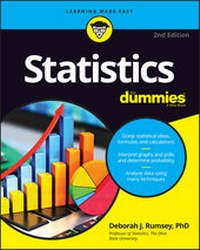
Statistics For Dummies
Description

Stymied by statistics? No fear? this friendly guide offers clear, practical explanations of statistical ideas, techniques, formulas, and calculations, with lots of examples that show you how these concepts apply to your everyday life.
Statistics For Dummies shows you how to interpret and critique graphs and charts, determine the odds with probability, guesstimate with confidence using confidence intervals, set up and carry out a hypothesis test, compute statistical formulas, and more.
* Tracks to a typical first semester statistics course
* Updated examples resonate with today's students
* Explanations mirror teaching methods and classroom protocol
Packed with practical advice and real-world problems, Statistics For Dummies gives you everything you need to analyze and interpret data for improved classroom or on-the-job performance.
More details
Other editions
Additional editions
Person
Content
- Intro
- Title Page
- Table of Contents
- Introduction
- About This Book
- Conventions Used in This Book
- What You're Not to Read
- Foolish Assumptions
- How This Book Is Organized
- Icons Used in This Book
- Where to Go from Here
- Part 1: Vital Statistics about Statistics
- Chapter 1: Statistics in a Nutshell
- Thriving in a Statistical World
- Designing Appropriate Studies
- Collecting Quality Data
- Creating Effective Summaries
- Determining Distributions
- Performing Proper Analyses
- Drawing Credible Conclusions
- Becoming a Sleuth, Not a Skeptic
- Chapter 2: The Statistics of Everyday Life
- Statistics and the Media: More Questions than Answers?
- Using Statistics at Work
- Chapter 3: Taking Control: So Many Numbers, So Little Time
- Detecting Errors, Exaggerations, and Just Plain Lies
- Feeling the Impact of Misleading Statistics
- Chapter 4: Tools of the Trade
- Statistics: More than Just Numbers
- Grabbing Some Basic Statistical Jargon
- Part 2: Number-Crunching Basics
- Chapter 5: Means, Medians, and More
- Summing Up Data with Descriptive Statistics
- Crunching Categorical Data: Tables and Percents
- Measuring the Center with Mean and Median
- Accounting for Variation
- Examining the Empirical Rule (68-95-99.7)
- Measuring Relative Standing with Percentiles
- Chapter 6: Getting the Picture: Graphing Categorical Data
- Take Another Little Piece of My Pie Chart
- Raising the Bar on Bar Graphs
- Chapter 7: Going by the Numbers: Graphing Numerical Data
- Handling Histograms
- Examining Boxplots
- Tackling Time Charts
- Part 3: Distributions and the Central Limit Theorem
- Chapter 8: Random Variables and the Binomial Distribution
- Defining a Random Variable
- Identifying a Binomial
- Finding Binomial Probabilities Using a Formula
- Finding Probabilities Using the Binomial Table
- Checking Out the Mean and Standard Deviation of the Binomial
- Chapter 9: The Normal Distribution
- Exploring the Basics of the Normal Distribution
- Meeting the Standard Normal (Z-) Distribution
- Finding Probabilities for a Normal Distribution
- Finding X When You Know the Percent
- Normal Approximation to the Binomial
- Chapter 10: The t-Distribution
- Basics of the t-Distribution
- Using the t-Table
- Studying Behavior Using the t-Table
- Chapter 11: Sampling Distributions and the Central Limit Theorem
- Defining a Sampling Distribution
- The Mean of a Sampling Distribution
- Measuring Standard Error
- Looking at the Shape of a Sampling Distribution
- Finding Probabilities for the Sample Mean
- The Sampling Distribution of the Sample Proportion
- Finding Probabilities for the Sample Proportion
- Part 4: Guesstimating and Hypothesizing with Confidence
- Chapter 12: Leaving Room for a Margin of Error
- Seeing the Importance of That Plus or Minus
- Finding the Margin of Error: A General Formula
- Determining the Impact of Sample Size
- Chapter 13: Confidence Intervals: Making Your?Best Guesstimate
- Not All Estimates Are Created Equal
- Linking a Statistic to a Parameter
- Getting with the Jargon
- Interpreting Results with Confidence
- Zooming In on Width
- Choosing a Confidence Level
- Factoring In the Sample Size
- Counting On Population Variability
- Calculating a Confidence Interval for a Population Mean
- Figuring Out What Sample Size You Need
- Determining the Confidence Interval for One Population Proportion
- Creating a Confidence Interval for the Difference of Two Means
- Estimating the Difference of Two Proportions
- Spotting Misleading Confidence Intervals
- Chapter 14: Claims, Tests, and Conclusions
- Setting Up the Hypotheses
- Gathering Good Evidence (Data)
- Compiling the Evidence: The Test Statistic
- Weighing the Evidence and Making Decisions: p-Values
- Making Conclusions
- Assessing the Chance of a Wrong Decision
- Chapter 15: Commonly Used Hypothesis Tests: Formulas and Examples
- Testing One Population Mean
- Handling Small Samples and Unknown Standard Deviations: The t-Test
- Testing One Population Proportion
- Comparing Two (Independent) Population Averages
- Testing for an Average Difference (The Paired t-Test)
- Comparing Two Population Proportions
- Part 5: Statistical Studies and the Hunt for a Meaningful Relationship
- Chapter 16: Polls, Polls, and More Polls
- Recognizing the Impact of Polls
- Behind the Scenes: The Ins and Outs of Surveys
- Chapter 17: Experiments: Medical Breakthroughs or Misleading?Results?
- Boiling Down the Basics of Studies
- Designing a Good Experiment
- Making Informed Decisions
- Chapter 18: Looking for Links: Correlation and Regression
- Picturing a Relationship with a Scatterplot
- Quantifying Linear Relationships Using the Correlation
- Working with Linear Regression
- Making Proper Predictions
- Explaining the Relationship: Correlation versus Cause and Effect
- Chapter 19: Two-Way Tables and Independence
- Organizing a Two-Way Table
- Interpreting Two-Way Tables
- Checking Independence and Describing Dependence
- Cautiously Interpreting Results
- Part 6: The Part of Tens
- Chapter 20: Ten Tips for the Statistically Savvy Sleuth
- Pinpoint Misleading Graphs
- Uncover Biased Data
- Search for a Margin of Error
- Identify Non-Random Samples
- Sniff Out Missing Sample Sizes
- Detect Misinterpreted Correlations
- Reveal Confounding Variables
- Inspect the Numbers
- Report Selective Reporting
- Expose the Anecdote
- Chapter 21: Ten Surefire Exam Score Boosters
- Know What You Don't Know, and then Do Something about It
- Avoid "Yeah-Yeah" Traps
- Make Friends with Formulas
- Make an "If-Then-How" Chart
- Figure Out What the Question Is Asking
- Label What You're Given
- Draw a Picture
- Make the Connection and Solve the Problem
- Do the Math - Twice
- Analyze Your Answers
- Appendix: Tables for Reference
- About the Author
- Advertisement Page
- Connect with Dummies
- End User License Agreement
Introduction
You get hit with an incredible amount of statistical information on a daily basis. You know what I'm talking about: charts, graphs, tables, and headlines that talk about the results of the latest poll, survey, experiment, or other scientific study. The purpose of this book is to develop and sharpen your skills in sorting through, analyzing, and evaluating all that info, and to do so in a clear, fun, and pain-free way. You also gain the ability to decipher and make important decisions about statistical results (for example, the results of the latest medical studies), while being ever aware of the ways that people can mislead you with statistics. And you see how to do it right when it's your turn to design the study, collect the data, crunch the numbers, and/or draw the conclusions.
This book is also designed to help those of you out there who are taking an introductory statistics class and can use some back-up. You'll gain a working knowledge of the big ideas of statistics and gather a boatload of tools and tricks of the trade that'll help you get ahead of the curve when you take your exams.
This book is chock-full of real examples from real sources that are relevant to your everyday life - from the latest medical breakthroughs, crime studies, and population trends to the latest U.S. government reports. I even address a survey on the worst cars of the millennium! By reading this book, you'll understand how to collect, display, and analyze data correctly and effectively, and you'll be ready to critically examine and make informed decisions about the latest polls, surveys, experiments, and reports that bombard you every day. You even find out how to use crickets to gauge temperature!
You also get to enjoy poking a little fun at statisticians (who take themselves too seriously at times). After all, with the right skills and knowledge, you don't have to be a statistician to understand introductory statistics.
About This Book
This book departs from traditional statistics texts, references, supplemental books, and study guides in the following ways:
- It includes practical and intuitive explanations of statistical concepts, ideas, techniques, formulas, and calculations found in an introductory statistics course.
- It shows you clear and concise step-by-step procedures that explain how you can intuitively work through statistics problems.
- It includes interesting real-world examples relating to your everyday life and workplace.
- It gives you upfront and honest answers to your questions like, "What does this really mean?" and "When and how will I ever use this?"
Conventions Used in This Book
You should be aware of three conventions as you make your way through this book:
- Definition of sample size (n): When I refer to the size of a sample, I mean the final number of individuals who participated in and provided information for the study. In other words, n stands for the size of the final data set.
- Dual-use of the word statistics: In some situations, I refer to statistics as a subject of study or as a field of research, so the word is a singular noun. For example, "Statistics is really quite an interesting subject." In other situations, I refer to statistics as the plural of statistic, in a numerical sense. For example, "The most common statistics are the mean and the standard deviation."
- Use of the word data: You're probably unaware of the debate raging amongst statisticians about whether the word data should be singular ("data is .") or plural ("data are ."). It got so bad that recently one group of statisticians had to develop two different versions of a statistics T-shirt: "Messy Data Happens" and "Messy Data Happen." At the risk of offending some of my colleagues, I go with the plural version of the word data in this book.
- Use of the term standard deviation: When I use the term standard deviation, I mean s, the sample standard deviation. (When I refer to the population standard deviation, I let you know.)
Here are a few other basic conventions to help you navigate this book:
- I use italics to let you know a new statistical term is appearing on the scene.
- If you see a boldfaced term or phrase in a bulleted list, it's been designated as a keyword or key phrase.
- Addresses for Web sites appear in
monofont.
What You're Not to Read
I like to think that you won't skip anything in this book, but I also know you're a busy person. So to save time, feel free to skip anything marked with the Technical Stuff icon as well as text in sidebars (the shaded gray boxes that appear throughout the book). These items feature information that's interesting but not crucial to your basic knowledge of statistics.
Foolish Assumptions
I don't assume that you've had any previous experience with statistics, other than the fact that you're a member of the general public who gets bombarded every day with statistics in the form of numbers, percents, charts, graphs, "statistically significant" results, "scientific" studies, polls, surveys, experiments, and so on.
What I do assume is that you can do some of the basic mathematical operations and understand some of the basic notation used in algebra, such as the variables x and y, summation signs, taking the square root, squaring a number, and so on. If you need to brush up on your algebra skills, check out Algebra I For Dummies, 2nd Edition, by Mary Jane Sterling (Wiley).
I don't want to mislead you: You do encounter formulas in this book, because statistics does involve a bit of number crunching. But don't let that worry you. I take you slowly and carefully through each step of any calculations you need to do. I also provide examples for you to work along with this book, so that you can become familiar and comfortable with the calculations and make them your own.
How This Book Is Organized
This book is organized into five parts that explore the major areas of introductory statistics, along with a final part that offers some quick top-ten nuggets for your information and enjoyment. Each part contains chapters that break down each major area of statistics into understandable pieces.
Part 1: Vital Statistics about Statistics
This part helps you become aware of the quantity and quality of statistics you encounter in your workplace and your everyday life. You find out that a great deal of that statistical information is incorrect, either by accident or by design. You take a first step toward becoming statistically savvy by recognizing some of the tools of the trade, developing an overview of statistics as a process for getting and interpreting information, and getting up to speed on some statistical jargon.
Part 2: Number-Crunching Basics
This part helps you become more familiar and comfortable with making, interpreting, and evaluating data displays (otherwise known as charts, graphs, and so on) for different types of data. You also find out how to summarize and explore data by calculating and combining some commonly used statistics as well as some statistics you may not know about yet.
Part 3: Distributions and the Central Limit Theorem
In this part, you get into all the details of the three most common statistical distributions: the binomial distribution, the normal (and standard normal, also known as Z-distribution), and the t-distribution. You discover the characteristics of each distribution and how to find and interpret probabilities, percentiles, means, and standard deviations. You also find measures of relative standing (like percentiles).
Finally, you discover how statisticians measure variability from sample to sample and why a measure of precision in your sample results is so important. And you get the lowdown on what some statisticians describe as the "Crowning Jewel of all Statistics": the Central Limit Theorem (CLT). I don't use quite this level of flourishing language to describe the CLT; I just tell my students it's an MDR ("Mighty Deep Result"; coined by my PhD adviser). As for how my students describe their feelings about the CLT, I'll leave that to your imagination.
Part 4: Guesstimating and Hypothesizing with Confidence
This part focuses on the two methods for taking the results from a sample and generalizing them to make conclusions about an entire population. (Statisticians call this process statistical inference.) These two methods are confidence intervals and hypothesis tests.
In this part, you use confidence intervals to come up with good estimates for one or two population means or proportions, or for the difference between them (for example, the average number of hours teenagers spend watching TV per week or the percentage of men versus women in the United States who take arthritis medicine every day). You get the nitty-gritty on how confidence intervals are formed, interpreted, and evaluated for correctness and credibility. You explore the factors that influence the width of a...
