

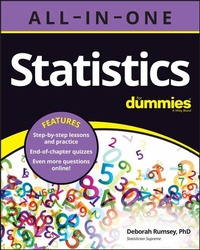
Statistics All-in-One For Dummies
Description

Statistics All-in-One For Dummies is packed with lessons, examples, and practice problems to help you slay your stats course. Develop confidence and understanding in statistics with easy-to-understand (even fun) explanations of key concepts. Plus, you'll get access to online chapter quizzes and other resources that will turn you into a stats master. This book teaches you how to interpret graphs, determine probability, critique data, and so much more. Written by an expert author and serious statistics nerd, Statistics AIO For Dummies explains everything in terms anyone can understand.
* Get a grasp of basic statistics concepts required in every statistics course
* Clear up the process of interpreting graphs, understanding polls, and analyzing data
* Master correlation, regression, and other data analysis tools
* Score higher on stats tests and get a better grade in your high school or college class
Statistics All-in-One For Dummies follows the curriculum of intro college statistics courses (including AP Stats!) so you can learn everything you need to know to get the grade you need--the Dummies way.
More details
Other editions
Additional editions
Person
Content
- Intro
- Title Page
- Copyright Page
- Table of Contents
- Introduction
- About This Book
- Foolish Assumptions
- Icons Used in This Book
- Beyond the Book
- Where to Go from Here
- Unit 1 Getting Started with Statistics
- Chapter 1 The Statistics of Everyday Life
- Statistics and the Media: More Questions than Answers?
- Probing popcorn problems
- Venturing into viruses
- Comprehending crashes
- Mulling malpractice
- Belaboring the loss of land
- Scrutinizing schools
- Scanning sports
- Banking on business news
- Touring the travel news
- Surveying sexual stats
- Breaking down weather reports
- Using Statistics at Work
- Delivering babies - and information
- Posing for pictures
- Poking through pizza data
- Statistics in the office
- Chapter 2 Taking Control: So Many Numbers, So Little Time
- Detecting Errors, Exaggerations, and Just Plain Lies
- Checking the math
- Uncovering misleading statistics
- Breaking down statistical debates
- Untwisting tornado statistics
- Zeroing in on what the scale tells you
- Checking your sources
- Counting on sample size
- Considering cause and effect
- Finding what you want to find
- Looking for lies in all the right places
- Feeling the Impact of Misleading Statistics
- Chapter 3 Tools of the Trade
- Thriving in a Statistical World
- Statistics: More than Just Numbers
- Designing Appropriate Studies
- Surveys (Polls)
- Experiments
- Treatment group versus control group
- Placebo
- Blind and double-blind
- Collecting Quality Data
- Sample, random, or otherwise
- Bias
- Grabbing Some Basic Statistical Jargon
- Data
- Data set
- Variable
- Population
- Statistic
- Parameter
- Mean (Average)
- Median
- Standard deviation
- Percentile
- Standard score
- Distribution and normal distribution
- Central Limit Theorem
- z-values
- Margin of error
- Confidence interval
- Hypothesis testing
- p-values
- Statistical significance
- Correlation, regression, and two-way tables
- Drawing Credible Conclusions
- Reeling in overstated results
- Questioning claims of cause and effect
- Becoming a Sleuth, Not a Skeptic
- Unit 2 Number-Crunching Basics
- Chapter 4 Crunching Categorical Data
- Summing Up Data with Descriptive Statistics
- Crunching Categorical Data: Tables and Percents
- Counting on the frequency
- Relating with percentages
- Two-way tables: Summarizing multiple measures
- Interpreting counts and percents with caution
- Practice Questions Answers and Explanations
- Whaddya Know? Chapter 4 Quiz
- Answers to Chapter 4 Quiz
- Chapter 5 Means, Medians, and More
- Measuring the Center with Mean and Median
- Averaging out to the mean
- Splitting your data down the median
- Comparing means and medians: Histograms
- Accounting for Variation
- Reporting the standard deviation
- Calculating standard deviation
- Interpreting standard deviation
- Understanding properties of standard deviation
- Lobbying for standard deviation
- Being out of range
- Examining the Empirical Rule (68-95-99.7)
- Measuring Relative Standing with Percentiles
- Calculating percentiles
- Interpreting percentiles
- Comparing household incomes
- Examining ACT Scores
- Gathering a five-number summary
- Exploring interquartile range
- Practice Questions Answers and Explanations
- Whaddya Know? Chapter 5 Quiz
- Answers to Chapter 5 Quiz
- Chapter 6 Getting the Picture: Graphing Categorical Data
- Take Another Little Piece of My Pie Chart
- Tallying personal expenses
- Bringing in a lotto revenue
- Ordering takeout
- Projecting age trends
- Raising the Bar on Bar Graphs
- Tracking transportation expenses
- Making a lotto profit
- Tipping the scales on a bar graph
- Pondering pet peeves
- Practice Questions Answers and Explanations
- Whaddya Know? Chapter 6 Quiz
- Answers to Chapter 6 Quiz
- Chapter 7 Going by the Numbers: Graphing Numerical Data
- Handling Histograms
- Making a histogram
- An award-winning example
- Creating appropriate groups
- Handling borderline values
- Clarifying the axes
- Interpreting a histogram
- Checking out the shape of the data
- Measuring center: Mean versus median
- Viewing variability: Amount of spread around the mean
- Putting numbers with pictures
- Detecting misleading histograms
- Missing the mark with too few groups
- Watching the scale and start/finish lines
- Examining Boxplots
- Making a boxplot
- Interpreting a boxplot
- Checking the shape with caution!
- Measuring variability with IQR
- Picking out the center using the median
- Investigating Old Faithful's boxplot
- Denoting outliers
- Making mistakes when interpreting a boxplot
- Tackling Time Charts
- Interpreting time charts
- Understanding variability: Time charts versus histograms
- Spotting misleading time charts
- Watching the scale and start/end points
- Simplifying excess data
- Practice Questions Answers and Explanations
- Whaddya Know? Chapter 7 Quiz
- Answers to Chapter 7 Quiz
- Unit 3 Distributions and the Central Limit Theorem
- Chapter 8 Coming to Terms with Probability
- A Set Notation Overview
- Noting outcomes: Sample spaces
- Finite sample spaces
- Countably infinite sample spaces
- Uncountably infinite sample spaces
- Noting subsets of sample spaces: Events
- Noting a void in the set: Empty sets
- Putting sets together: Unions, intersections, and complements
- Unions
- Intersections
- Complements
- Probabilities of Events Involving A and/or B
- Probability notation
- Marginal probabilities
- Union probabilities
- Intersection (joint) probabilities
- Complement probabilities
- Conditional probabilities
- Solving conditional probabilities without a formula
- Solving conditional probabilities with a formula
- Understanding and Applying the Rules of Probability
- The complement rule (for opposites, not for flattering a date)
- The multiplication rule (for intersections, not for rabbits)
- The addition rule (for unions of the nonmarital nature)
- Recognizing Independence in Multiple Events
- Checking independence for two events with the definition
- Using the multiplication rule for independent events
- Including Mutually Exclusive Events
- Recognizing mutually exclusive events
- Simplifying the addition rule with mutually exclusive events
- Distinguishing Independent from Mutually Exclusive Events
- Comparing and contrasting independence and exclusivity
- Checking for independence or exclusivity in a 52-card deck
- Avoiding Probability Misconceptions
- Predictions Using Probability
- Practice Questions Answers and Explanations
- Whaddya Know? Chapter 8 Quiz
- Answers to Chapter 8 Quiz
- Chapter 9 Random Variables and the Binomial Distribution
- Defining a Random Variable
- Discrete versus continuous
- Probability distributions
- The mean and variance of a discrete random variable
- Identifying a Binomial
- Checking binomial conditions step by step
- No fixed number of trials
- More than success or failure
- Trials are not independent
- Probability of success (p) changes
- Finding Binomial Probabilities Using a Formula
- Finding Probabilities Using the Binomial Table
- Finding probabilities for specific values of X
- Finding probabilities for X greater-than, less-than, or between two values
- Checking Out the Mean and Standard Deviation of the Binomial
- Practice Questions Answers and Explanations
- Whaddya Know? Chapter 9 Quiz
- Answers to Chapter 9 Quiz
- Chapter 10 The Normal Distribution
- Exploring the Basics of the Normal Distribution
- Meeting the Standard Normal (Z-) Distribution
- Checking out Z
- Standardizing from X to Z
- Finding probabilities for Z with the Z-table
- Finding Probabilities for a Normal Distribution
- Knowing Where You Stand with Percentiles
- Finding X When You Know the Percent
- Figuring out a percentile for a normal distribution
- Doing a low percentile problem
- Working with a higher percentile
- Translating tricky wording in percentile problems
- Normal Approximation to the Binomial
- Practice Questions Answers and Explanations
- Whaddya Know? Chapter 10 Quiz
- Answers to Chapter 10 Quiz
- Chapter 11 The t-Distribution
- Basics of the t-Distribution
- Comparing the t- and Z-distributions
- Discovering the effect of variability on t-distributions
- Using the t-Table
- Finding probabilities with the t-table
- Figuring percentiles for the t-distribution
- Picking out t*-values for confidence intervals
- Studying Behavior Using the t-Table
- Practice Questions Answers and Explanations
- Whaddya Know? Chapter 11 Quiz
- Answers to Chapter 11 Quiz
- Chapter 12 Sampling Distributions and the Central Limit Theorem
- Defining a Sampling Distribution
- The Mean of a Sampling Distribution
- Measuring Standard Error
- Sample size and standard error
- Population standard deviation and standard error
- Looking at the Shape of a Sampling Distribution
- Case 1: The distribution of X is normal
- Case 2: The distribution of X is not normal - Enter the Central Limit Theorem
- Averaging a fair die is approximately normal
- Averaging an unfair die is still approximately normal
- Clarifying three major points about the Central Limit Theorem
- Finding Probabilities for the Sample Mean
- The Sampling Distribution of the Sample Proportion
- Finding Probabilities for the Sample Proportion
- Practice Questions Answers and Explanations
- Whaddya Know? Chapter 12 Quiz
- Answers to Chapter 12 Quiz
- Unit 4 Guesstimating and Hypothesizing with Confidence
- Chapter 13 Leaving Room for a Margin of Error
- Seeing the Importance of that Plus or Minus
- Finding the Margin of Error: A General Formula
- Measuring sample variability
- Calculating margin of error for a sample proportion
- Reporting results
- Calculating margin of error for a sample mean
- Being confident you're right
- Determining the Impact of Sample Size
- Sample size and margin of error
- Bigger isn't always (that much) better!
- Keeping margin of error in perspective
- Practice Questions Answers and Explanations
- Whaddya Know? Chapter 13 Quiz
- Answers to Chapter 13 Quiz
- Chapter 14 Confidence Intervals: Making Your Best Guesstimate
- Not All Estimates Are Created Equal
- Linking a Statistic to a Parameter
- Getting with the Jargon
- Interpreting Results with Confidence
- Zooming In on Width
- Choosing a Confidence Level
- Factoring In the Sample Size
- Counting On Population Variability
- Calculating a Confidence Interval for a Population Mean
- Case 1: Population standard deviation is known
- Case 2: Population standard deviation is unknown and/or n is small
- Figuring Out What Sample Size You Need
- Determining the Confidence Interval for One Population Proportion
- Creating a Confidence Interval for the Difference of Two Means
- Case 1: Population standard deviations are known
- Case 2: Population standard deviations are unknown and/or sample sizes are small
- Estimating the Difference of Two Proportions
- Spotting Misleading Confidence Intervals
- Practice Questions Answers and Explanations
- Whaddya Know? Chapter 14 Quiz
- Answers to Chapter 14 Quiz
- Chapter 15 Claims, Tests, and Conclusions
- Setting Up the Hypotheses
- Defining the null
- What's the alternative?
- Gathering Good Evidence (Data)
- Compiling the Evidence: The Test Statistic
- Gathering sample statistics
- Measuring variability using standard errors
- Understanding standard scores
- Calculating and interpreting the test statistic
- Weighing the Evidence and Making Decisions: p-Values
- Connecting test statistics and p-values
- Defining a p-value
- Calculating a p-value
- Making Conclusions
- Setting boundaries for rejecting
- Testing varicose veins
- Assessing the Chance of a Wrong Decision
- Making a false alarm: Type I errors
- Missing out on a detection: Type II errors
- Practice Questions Answers and Explanations
- Whaddya Know? Chapter 15 Quiz
- Answers to Chapter 15 Quiz
- Chapter 16 Commonly Used Hypothesis Tests: Formulas and Examples
- Testing One Population Mean
- Handling Small Samples and Unknown Standard Deviations: The t-Test
- Putting the t-test to work
- Relating t to Z
- Handling negative t-values
- Examining the not-equal-to alternative
- Drawing conclusions using the critical value
- Testing One Population Proportion
- Comparing Two (Independent) Population Averages
- Case 1: Difference of two population means when population standard deviations are known
- Case 2: Difference of two population means when population standard deviations are unknown
- Testing for an Average Difference (The Paired t-Test)
- Comparing Two Population Proportions
- Practice Questions Answers and Explanations
- Whaddya Know? Chapter 16 Quiz
- Answers to Chapter 16 Quiz
- Unit 5 Statistical Studies and the Hunt for a Meaningful Relationship
- Chapter 17 Polls, Polls, and More Polls
- Recognizing the Impact of Polls
- Getting to the source
- Surveying what's hot
- Impacting lives
- Behind the Scenes: The Ins and Outs of Surveys
- Planning and designing a survey
- Clarifying the purpose of your survey
- Defining the target population
- Choosing the type and timing of the survey
- Designing the introduction with ethics in mind
- Formulating the questions
- Selecting the sample
- A good sample represents the target population
- A good sample is selected randomly
- A good sample is large enough for the results to be accurate
- Carrying out a survey
- Collecting the data
- Following up, following up, and following up
- Interpreting results and finding problems
- Organizing and analyzing
- Drawing conclusions
- Practice Questions Answers and Explanations
- Whaddya Know? Chapter 17 Quiz
- Answers to Chapter 17 Quiz
- Chapter 18 Experiments and Observational Studies: Medical Breakthroughs or Misleading Results?
- Boiling Down the Basics of Studies
- Looking at the lingo of studies
- Observing observational studies
- Examining experiments
- Designing a Good Experiment
- Designing the experiment to make comparisons
- Fake treatments - the placebo effect
- Standard treatments
- No treatment
- Selecting the sample size
- Limiting small samples to small conclusions
- Defining sample size
- Choosing the subjects
- Making random assignments
- Controlling for confounding variables
- Respecting ethical issues
- Collecting good data
- Analyzing the data properly
- Interpreting Experiment Results
- Making appropriate conclusions
- Overstating the results
- Taking the results one step beyond the actual data
- Generalizing results to people beyond the scope of the study
- Making informed decisions
- Practice Questions Answers and Explanations
- Whaddya Know? Chapter 18 Quiz
- Answers to Chapter 18 Quiz
- Chapter 19 Looking for Links: Correlation and Regression
- Picturing a Relationship with a Scatterplot
- Making a scatterplot
- Interpreting a scatterplot
- Quantifying Linear Relationships Using the Correlation
- Calculating the correlation
- Interpreting the correlation
- Examining properties of the correlation
- Working with Linear Regression
- Figuring out which variable is X and which is Y
- Checking the conditions
- Calculating the regression line
- Finding the slope
- Finding the y-intercept
- Interpreting the regression line
- Interpreting the slope
- Interpreting the y-intercept
- Putting it all together: The regression line for the crickets
- Making Proper Predictions
- Checking the conditions
- Staying in-bounds
- Regression Analysis: Understanding the Output
- Residing with Residuals
- Explaining the Relationship: Correlation versus Cause and Effect
- Practice Questions Answers and Explanations
- Whaddya Know? Chapter 19 Quiz
- Answers to Chapter 19 Quiz
- Chapter 20 Two-Way Tables and Independence
- Organizing a Two-Way Table
- Setting up the cells
- Figuring the totals
- Interpreting Two-Way Tables
- Singling out variables with marginal distributions
- Calculating marginal distributions
- Graphing marginal distributions
- Examining all groups - a joint distribution
- Calculating joint distributions
- Graphing joint distributions
- Comparing groups with conditional distributions
- Calculating conditional distributions
- Graphing conditional distributions
- Checking Independence and Describing Dependence
- Checking for independence
- Comparing the results of two conditional distributions
- Comparing marginal and conditional to check for independence
- Describing a dependent relationship
- Cautiously Interpreting Results
- Checking for legitimate cause and effect
- Projecting from sample to population
- Making prudent predictions
- Resisting the urge to jump to conclusions
- Practice Questions Answers and Explanations
- Whaddya Know? Chapter 20 Quiz
- Answers to Chapter 20 Quiz
- Appendix: Tables for Reference
- The Z-Table
- The t-Table
- The Binomial Table
- Index
- EULA
Introduction
You get hit with an incredible amount of statistical information on a daily basis. You know what I'm talking about: charts, graphs, tables, and headlines that talk about the results of the latest poll, survey, experiment, or other scientific study. The purpose of this book is to develop and sharpen your skills in sorting through, analyzing, and evaluating all that info, and to do so in a clear, fun, and pain-free way with tons of opportunities to practice. You also gain the ability to decipher and make important decisions about statistical results (for example, the results of the latest medical studies), while being ever aware of the ways that people can mislead you with statistics. And you see how to do it right when it's your turn to design the study, collect the data, crunch the numbers, and/or draw the conclusions.
This book is also designed to help those of you who are looking to get a solid foundation in introductory statistics or those taking a statistics class and wanting some backup. You'll gain a working knowledge of the big ideas of statistics and gather a boatload of tools and tricks of the trade that'll help you get ahead of the curve, especially for taking exams.
This book is chock-full of real examples from real sources that are relevant to your everyday life - from the latest medical breakthroughs, crime studies, and population trends to the latest U.S. government reports. I even address a survey on the worst cars of the millennium! By reading this book, you'll understand how to collect, display, and analyze data correctly and effectively, and you'll be ready to critically examine and make informed decisions about the latest polls, surveys, experiments, and reports that bombard you every day. You will even find out how to use crickets to gauge temperature!
You will also get to climb inside the minds of statisticians to see what's worth taking seriously and what isn't to be taken so seriously. After all, with the right skills and knowledge, you don't have to be a professional statistician to understand introductory statistics. You can be a data guru in your own right.
About This Book
This book departs from traditional statistics texts, references, supplemental books, and study guides in the following ways:
- It includes practical and intuitive explanations of statistical concepts, ideas, techniques, formulas, and calculations found in an introductory statistics course.
- It shows you clear and concise step-by-step procedures that explain how you can intuitively work through statistics problems.
- It features interesting real-world examples relating to your everyday life and workplace.
- It contains plenty of excellent practice problems crafted in a straightforward manner to lead you down the path of success.
- It offers not only answers, but also clear, complete explanations of the answers. Explanations help you know exactly how to approach a problem, what information you need to solve it, and common problems you need to avoid.
- It includes tips, strategies, and warnings based on my vast experience with students of all backgrounds and learning styles.
- It gives you upfront and honest answers to your questions like, "What does this really mean?" and "When and how will I ever use this?"
As you work your way through the lessons and problems in this book, you should be aware of four conventions that I've used.
- Dual use of the word statistics: In some situations, I refer to statistics as a subject of study or as a field of research, so the word is a singular noun. For example, "Statistics is really quite an interesting subject." In other situations, I refer to statistics as the plural of statistic, in a numerical sense. For example, "The most commonly used statistics are the mean and the standard deviation."
- Use of the word data: You're probably unaware of the debate raging among statisticians about whether the word data should be singular ("data is ") or plural ("data are "). It got so bad that one group of statisticians had to develop two versions of a statistics T-shirt: "Messy Data Happens" and "Messy Data Happen." I go with the plural version of the word data in this book.
- Use of the term standard deviation: When I use the term standard deviation, I mean s, the sample standard deviation. (When I refer to the population standard deviation, I let you know.)
- Use of italics: I use italics to let you know a new statistical term is appearing on the scene. Look for a definition accompanying its first appearance.
Foolish Assumptions
I don't assume that you've had any previous experience with statistics, other than the fact that you're a member of the general public who gets bombarded every day with statistics in the form of numbers, percents, charts, graphs, "statistically significant" results, "scientific" studies, polls, surveys, experiments, and so on.
What I do assume is that you can do some of the basic mathematical operations and understand some of the basic notation used in algebra, such as the variables x and y, summation signs (S), taking the square root, squaring a number, and so on. If you need to brush up on your algebra skills, check out U Can Algebra I For Dummies by Mary Jane Sterling (Wiley).
I don't want to mislead you: You do encounter formulas in this book, because statistics does involve a bit of number crunching. But don't let that worry you. I take you slowly and carefully through each step of any calculations you need to do, explaining things both with notation and without. I also provide practice questions for you to work so you can become familiar and comfortable with the calculations and make them your own.
Icons Used in This Book
You'll see the following five icons throughout the book:
Each example is a stat question based on the discussion and explanation, followed by a solution. Work through these examples, and then refer to them to help you solve the practice problems that follow them as well as the quiz questions at the end of the chapter.
This icon points out important information that you need to focus on. Make sure you understand this information fully before moving on. You can skim through these icons when reading a chapter to make sure you remember the highlights.
Tips are hints that can help speed you along when answering a question. See whether you find them useful when working on practice problems.
This icon flags common mistakes that students make if they're not careful. Take note and proceed with caution!
When you see this icon, it's time to put on your thinking cap and work out a few practice problems on your own. The answers and detailed solutions are available so you can feel confident about your progress.
Beyond the Book
In addition to the material in the print or e-book you're reading right now, this book also comes with a handy online Cheat Sheet. Use it when you need a quick refresher on a formula or the next step in conducting a hypothesis test. To get this Cheat Sheet, simply go to www.dummies.com and type Statistics All in One For Dummies Cheat Sheet in the Search box.
You'll also have access to online quizzes related to each chapter, beginning with Unit 2, Chapter 4. These quizzes provide a whole new set of problems for practice and confidence-building. To access the quizzes, follow these simple steps:
- Register your book or ebook at Dummies.com to get your PIN. Go to
www.dummies.com/go/getaccess. - Select your product from the drop-down list on that page.
- Follow the prompts to validate your product, and then check your email for a confirmation message that includes your PIN and instructions for logging in.
If you do not receive this email within two hours, please check your spam folder before contacting us through our Technical Support website at http://support.wiley.com or by phone at 877-762-2974.
Now you're ready to go! You can come back to the practice material as often as you want - simply log on with the username and password you created during your initial login. No need to enter the access code a second time.
Your registration is good for one year from the day you activate your PIN.
Where to Go from Here
This book is written in such a way that you can start anywhere and still be able to understand what's going on. So you can take a peek at the table of contents or the index, look up the information that interests you, and flip to the page listed. However, if you have a specific topic in mind and are eager to dive into it, here are some directions:
- To work on interpreting graphs, charts, means or medians, and the like, head to Unit 2.
- To find info on the normal, Z-, t-, or binomial distributions or the Central Limit Theorem, see Unit 3.
- To focus on confidence intervals and hypothesis tests of all shapes and sizes, flip to Unit 4.
- To delve into surveys, experiments, regression, and two-way...
