

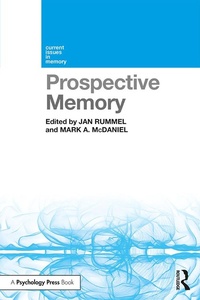
Prospective Memory
1st Edition
Published on 21. May 2019
210 pages
978-1-351-00014-7 (ISBN)
Description

Featuring contributions from world-leading experts, this book presents a timely overview of current theoretical, methodological, and applied issues in the field of prospective memory. The authors explore how prospective memories are formed, how they are maintained over time, and how they are retrieved. This volume integrates our understanding of prospective memory and how it functions with related cognitive processes and themes, such as context memory, metamemory, working memory, and cognitive control. Considering recent methodological advances in the field, such as the use of cognitive modeling, the book also covers individual differences in prospective memory abilities, their development across the life span, and their manifestations in naturalistic settings. The book also illustrates how the understanding of prospective memory can be integrated with other related research areas.
Prospective Memory is an invaluable resource for students and researchers of human memory.
Prospective Memory is an invaluable resource for students and researchers of human memory.
More details
Series
Edition
1. Auflage
Language
English
Place of publication
London
United Kingdom
Publishing group
Taylor & Francis Ltd
Target group
College/higher education
Illustrations
7 Tables, black and white; 9 Line drawings, black and white; 1 Halftones, black and white
ISBN-13
978-1-351-00014-7 (9781351000147)
Copyright in bibliographic data and cover images is held by Nielsen Book Services Limited or by the publishers or by their respective licensors: all rights reserved.
Schweitzer Classification
Other editions
Additional editions
Jan Rummel | Mark A. McDaniel
Prospective Memory
Book
06/2019
1st Edition
Routledge
€206.20
Shipment within 10-20 days
Jan Rummel | Mark A. McDaniel
Prospective Memory
Book
05/2019
1st Edition
Routledge
€69.10
Shipment within 10-20 days
Persons
Jan Rummel is a designated Heisenberg Professor and the principal investigator of the Cognition and Attention Regulation Laboratory (CARL) at Heidelberg University, Germany. His research focuses on the cognitive processes involved in prospective memory, intentional forgetting, and the regulation of attention.
Mark A. McDaniel is a Professor of Psychological & Brain Sciences at Washington University in St. Louis, United States. His research focuses on prospective memory, encoding and retrieval processes in memory, and applications of cognitive psychology to education. He is co-author of Prospective Memory: An Overview and Synthesis of an Emerging Field (2007).
Mark A. McDaniel is a Professor of Psychological & Brain Sciences at Washington University in St. Louis, United States. His research focuses on prospective memory, encoding and retrieval processes in memory, and applications of cognitive psychology to education. He is co-author of Prospective Memory: An Overview and Synthesis of an Emerging Field (2007).
Content
List of Contributors
Introduction: Prospective Memory
Jan Rummel & Mark A. McDaniel
The Multiprocess Framework: Historical Context and the "Dynamic" Extension
Jill Talley Shelton, Michael K. Scullin, & Jessica Y. Hacker
Prospective Memory in Context: Methods, Findings, and Future Directions
Rebekah E. Smith & Donald J. Skinner
Fate of Suspended and Completed Prospective Memory Intentions
Julie M. Bugg & Emily Streeper
Metacognition of Prospective Memory: Will I remember to remember?
Beatrice G. Kuhlmann
Evidence Accumulation Modeling of Event-Based Prospective Memory
Luke Strickland, Shayne Loft, Andrew Heathcote
Neuropsychological and Physiological Correlates of Prospective Memory
Giorgia Cona & Nicolas Rothen
Individual Differences in Prospective Memory
Hunter Ball, Anne Vogel & Gene A. Brewer
Prospective Memory Across the Lifespan
Nicola Ballhausen, Alexandra Hering, Peter G. Rendell, & Matthias Kliegel
Take the Field! Investigating Prospective Memory in Naturalistic and Real-Life Settings
Jan Rummel & Lia Kvavilashvili
Prospective Memory in Safety-Critical Work Wontexts
Shayne Loft, Key Dismukes, & Tobias Grundgeiger
Realized Accomplishments in Prospective Memory and Some Thoughts About the Future
Mark A. McDaniel & Gilles O. Einstein
Index
Introduction: Prospective Memory
Jan Rummel & Mark A. McDaniel
The Multiprocess Framework: Historical Context and the "Dynamic" Extension
Jill Talley Shelton, Michael K. Scullin, & Jessica Y. Hacker
Prospective Memory in Context: Methods, Findings, and Future Directions
Rebekah E. Smith & Donald J. Skinner
Fate of Suspended and Completed Prospective Memory Intentions
Julie M. Bugg & Emily Streeper
Metacognition of Prospective Memory: Will I remember to remember?
Beatrice G. Kuhlmann
Evidence Accumulation Modeling of Event-Based Prospective Memory
Luke Strickland, Shayne Loft, Andrew Heathcote
Neuropsychological and Physiological Correlates of Prospective Memory
Giorgia Cona & Nicolas Rothen
Individual Differences in Prospective Memory
Hunter Ball, Anne Vogel & Gene A. Brewer
Prospective Memory Across the Lifespan
Nicola Ballhausen, Alexandra Hering, Peter G. Rendell, & Matthias Kliegel
Take the Field! Investigating Prospective Memory in Naturalistic and Real-Life Settings
Jan Rummel & Lia Kvavilashvili
Prospective Memory in Safety-Critical Work Wontexts
Shayne Loft, Key Dismukes, & Tobias Grundgeiger
Realized Accomplishments in Prospective Memory and Some Thoughts About the Future
Mark A. McDaniel & Gilles O. Einstein
Index
