

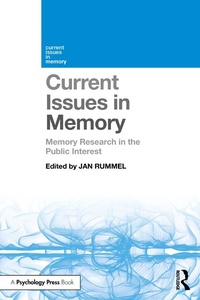
Current Issues in Memory
Memory Research in the Public Interest
1st Edition
Published on 15. March 2021
416 pages
978-1-000-36347-0 (ISBN)
Description

Current Issues in Memory is a series of edited books that reflect the state-of-the-art areas of current and emerging interest in the psychological study of Memory.
For the first time, this book offers a comprehensive new collection which gathers together some of the most influential chapters from the series into one essential volume. Featuring 17 chapters by many of the leading researchers in the field, the volume seeks to illustrate how memory research may be informative to the general public-either because it speaks to questions of personal or societal importance or because it changes traditional ways of thinking within society. Topics range from working memory to false fabrication and autobiographical forgetting, showcasing the breadth of memory research in the public sphere.
With an introduction and conclusion by Professor Jan Rummel, this is the ideal companion for any student or practitioner looking for an insightful overview of the most researched topics in the field.
For the first time, this book offers a comprehensive new collection which gathers together some of the most influential chapters from the series into one essential volume. Featuring 17 chapters by many of the leading researchers in the field, the volume seeks to illustrate how memory research may be informative to the general public-either because it speaks to questions of personal or societal importance or because it changes traditional ways of thinking within society. Topics range from working memory to false fabrication and autobiographical forgetting, showcasing the breadth of memory research in the public sphere.
With an introduction and conclusion by Professor Jan Rummel, this is the ideal companion for any student or practitioner looking for an insightful overview of the most researched topics in the field.
More details
Series
Edition
1. Auflage
Language
English
Place of publication
London
United Kingdom
Publishing group
Taylor & Francis Ltd
Target group
College/higher education
Illustrations
12 Tables, black and white; 25 Line drawings, black and white; 2 Halftones, color; 6 Halftones, black and white; 2 Illustrations, color; 31 Illustrations, black and white
ISBN-13
978-1-000-36347-0 (9781000363470)
Copyright in bibliographic data and cover images is held by Nielsen Book Services Limited or by the publishers or by their respective licensors: all rights reserved.
Schweitzer Classification
Other editions
Additional editions
Book
03/2021
1st Edition
Routledge
€77.98
Shipment within 15-20 days
Book
03/2021
1st Edition
Routledge
€238.50
Shipment within 15-20 days
Person
Jan Rummel is a designated Heisenberg Professor and the principal investigator of the Cognition and Attention Regulation Laboratory (CARL) at Heidelberg University, Germany. His research focuses on the cognitive processes involved in prospective memory, intentional forgetting, and the regulation of attention.
Content
Section 1: Memory representations: From (visual) perception to stored information
1. The Organisation of Visuo-Spatial Working Memory: Evidence from the Study of Developmental Disorders.
Cesare Cornoldi and Irene C. Mammarella
2. Visual memory, spatial representation, and navigation
Amy L. Shelton and Naohide Yamamoto
3. Remembering Faces
Vicki Bruce
4. Memory for real-world scenes
Andrew Hollingworth
Section 2: Memory adaptations: Forgetting the past, remembering the future
5. The role of retroactive interference and consolidation in everyday forgetting
John T. Wixted
6. Autobiographical Forgetting, Social Forgetting and Situated Forgetting: Forgetting in Context
Celia B. Harris, John Sutton, & Amanda J. Barnier
7. Take The Field! Investigating prospective memory in naturalistic and real-life settings
Jan Rummel & Lia Kvavilashvili
8. Prospective Memory In Safety-Critical Work Contexts
Shayne Loft, Key Dismukes, & Tobias Grundgeiger
Section 3: Memory limitations: False memories
9. False Memories Matter: The repercussions that follow the development of false memory
Cara Laney and Elizabeth F. Loftus
10.Photos And Memory
Kimberley A. Wade, Sophie J. Nightingale, and Melissa F. Colloff
11. Forced Fabrication And False Eyewitness Memories
Maria S. Zaragoza, Patrick Rich, Eric Rindal, and Rachel DeFranco
12. When Children Are The Worst And Best Eyewitnesses: Factors Behind The Development Of False Memory
Henry Otgaar, Mark L. Howe, Nathalie Brackmann, and Jianqin Wang
13. Factors affecting the reliability of children's forensic reports: An updated review
Kamala London, Sarah Kulkofsky, and Christina O. Perez
Section 4: Memory augmentations: How can memory capacities be improved?
14. Individual differences in working memory and aging
Timothy A. Salthouse
15. Working memory training in late adulthood: A behavioral and brain perspective
Anna Stigsdotter Neely and Lars Nyberg
16. More than just a memory: The nature and validity of working memory in educational settings
Darren S. Levin, S. Kenneth Thurman and Marissa H. Kiepert
17. Bene?ts of testing memory: Best practices and boundary conditions
Henry L. Roediger, III, Pooja K. Agarwal, Sean H. K. Kang and Elizabeth J. Marsh
1. The Organisation of Visuo-Spatial Working Memory: Evidence from the Study of Developmental Disorders.
Cesare Cornoldi and Irene C. Mammarella
2. Visual memory, spatial representation, and navigation
Amy L. Shelton and Naohide Yamamoto
3. Remembering Faces
Vicki Bruce
4. Memory for real-world scenes
Andrew Hollingworth
Section 2: Memory adaptations: Forgetting the past, remembering the future
5. The role of retroactive interference and consolidation in everyday forgetting
John T. Wixted
6. Autobiographical Forgetting, Social Forgetting and Situated Forgetting: Forgetting in Context
Celia B. Harris, John Sutton, & Amanda J. Barnier
7. Take The Field! Investigating prospective memory in naturalistic and real-life settings
Jan Rummel & Lia Kvavilashvili
8. Prospective Memory In Safety-Critical Work Contexts
Shayne Loft, Key Dismukes, & Tobias Grundgeiger
Section 3: Memory limitations: False memories
9. False Memories Matter: The repercussions that follow the development of false memory
Cara Laney and Elizabeth F. Loftus
10.Photos And Memory
Kimberley A. Wade, Sophie J. Nightingale, and Melissa F. Colloff
11. Forced Fabrication And False Eyewitness Memories
Maria S. Zaragoza, Patrick Rich, Eric Rindal, and Rachel DeFranco
12. When Children Are The Worst And Best Eyewitnesses: Factors Behind The Development Of False Memory
Henry Otgaar, Mark L. Howe, Nathalie Brackmann, and Jianqin Wang
13. Factors affecting the reliability of children's forensic reports: An updated review
Kamala London, Sarah Kulkofsky, and Christina O. Perez
Section 4: Memory augmentations: How can memory capacities be improved?
14. Individual differences in working memory and aging
Timothy A. Salthouse
15. Working memory training in late adulthood: A behavioral and brain perspective
Anna Stigsdotter Neely and Lars Nyberg
16. More than just a memory: The nature and validity of working memory in educational settings
Darren S. Levin, S. Kenneth Thurman and Marissa H. Kiepert
17. Bene?ts of testing memory: Best practices and boundary conditions
Henry L. Roediger, III, Pooja K. Agarwal, Sean H. K. Kang and Elizabeth J. Marsh
