

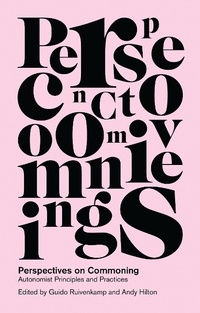
Perspectives on Commoning
Autonomist Principles and Practices
1st Edition
Published on 15. September 2017
485 pages
978-1-78699-180-5 (ISBN)
Description

In the wake of socialism's demise and liberalism's loss of direction, new ideas are needed for the next major realignment of the social and political domain. Making a unique contribution to the idea of 'the commons', this book offers a radical form of direct democracy with real-world implications. But whereas much of the current scholarship has looked at the commons from the perspective of governance, this book instead focuses on 'commoning' as social practice.
Perspectives on Commoning argues that the commons are not just resources external to us, but are a function or characterisation of what we do. Thus, we can talk of the act of commoning, positioning our behaviour beyond the domains of the private and the public, beyond the dichotomy of capitalism versus socialism.
Covering everything from biopolitics to urban spaces, this impressive range of international contributors address the commons as both theory and history, providing a useful review of current conceptions as well as practical proposals for the future. A unique consolidation of philosophy, sociology and economics, the book shows how a new understanding of the commons as practice will help to achieve its full emancipatory potential.
Perspectives on Commoning argues that the commons are not just resources external to us, but are a function or characterisation of what we do. Thus, we can talk of the act of commoning, positioning our behaviour beyond the domains of the private and the public, beyond the dichotomy of capitalism versus socialism.
Covering everything from biopolitics to urban spaces, this impressive range of international contributors address the commons as both theory and history, providing a useful review of current conceptions as well as practical proposals for the future. A unique consolidation of philosophy, sociology and economics, the book shows how a new understanding of the commons as practice will help to achieve its full emancipatory potential.
Reviews / Votes
Drawing on history, political theory, economics, culture and contemporary activism, this collection explores the great promise of the commons in helping to build a new and better world. * David Bollier, author of Think Like a Commoner * A rich and innovative selection. It offers both conceptual and practical resources for thinking about and enacting the forms of sharing that will be needed as the neoliberal edifice fractures and dissolves. * Jack Kloppenburg, University of Wisconsin-Madison (Emeritus) * An important and stimulating book. Its central notions of commons and "commoning" offer the potential for currently disparate movements to come together, both conceptually and politically. * Jan Douwe van der Ploeg, Wageningen University, The Netherlands *More details
Series
Edition
1. Auflage
Language
English
Place of publication
London
United Kingdom
Publishing group
Bloomsbury Publishing PLC
Target group
College/higher education
Illustrations
Tables, black and white 3 ; Figures 1
ISBN-13
978-1-78699-180-5 (9781786991805)
Copyright in bibliographic data and cover images is held by Nielsen Book Services Limited or by the publishers or by their respective licensors: all rights reserved.
Schweitzer Classification
Other editions
Additional editions

Book
09/2017
Zed Books Ltd
€106.66
Article exhausted; check different version
Persons
Guido Ruivenkamp is an associate professor of sociology and anthropology at Wageningen University, and extraordinary professor at the University of Humanistic Studies in Utrecht. His previous books include Reconstructing Biotechnologies: Critical Social Analyses (co-author, 2008), and Biotechnology in Development: Experiences from the South (2008).
Andy Hilton works in Istanbul as an ELT instructor, English language editor and proof-reader. He has collaborated on a number of articles and research pieces on Turkey and the commons.
Andy Hilton works in Istanbul as an ELT instructor, English language editor and proof-reader. He has collaborated on a number of articles and research pieces on Turkey and the commons.
Content
Glossary
Preface
Introduction - Guido Ruivenkamp and Andy Hilton
1. The Prefigurative Power of the Common(s) - Mathijs van de Sande
2. Realising the Common: The Assembly as an Organising Structure - Elise Thorburn
3. Instituting the Common: The Perspective of the Multitude - Sonja Lavaert
4. Insolvency/Autonomy: What is the Meaning of Autonomy in the Semiocapitalist Age? - Franco Bifo Berardi
5. The Conditions of the Common: A Stieglerian Critique of Hardt and Negri's Thesis on Cognitive Capitalism as a Prefiguration of Communism - Pieter Lemmens
6. Grounding Social Revolution: Elements for a Systems Theory of Commoning - Massimo De Angelis
7. Commodification and the Social Commons: Smallholder Autonomy and 'Rurban' Relations in Turkey - Murat OEztuerk, Joost Jongerden, Andy Hilton
8. The Square as the Place of the Commons - Ruud Kaulingfreks and Femke Kaulingfreks
9. Transition towards a Food Commons Regime: Re-commoning Food to Crowd-feed the World - Jose Luis Vivero Pol
10. Seeds: From Commodities Towards Commons - Guido Ruivenkamp
11. Peer-commonist Producing Livelihoods - Stefan Meretz
Preface
Introduction - Guido Ruivenkamp and Andy Hilton
1. The Prefigurative Power of the Common(s) - Mathijs van de Sande
2. Realising the Common: The Assembly as an Organising Structure - Elise Thorburn
3. Instituting the Common: The Perspective of the Multitude - Sonja Lavaert
4. Insolvency/Autonomy: What is the Meaning of Autonomy in the Semiocapitalist Age? - Franco Bifo Berardi
5. The Conditions of the Common: A Stieglerian Critique of Hardt and Negri's Thesis on Cognitive Capitalism as a Prefiguration of Communism - Pieter Lemmens
6. Grounding Social Revolution: Elements for a Systems Theory of Commoning - Massimo De Angelis
7. Commodification and the Social Commons: Smallholder Autonomy and 'Rurban' Relations in Turkey - Murat OEztuerk, Joost Jongerden, Andy Hilton
8. The Square as the Place of the Commons - Ruud Kaulingfreks and Femke Kaulingfreks
9. Transition towards a Food Commons Regime: Re-commoning Food to Crowd-feed the World - Jose Luis Vivero Pol
10. Seeds: From Commodities Towards Commons - Guido Ruivenkamp
11. Peer-commonist Producing Livelihoods - Stefan Meretz
