

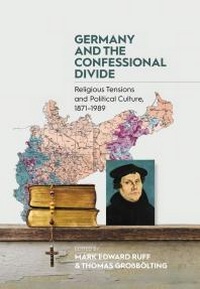
Germany and the Confessional Divide
Religious Tensions and Political Culture, 1871-1989
1st Edition
Published on 10. December 2021
438 pages
978-1-80073-088-5 (ISBN)
Description

From German unification in 1871 through the early 1960s, confessional tensions between Catholics and Protestants were a source of deep division in German society. Engaging this period of historic strife, Germany and the Confessional Divide focuses on three traumatic episodes: the Kulturkampf waged against the Catholic Church in the 1870s, the collapse of the Hohenzollern monarchy and state-supported Protestantism after World War I, and the Nazi persecution of the churches. It argues that memories of these traumatic experiences regularly reignited confessional tensions. Only as German society became increasingly secular did these memories fade and tensions ease.
Reviews / Votes
"Germany and the Confessional Divide offers a richly nuanced interpretation of the relationship between religion, politics and culture in modern Germany. Incorporating sharp methodologies, it identifies pivotal stages of change and situates them within a larger narrative of German history. an important resource for unravelling the complexities of religion in the modern world... With historical precision and insightful analysis, Germany and the Confessional Divide resolves older scholarly riddles as well as presenting innovative directions for future studies in the field." * European History Quarterly"Given the respective pedigrees of the scholars who contributed to this volume, its quality should come as no surprise." * German Studies Review
"This volume is a rich contribution to the literature on the German churches in the nineteenth and twentieth century. Importantly, it bridges the confessional divide that has long dominated historical scholarship on the German churches." * Kyle Jantzen, Ambrose University
"The editors bring together an impressive group of scholars to address the question of relations between Catholics and Protestants in Germany, succeeding where other volumes have not." * Kevin P. Spicer, Stonehill College
More details
Edition
1. Auflage
Language
English
Place of publication
Oxford
United Kingdom
Target group
Professional and scholarly
Illustrations
Bibliography; Index; 3 Figures; 3 Tables, unspecified
ISBN-13
978-1-80073-088-5 (9781800730885)
DOI
10.3167/9781800730878
Copyright in bibliographic data and cover images is held by Nielsen Book Services Limited or by the publishers or by their respective licensors: all rights reserved.
Schweitzer Classification
Other editions
Additional editions
Mark Edward Ruff | Thomas Grossboelting
Germany and the Confessional Divide
Religious Tensions and Political Culture, 1871-1989
Book
12/2021
1st Edition
Berghahn Books
€151.50
Shipment within 3-4 weeks
Persons
Mark Edward Ruff is Professor of History at Saint Louis University. He is the co-editor of three edited volumes on Christianity and Catholicism in the 19th and 20th centuries and the author of two monographs, including The Battle for the Catholic Past in Germany, 1945-1980 published by Cambridge University Press in 2017. He has received research fellowships from the American Council of Learned Societies (ACLS), the National Endowment of the Humanities (NEH) and the Alexander-von-Humboldt Stiftung.
Content
Acknowledgments
Introduction
Mark Edward Ruff and Thomas Grossboelting
Chapter 1. The Kulturkampf and Catholic Identity
Jeffrey T. Zalar
Chapter 2. "Time to Close Ranks:" The Catholic "Kulturfront" during the Weimar Republic
Klaus Grosse Kracht
Chapter 3. The Revolution of 1918/1919: A Traumatic Experience for German Protestantism
Benedikt Brunner
Chapter 4. The Confessional Divide in Voting Behavior
Juergen Falter
Chapter 5. The Fascist Origins of German Ecumenism
James Chappel
Chapter 6. Conversion as a Confessional Irritant: Examples from the Third Reich
Benjamin Ziemann
Chapter 7. Imperfect Interconfessionalism: Women, Gender, and Sexuality in Early Christian Democracy
Maria Mitchell
Chapter 8. Importing Controversy: The Martin Luther Film of 1953 and Confessional Tensions
Mark Edward Ruff
Chapter 9. In the Presence of Absence: Transformations of the Confessional Divide in West Germany after the Holocaust
Brandon Bloch
Chapter 10. A Tense Triangle: The Protestant Church, the Catholic Church, and the SED State
Claudia Lepp
Chapter 11. A Minority between Confession and Politics: Catholicism in the Soviet Zone of Occupation and the GDR (1945-1990)
Christoph Koesters
Chapter 12. The Churches and Changes in Missionary Work. Biconfessionalism and Developmental Aid to the "Third World" since the 1960s
Florian Bock
Chapter 13. Deconfessionalization after 1945: Protestants and Catholics, Jews and Muslims as Actors within the Religious Sphere of the Federal Republic of Germany
Thomas Grossboelting
Conclusion: Closing Reflections
Mark Edward Ruff and Thomas Grossboelting
Introduction
Mark Edward Ruff and Thomas Grossboelting
Chapter 1. The Kulturkampf and Catholic Identity
Jeffrey T. Zalar
Chapter 2. "Time to Close Ranks:" The Catholic "Kulturfront" during the Weimar Republic
Klaus Grosse Kracht
Chapter 3. The Revolution of 1918/1919: A Traumatic Experience for German Protestantism
Benedikt Brunner
Chapter 4. The Confessional Divide in Voting Behavior
Juergen Falter
Chapter 5. The Fascist Origins of German Ecumenism
James Chappel
Chapter 6. Conversion as a Confessional Irritant: Examples from the Third Reich
Benjamin Ziemann
Chapter 7. Imperfect Interconfessionalism: Women, Gender, and Sexuality in Early Christian Democracy
Maria Mitchell
Chapter 8. Importing Controversy: The Martin Luther Film of 1953 and Confessional Tensions
Mark Edward Ruff
Chapter 9. In the Presence of Absence: Transformations of the Confessional Divide in West Germany after the Holocaust
Brandon Bloch
Chapter 10. A Tense Triangle: The Protestant Church, the Catholic Church, and the SED State
Claudia Lepp
Chapter 11. A Minority between Confession and Politics: Catholicism in the Soviet Zone of Occupation and the GDR (1945-1990)
Christoph Koesters
Chapter 12. The Churches and Changes in Missionary Work. Biconfessionalism and Developmental Aid to the "Third World" since the 1960s
Florian Bock
Chapter 13. Deconfessionalization after 1945: Protestants and Catholics, Jews and Muslims as Actors within the Religious Sphere of the Federal Republic of Germany
Thomas Grossboelting
Conclusion: Closing Reflections
Mark Edward Ruff and Thomas Grossboelting
