

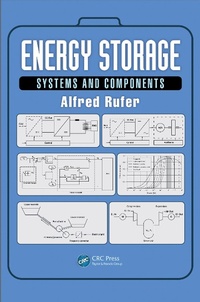
Energy Storage
Systems and Components
1st Edition
Published on 31. October 2017
290 pages
978-1-351-62193-9 (ISBN)
Description

This book will provide the technical community with an overview of the development of new solutions and products that address key topics, including electric/hybrid vehicles, ultrafast battery charging, smart grids, renewable energy (e.g., solar and wind), peak shaving, and reduction of energy consumption. The needs for storage discussed are within the context of changes between the centralized power generation of today and the distributed utility of tomorrow, including the integration of renewable energy sources.
Throughout the book, methods for quantitative and qualitative comparison of energy storage means are presented through their energy capacity as well as through their power capability for different applications. The definitions and symbols for energy density and power density are given and relate to the volume and weight of a given system or component. A relatively underdeveloped concept that is crucial to this text is known as the theory of Ragone plots. This theory makes possible the evaluation of the real amount of energy that can possibly release out of a given system, with respect to the level of power dependency chosen for the discharge process.
From systems using electrochemical transformations, to classical battery energy storage elements and so-called flow batteries, to fuel cells and hydrogen storage, this book further investigates storage systems based on physical principles (e.g., gravitational potential forces, air compression, and rotational kinetic energy). This text also examines purely electrical systems such as superconductive magnets and capacitors. Another subject of analysis is the presentation of power electronic circuits and architectures that are needed for continuously controllable power flow to and from different storage means. For all systems described, the elementary principles of operation are given as well as the relationships for the quantified storage of energy. Finally, Energy Storage: Systems and Components contains multiple international case studies and a rich set of exercises that serve both students and practicing engineers.
Throughout the book, methods for quantitative and qualitative comparison of energy storage means are presented through their energy capacity as well as through their power capability for different applications. The definitions and symbols for energy density and power density are given and relate to the volume and weight of a given system or component. A relatively underdeveloped concept that is crucial to this text is known as the theory of Ragone plots. This theory makes possible the evaluation of the real amount of energy that can possibly release out of a given system, with respect to the level of power dependency chosen for the discharge process.
From systems using electrochemical transformations, to classical battery energy storage elements and so-called flow batteries, to fuel cells and hydrogen storage, this book further investigates storage systems based on physical principles (e.g., gravitational potential forces, air compression, and rotational kinetic energy). This text also examines purely electrical systems such as superconductive magnets and capacitors. Another subject of analysis is the presentation of power electronic circuits and architectures that are needed for continuously controllable power flow to and from different storage means. For all systems described, the elementary principles of operation are given as well as the relationships for the quantified storage of energy. Finally, Energy Storage: Systems and Components contains multiple international case studies and a rich set of exercises that serve both students and practicing engineers.
Reviews / Votes
"This excellent book contains a comprehensive description and comparison of different storage techniques and principles. This is extremely valuable to clearly understand the peculiarities and limitations of the current technologies and inspire future research efforts and technology developments. The book will provide the technical community with solid and detailed knowledge that will help develop new solutions and products to address key hot topics of our time, like electric/hybrid vehicles, ultrafast battery charging, smart grids, renewable energy, peak shaving, and reduction of energy consumption." - Silvio Colombi, General Electric, Ticino, Switzerland"I would advise electrical engineers and electrochemists to read this book. Personally, this reference book will stand on my bookshelf besides books dedicated to batteries and fuel cells."
-Jean Francois Equey, Adenosine Sarl, Morges, Switzerland
"I really appreciated the systematic and thorough presentation of energy storage systems and components. Engineering approach and detailed descriptions with quantitative examples should make this book a unique tool to support planning and specification of energy storage project."
-Francois Avellan, Ecole Polytechnique Federale de Lausanne, Switzerland
"With complete coverage of the basic physical principles, Energy Storage: Systems and Components presents a valuable resource of the latest technologies in energy storage, providing a perfect mix of fundamentals and applications. Rufer explores the various aspects of energy storage through careful explanations of concepts and use of numerous practical examples and figures."
-Mahbod Heidari, University of Geneva, Switzerland
"... contains a good balance between phenomenological descriptions and modeling of energy storage systems. Therefore, it can be considered as a good reference for those interested to understand, and mathematically quantify, the behavior of these devices."
-Mario Paolone, Ecole Polytechnique Federale de Lausanne, Switzerland
"A book that brings the essential theory on storage systems and as well informs about the practical aspects of different solutions."
- JF Affolter, HES-SO / HEIG-VD / IESE, Yverdon-les-Bains, Switzerland
"The new textbook Energy Storage. Systems and Components authored by Professor emeritus Alfred Rufer from the Swiss Federal Institute of Technology Lausanne (EPFL), Lausanne, Switzerland, appeared just at the moment when both the development of intelligent networks and electromobility reached the state of wide use of energy magazines. The book is well balanced and easy for understand, written without unnecessary theoretical ballast."
-Marian P. Kazmierkowski, Warsaw University of Technology, Poland
More details
Language
English
Place of publication
London
United Kingdom
Publishing group
Taylor & Francis Ltd
Target group
Professional and scholarly
Illustrations
41 Illustrations, color; 197 Illustrations, black and white
File size
8,05 MB
ISBN-13
978-1-351-62193-9 (9781351621939)
Copyright in bibliographic data and cover images is held by Nielsen Book Services Limited or by the publishers or by their respective licensors: all rights reserved.
Schweitzer Classification
Other editions
New editions
E-Book
approx. 06/2026
2nd Edition
CRC Press
€172.99
Available for download
Additional editions
Book
11/2017
1st Edition
CRC Press
€245.12
Shipment within 10-20 days
Person
Alfred Rufer (1951) received the M.S. degree from the Swiss Federal Institute of Technology Lausanne (EPFL), Lausanne, Switzerland, in 1976. In 1978 he joined ABB where he was involved in the fields of high power electronics and control. In 1993 he became an Assistant Professor at EPFL. Since 1996, he has been a full professor and head of the industrial Electronics Laboratory EPFL. He has authored or coauthored more than 200 publications on power electronics and applications, and he holds several patents. Alfred Rufer's research activities focus on one hand on power converters as modular multilevel converters in asymmetric or hybrid technologies. Another important field initiated by Alfred Rufer is dedicated to energy storage, where many applications have been studied. Other new developments have recently been presented, for example a low aging, easy to recycle, hybrid energy storage device based on compressed air. In 2006, Alfred Rufer was elected to the IEEE Fellow grade.
Content
1. Generalities on Energy Storage 2. Energy Storage Systems 3. Comparative Ratings and Properties 4. Electrochemical Energy Storage 5. Energy Storage by Means of Supercapacitors 6. Energy Storage Systems Based on Compressed Air 7. Hydropower and Pumped Storage Facilities 8. Flywheel Systems 9. Energy Storage Based on Hydrogen 10. System Arrangements and Applications Appendix A: Power Electronics-Basic Circuits and Principles
