

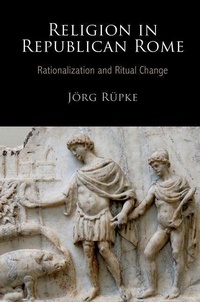
Religion in Republican Rome
Rationalization and Ritual Change
1st Edition
Published on 28. May 2012
328 pages
978-0-8122-0657-9 (ISBN)
Description

Roman religion as we know it is largely the product of the middle and late republic, the period falling roughly between the victory of Rome over its Latin allies in 338 B.C.E. and the attempt of the Italian peoples in the Social War to stop Roman domination, resulting in the victory of Rome over all of Italy in 89 B.C.E. This period witnessed the expansion and elaboration of large public rituals such as the games and the triumph as well as significant changes to Roman intellectual life, including the emergence of new media like the written calendar and new genres such as law, antiquarian writing, and philosophical discourse.
In Religion in Republican Rome JOErg RUEpke argues that religious change in the period is best understood as a process of rationalization: rules and principles were abstracted from practice, then made the object of a specialized discourse with its own rules of argument and institutional loci. Thus codified and elaborated, these then guided future conduct and elaboration. RUEpke concentrates on figures both famous and less well known, including Gnaeus Flavius, Ennius, Accius, Varro, Cicero, and Julius Caesar. He contextualizes the development of rational argument about religion and antiquarian systematization of religious practices with respect to two complex processes: Roman expansion in its manifold dimensions on the one hand and cultural exchange between Greece and Rome on the other.
In Religion in Republican Rome JOErg RUEpke argues that religious change in the period is best understood as a process of rationalization: rules and principles were abstracted from practice, then made the object of a specialized discourse with its own rules of argument and institutional loci. Thus codified and elaborated, these then guided future conduct and elaboration. RUEpke concentrates on figures both famous and less well known, including Gnaeus Flavius, Ennius, Accius, Varro, Cicero, and Julius Caesar. He contextualizes the development of rational argument about religion and antiquarian systematization of religious practices with respect to two complex processes: Roman expansion in its manifold dimensions on the one hand and cultural exchange between Greece and Rome on the other.
Reviews / Votes
"A tightly argued but panoramic vision of the history of religion in Republican Rome. Building on over a decade of publications in this area, this book provides a new picture of the relationship between religion and society in the period between the fourth century B.C.E. and the Augustan monarchy." (American Journal of Philology) "An erudite and fascinating book, and a very serious contribution to our understanding of the Roman republic." (Jeffrey Tatum, Victoria University of Wellington) "This study is the most recent contribution to the area of Roman Republican religion by one of the most significant historians of that field in the 21st century. Drawing on the observations of Max Weber and Wolfgang Schluchter, Ruepke presents a brilliant, erudite argument that Roman Republican religion evolved through a process of rationalization that began in the fourth century B.C.E. and culminated with the rise of the Principate in the first century B.C.E." (Choice)More details
Series
Language
English
Place of publication
Pennsylvania
United States
Target group
College/higher education
File size
2,16 MB
ISBN-13
978-0-8122-0657-9 (9780812206579)
Copyright in bibliographic data and cover images is held by Nielsen Book Services Limited or by the publishers or by their respective licensors: all rights reserved.
Schweitzer Classification
Other editions
Additional editions
Book
04/2012
University of Pennsylvania Press
€82.94
Article exhausted; check different version
Person
Jorg Rupke is Fellow in Religious Studies at the Max Weber Center at the University of Erfurt. He is author or editor of several books, including Religion of the Romans.
Content
Introduction
1. The Background: Roman Religion of the Archaic and Early Republican Periods
2. Institutionalizing and Ordering Public Communication
3. Changes in Religious Festivals
4. Incipient Systematization of Religion in Second-Century Drama: Accius
5. Ritualization and Control
6. Writing and Systematization
7. The Pontifical Calendar and the Law
8. Religion and Divination in the Second Century
9. Religion in the Lex Ursonensis
10. Religious Discourses in the Second and First Centuries: Antiquarianism and Philosophy
11. Ennius's Fasti in Fulvius's Temple: Greek Rationality and Roman Tradition
12. Varro's tria genera theologiae: Crossing Antiquarianism and Philosophy
13. Cicero's Discourse on Religion
14. Greek Rationality and Roman Traditions in the Late Republic
Notes
Bibliography
Index Locorum
General Index
Acknowledgments
1. The Background: Roman Religion of the Archaic and Early Republican Periods
2. Institutionalizing and Ordering Public Communication
3. Changes in Religious Festivals
4. Incipient Systematization of Religion in Second-Century Drama: Accius
5. Ritualization and Control
6. Writing and Systematization
7. The Pontifical Calendar and the Law
8. Religion and Divination in the Second Century
9. Religion in the Lex Ursonensis
10. Religious Discourses in the Second and First Centuries: Antiquarianism and Philosophy
11. Ennius's Fasti in Fulvius's Temple: Greek Rationality and Roman Tradition
12. Varro's tria genera theologiae: Crossing Antiquarianism and Philosophy
13. Cicero's Discourse on Religion
14. Greek Rationality and Roman Traditions in the Late Republic
Notes
Bibliography
Index Locorum
General Index
Acknowledgments
