

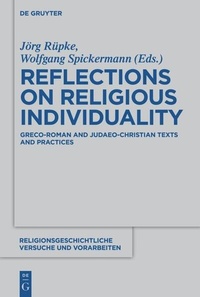
Reflections on Religious Individuality
Description

This volume will concentrate its search for religious individuality on texts and practices related to texts from Classical Greece to Late Antiquity. Texts offer opportunities to express one's own religious experience and shape one's own religious personality within the boundaries of what is acceptable. Inscriptions in public or at least easily accessible spaces might substantially differ in there range of expressions and topics from letters within a sectarian religious group (which, at the same time, might put enormous pressure on conformity among its members, regarded as deviant by a majority of contemporaries). Furthermore, texts might offer and advocate new practices in reading, meditating, remembering or repeating these very texts. Such practices might contribute to the development of religious individuality, experienced or expressed in factual isolation, responsibility, competition, and finally in philosophical or theological reflections about "personhood" or "self". The volume develops its topic in three sections, addressing personhood, representative and charismatic individuality, the interaction of individual and groups and practices of reading and writing. It explores Jewish, Christian, Greek and Latin texts.
Reviews / Votes
"The stimulating collection raises expectations for further contributions from the Erfurt research group."Brent Nongbri in: BMCR 2013.07.10More details
Other editions
Additional editions
Persons
Content
- Intro
- Introduction
- Individuals and Personhood
- Kultgründungen durch Individuen im klassischen Griechenland
- ' ... Hidden with Christ in God' (Colossians 3:3): Modes of Personhood in Deutero-Pauline Tradition
- Representative and Charismatic Individuality
- Representative Individuality in Iamblichus' De vita pythagorica
- Sosipatra and the Theurgic Life: Eunapius Vitae Sophistorum 6.6.5-6.9.24
- Gregory Taught, Gregory Written: The effacement and definition of individualization in the Address to Origen and the Life of Gregory the Wonderworker
- The Father of Man: Abraham as the rabbinic Jesus
- Reading and Writing
- Reading Practices in Early Christianity and the Individualisation Process
- Reading and Religion in Rome
- "Einer jeden Gottheit ihren eigenen Kult": Verbriefte Individualreligion am Clitumnus fons (Plinius epist. 8,8)
- Four Letter-writers: Religion in Pliny, Trajan, Libanius, and Julian
- Index
