

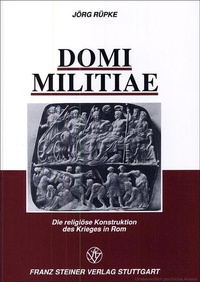
Peace and War in Rome
Description

Warfare is one of the defining elements that drove the development of the city of Rome from a small territory into a Mediterranean Empire. Religion is identified as having played an important part in this. Never done before, this e-book undertakes a survey of all rituals, and religious institutions in a broader sense, along with discourses related to peace and warfare. Priests and senators, generals and soldiers, men and women are acknowledged as agents with very different competencies, interests, and experiences, but also different opportunities to leave material traces or textual reflections of their activities. Throughout, the author pays attention to developments in time as well as space. He seeks to reconstruct the religious construction of peace and war at Rome as a tool and an attitude caught up in a process of change. The e-book persists in addressing the ways in which specific religious concepts might further or impede the pursuit of power and obedience to power, sharpen or mitigate internal competition, be conducive or not to the integration of allied powers, without ever claiming to "explain" military success or expansion.
More details
Other editions
Additional editions
Persons
Content
- Intro
- Table of contents
- Introduction
- Part I Rome: a city prepared
- 1 A bellicose polity?
- 2 Warfare in the context of time
- 2.1 War as reflected in the calendar
- 2.2 The so-called military cycle of festivals
- 2.3 Warfare and the fasti
- 3 Domi militiae
- 3.1 The sacral topography of war
- 3.2 The Pomerium: on Rome's sacral topography
- 3.3 Imperium auspiciumque: Political and religious competencies
- 3.4 Orbis terrarum: on Roman religious geography144
- 3.5 The military inclusion of the non-military zone
- 4 Populus est exercitus
- 4.1 Roman warriors
- 4.2 Non-combatants
- 4.3 The draft
- 4.4 Exceptional forms of mobilization
- 4.5 The military oath
- 4.6 The legal status of soldiers
- 4.7 Summing up: initiation into an impasse?
- Part II Rome at war
- 5 Declaring war
- 5.1 Fetials: A change in the mode of declaring war
- 5.2 The just war
- 5.3 The decision for war
- 6 Leaving Rome
- 6.1 Prodigies: Religion as a medium of communication
- 6.2 Auspices and sacrifices: Legitimizing and and reflecting in religious terms
- 6.3 Combating anxieties
- 6.4 A multitude of ritual tools
- 6.5 The doors of Ianus
- 6.6 Augurium salutis
- 7 On the March
- 7.1 Assembling the army
- 7.2 Crossing frontiers
- 7.3 Divination
- 8 Battle
- 8.1 Preparing for battle
- 8.2 Religious weapons: Vota
- 8.3 Religious weapons: Self-sacrifice and devotions
- 8.4 Religious weapons: Calling out the gods of the enemy
- Part III in the camp
- 9 The camp
- 9.1 General aspects
- 9.2 The camp as a sacral unit
- 10 Religion organized for soldiers
- 10.1 Public religious roles
- 10.2 Routine ritual
- 10.3 The course of the year
- 10.4 Sacral topography
- 11 Religion organized by soldiers
- 11.1 The cult of the standards
- 11.2 The cult of the genius
- 11.3 Worshipping the emperor
- 11.4 Places of assembly
- 11.5 Groups
- 11.6 Being on foreign ground
- Part IV Rome in Victory
- 12 After the battle
- 12.1 Burning weapons
- 12.2 Burying the dead
- 12.3 Distributing decorations
- 12.4 Honouring the general
- 13 After war
- 13.1 Capitulation
- 13.2 Prisoners and plunder
- 14 Back into the city
- 14.1 Thanking the gods
- 14.2 Objects of pride
- 14.3 The Triumph
- 14.4 Vows need to be fulfilled
- Part V war and religion in Rome
- 15 The religious construction of war
- 15.1 The oldest level
- 15.2 The middle Republic
- 15.3 The later Republic
- 15.4 Augustus
- 16 The political construction of war aided by religion
- 16.1 The campaign's ritual framework
- 16.2 The imperator at the centre
- 16.3 The military and the commonwealth
- 16.4 Killing and being killed
- 17 The religion of the legionaries
- 17.1 Religion in the camp
- 17.2 Surviving military service
- 17.3 Religion as a crisis phenomenon?
- 17.4 A religion of specialists?
- 17.5 Religion in foreign parts
- 18 Historicizing war and religion
- Afterword
- With gods on their side, home and away
- Bibliography
- Index
