

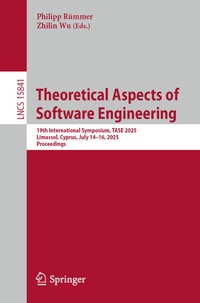
Theoretical Aspects of Software Engineering
Description

This book constitutes the refereed proceedings of the 19th International Symposium on Theoretical Aspects of Software Engineering, TASE 2025, held in Limassol, Cyprus, during July 14-16, 2025.
The 20 full papers, 1 short paper, 2 invited papers were carefully selected from 66 submissions.
The papers present the latest developments in formal and theoretical software engineering methods and techniques.
They are grouped in topical sections on program verification; verification and concurrency; SAT and SMT solving; trustworthy AI and system software; program analysis using machine learning; security; and dynamic analysis.
More details
Other editions
Additional editions
Content
.- Program Verification.
.- Safeguarding Neural Network-Controlled Systems via Formal Methods: From Safety-by-Design to Runtime Assurance (Invited Talk) .
.- Testing-Based Formal Verification with Program Slicing on Functional Soundness and Completeness.
.- Dependent Assertion Logic for Modular Software Verification.
.- A Formal Framework for Naturally Specifying and Verifying Sequential Algorithms.
.- Machine-Checked Compositional Specification and Proofs for Embedded Systems.
.- Verification and Concurrency.
.- Failure divergence refinement for Event-B
.- Mining Diamonds in labeled Transition Systems.
.- Portability of Optimizations from SC to TSO.
.- SAT and SMT Solving.
.- Adaptive Clause Management in SMT Solvers: A Dynamic Weighting Framework for Formal Verification.
.- SNRWLS: Improve (W)PMS Solver with Weighting Strategies Related to Number of Soft Clauses.
.- Trustworthy AI and System Software.
.- Robust Deep Reinforcement Learning Using Formal Verification.
.- A Formally Verified Neural Network Converter for the Interactive Theorem Prover Coq.
.- COMPASS: An Agent for MLIR Compilation Pass Pipeline Generation.
.- Stable Ranges: Shared Dichotomy in Large Version-Controlled Repositories.
.- Program Analysis using Machine Learning.
.- CASTLE: Benchmarking Dataset for Static Code Analyzers and LLMs towards CWE Detection.
.- FAMiT: Mitigating False Alarms for Program Analysis Using Large Language Models.
.- Security.
.- A Cross-domain Data Sharing Scheme Based on Federated Blockchain.
.- Operational Semantics for Crystality: A Smart Contract Language for Parallel EVMs.
.- Detecting speculative data flow vulnerabilities using weakest precondition reasoning.
.- Dynamic Analysis.
.- Random Testing of Model Checkers for Timed Automata with Automated Oracle Generation.
.- State Significance-Guided Fuzzing for Stateful Protocol Program.
.- Unleash the Hidden Power of CAR-based Model Checking through Dynamic Traversal.
