

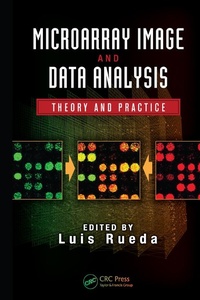
Microarray Image and Data Analysis
Theory and Practice
1st Edition
Published on 3. September 2018
520 pages
978-1-351-83167-3 (ISBN)
Description

Microarray Image and Data Analysis: Theory and Practice is a compilation of the latest and greatest microarray image and data analysis methods from the multidisciplinary international research community. Delivering a detailed discussion of the biological aspects and applications of microarrays, the book:
Describes the key stages of image processing, gridding, segmentation, compression, quantification, and normalization
Features cutting-edge approaches to clustering, biclustering, and the reconstruction of regulatory networks
Covers different types of microarrays such as DNA, protein, tissue, and low- and high-density oligonucleotide arrays
Examines the current state of various microarray technologies, including their availability and affordability
Explains how data generated by microarray experiments are analyzed to obtain meaningful biological conclusions
An essential reference for academia and industry, Microarray Image and Data Analysis: Theory and Practice provides readers with valuable tools and techniques that extend to a wide range of biological studies and microarray platforms.
Describes the key stages of image processing, gridding, segmentation, compression, quantification, and normalization
Features cutting-edge approaches to clustering, biclustering, and the reconstruction of regulatory networks
Covers different types of microarrays such as DNA, protein, tissue, and low- and high-density oligonucleotide arrays
Examines the current state of various microarray technologies, including their availability and affordability
Explains how data generated by microarray experiments are analyzed to obtain meaningful biological conclusions
An essential reference for academia and industry, Microarray Image and Data Analysis: Theory and Practice provides readers with valuable tools and techniques that extend to a wide range of biological studies and microarray platforms.
More details
Series
Edition
1. Auflage
Language
English
Place of publication
London
United Kingdom
Publishing group
Taylor & Francis Ltd
Target group
College/higher education
Product notice
Reflowable
Illustrations
51 Tables, black and white; 137 Illustrations, black and white
File size
17,50 MB
ISBN-13
978-1-351-83167-3 (9781351831673)
Copyright in bibliographic data and cover images is held by Nielsen Book Services Limited or by the publishers or by their respective licensors: all rights reserved.
Schweitzer Classification
Other editions
Additional editions
Book
06/2019
1st Edition
CRC Press
€136.30
Shipment within 10-20 days
Book
03/2014
1st Edition
CRC Press
€182.50
Shipment within 15-20 days
Person
Luis Rueda is professor for the School of Computer Science, University of Windsor, Ontario, Canada. Before joining the University of Windsor, he earned a Ph.D from Carleton University, Ottawa, Ontario, Canada and spent two years at the University of Concepcion, Chile. A member of IEEE, the Association for Computing Machinery, and the International Society for Computational Biology, he holds three patents on data encryption, secrecy, and stealth; has published over 100 journal and conference papers; and has participated in numerous editorial and technical committees. His research is primarily focused on machine learning and pattern recognition in transcriptomics, interactomics, and genomics.
Content
Introduction to Microarrays. Biological Aspects: Types and Applications of Microarrays. Gridding Methods for DNA Microarray Images. Machine Learning-Based DNA Microarray Image Gridding. Non-Statistical Segmentation Methods for DNA Microarray Images. Statistical Segmentation Methods for DNA Microarray Images. Microarray Image Restoration and Noise Filtering. Compression of DNA Microarray Images. Image Processing of Affymetrix Microarrays. Treatment of Noise and Artifacts in Affymetrix Arrays. Quality Control and Analysis Algorithms for Tissue Microarrays. CNV-Interactome-Transcriptome Integration. Mining Gene-Sample-Time Microarray Data. Systematic and Stochastic Biclustering Algorithms for Microarray Data Analysis. Reconstruction of Regulatory Networks from Microarray Data. Multidimensional Visualization of Microarray Data. Bioconductor Tools for Microarray Data Analysis.
