

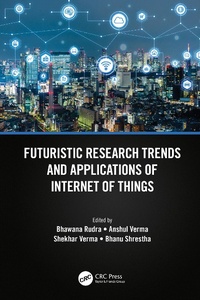
Futuristic Research Trends and Applications of Internet of Things
1st Edition
Published on 9. August 2022
286 pages
978-1-000-61011-6 (ISBN)
Description

The Internet of Things (IoT) is an interconnection of several devices, networks, technologies, and human resources to achieve a common goal. A variety of IoT-based applications are being used in different sectors and have succeeded in providing huge benefits to the users. As a revolution, IoT overtook the entire global landscape with its presence in almost every sector, including smart cities, smart grid, intelligent transportation, healthcare, education, and so on. This technological revolution also moved to the machines, converting them into intelligent computers that can make real-time decisions and communicate with each other, forming an Internet of Systems/Machines. The use of secure light-weight protocols will help us in developing environment-friendly and energy-efficient IoT systems.
IoT is an emerging and recent area of research, adopted for many applications, and there is a need to investigate further challenges in all aspects of it. This book will provide information on fundamentals, architectures, communication protocols, use of AI, existing applications, and emerging research trends in IoT. It follows a theoretical approach to describe the fundamentals for beginners as well as a practical approach with the implementation of case studies for intermediate and advanced readers. The book will be beneficial for academicians, researchers, developers, and engineers who work in or are interested in fields related to IoT. This book serves as a reference for graduate and postgraduate courses in computer science, computer engineering, and information technology streams.
IoT is an emerging and recent area of research, adopted for many applications, and there is a need to investigate further challenges in all aspects of it. This book will provide information on fundamentals, architectures, communication protocols, use of AI, existing applications, and emerging research trends in IoT. It follows a theoretical approach to describe the fundamentals for beginners as well as a practical approach with the implementation of case studies for intermediate and advanced readers. The book will be beneficial for academicians, researchers, developers, and engineers who work in or are interested in fields related to IoT. This book serves as a reference for graduate and postgraduate courses in computer science, computer engineering, and information technology streams.
More details
Edition
1. Auflage
Language
English
Place of publication
London
United Kingdom
Publishing group
Taylor & Francis Ltd
Target group
College/higher education
Professional and scholarly
Illustrations
23 Tables, black and white; 79 Line drawings, black and white; 72 Halftones, black and white; 151 Illustrations, black and white
ISBN-13
978-1-000-61011-6 (9781000610116)
Copyright in bibliographic data and cover images is held by Nielsen Book Services Limited or by the publishers or by their respective licensors: all rights reserved.
Schweitzer Classification
Other editions
Additional editions
Bhawana Rudra | Anshul Verma | Shekhar Verma
Futuristic Research Trends and Applications of Internet of Things
Book
10/2024
1st Edition
CRC Press
€88.90
Shipment within 10-20 days
Bhawana Rudra | Anshul Verma | Shekhar Verma
Futuristic Research Trends and Applications of Internet of Things
Book
08/2022
1st Edition
CRC Press
€167.20
Shipment within 10-20 days
Persons
Dr. Bhawana Rudra received Ph.D. degree in Information Technology from Indian Institute of Information Technology Allahabad, India in 2015. She has published several research papers in peer-reviewed International Journals (SCI) and International Conferences (SCOPUS, DBLP). She has also published one book on Future Internet Security Issues. She has applied for PATENT in the field of Internet of Things and currently published a Text Book on Flexible Network Architectures Security Issues and Principles in 2018 and the publisher is Taylor and Francis, USA. She has received several awards such as Emerging Researcher Award, Bright Educator Award from the organizations like International Institute of Organized Research-Australia as well as from Green Thinkerz in 2017 and 2018. Currently, she is serving as Assistant Professor in the Department of Information Technology, National Institute of Technology (NIT) Karnataka. She has also served as a faculty in Computer Science and Engineering Department, B V Raju Institute of Technology, Narsapur, India as an Associate Professor from 2016 to 2018, and as an Assistant Professor in the Department of Information Technology at Vasavi College of Engineering, India from 2014 to 2016. Her research interests include the Internet of Things, Network Security, Distributed Systems, Blockchain Technology, and Quantum computing.
Dr. Anshul Verma received M.Tech. and Ph.D. degrees in Computer Science & Engineering from ABV-Indian Institute of Information Technology and Management Gwalior, India in 2011 and 2016, respectively. He has done Post-doctorate from Indian Institute of Technology Kharagpur, India in 2017. Currently, he is serving as Assistant Professor in the Department of Computer Science, Institute of Science, Banaras Hindu University Varanasi, India. He has also served as faculty in Computer Science & Engineering at Motilal Nehru National Institute of Technology (MNNIT) Allahabad and National Institute of Technology (NIT) Jamshedpur, India, from 2015 to 2017. His research interests include Wireless Sensor Networks, Internet of Things, Mobile Ad-hoc Networks, Distributed Systems, and Formal Methods. He has participated as advisory board member, session chair, programme committee member in many conferences and he is serving as aditorial board member in many journals. He is serving as the Editor of the Journal of Scientific Research, BHU, Varanasi, India.
Prof. Shekhar Verma has received his BTech, MTech, and PhD from IIT BHU, Varanasi. He is currently working as a professor in Information Technology at Indian Institute of Information Technology Allahabad. He has published more than 100 research papers in reputed refereed International Journals and more than 80 papers in international conferences. He has supervised 20 PhD scholars and handled many R&D projects. He is a member of the "Machine Learning and Optimization Group" at IIIT Allahabad. His research interest includes Machine Learning, Wireless sensor networks, computer networks, Information and network security, vehicular networks, and cryptography.
Prof. Bhanu Shrestha did Master of Science and Doctor of Philosophy in Electronic Engineering from Kwangwoon University, Seoul, Republic of Korea, in 2004 and 2008 respectively. He is currently working as a Professor in the Department of Electronic Engineering (Glocal Education Center) at Kwangwoon University, Seoul, Korea. His research areas include RFICMMiC, Design Fabrication, Wireless Networks, Internet of Things, etc. He is Founder Director and Vice-chairman of ICT-Advanced Engineering Society (2018-present); Chief Advisor of All Nepal Taekwondo Academy, Kathmandu, Nepal (2007-2008); Member of All India Taekwondo Dojang, New Delhi (2007-2008); Member of Nepal Engineering Council, Kathmandu (2001-2007); Member of Nepal Engineering Association, Kathmandu (2002-2007); Member of Nepal S. Korea Friendship Society (president since 2005).
Dr. Anshul Verma received M.Tech. and Ph.D. degrees in Computer Science & Engineering from ABV-Indian Institute of Information Technology and Management Gwalior, India in 2011 and 2016, respectively. He has done Post-doctorate from Indian Institute of Technology Kharagpur, India in 2017. Currently, he is serving as Assistant Professor in the Department of Computer Science, Institute of Science, Banaras Hindu University Varanasi, India. He has also served as faculty in Computer Science & Engineering at Motilal Nehru National Institute of Technology (MNNIT) Allahabad and National Institute of Technology (NIT) Jamshedpur, India, from 2015 to 2017. His research interests include Wireless Sensor Networks, Internet of Things, Mobile Ad-hoc Networks, Distributed Systems, and Formal Methods. He has participated as advisory board member, session chair, programme committee member in many conferences and he is serving as aditorial board member in many journals. He is serving as the Editor of the Journal of Scientific Research, BHU, Varanasi, India.
Prof. Shekhar Verma has received his BTech, MTech, and PhD from IIT BHU, Varanasi. He is currently working as a professor in Information Technology at Indian Institute of Information Technology Allahabad. He has published more than 100 research papers in reputed refereed International Journals and more than 80 papers in international conferences. He has supervised 20 PhD scholars and handled many R&D projects. He is a member of the "Machine Learning and Optimization Group" at IIIT Allahabad. His research interest includes Machine Learning, Wireless sensor networks, computer networks, Information and network security, vehicular networks, and cryptography.
Prof. Bhanu Shrestha did Master of Science and Doctor of Philosophy in Electronic Engineering from Kwangwoon University, Seoul, Republic of Korea, in 2004 and 2008 respectively. He is currently working as a Professor in the Department of Electronic Engineering (Glocal Education Center) at Kwangwoon University, Seoul, Korea. His research areas include RFICMMiC, Design Fabrication, Wireless Networks, Internet of Things, etc. He is Founder Director and Vice-chairman of ICT-Advanced Engineering Society (2018-present); Chief Advisor of All Nepal Taekwondo Academy, Kathmandu, Nepal (2007-2008); Member of All India Taekwondo Dojang, New Delhi (2007-2008); Member of Nepal Engineering Council, Kathmandu (2001-2007); Member of Nepal Engineering Association, Kathmandu (2002-2007); Member of Nepal S. Korea Friendship Society (president since 2005).
Content
1 Fundamentals of Internet of Things
Sarthak Srivastava, Anshul Verma, and Pradeepika Verma
2 Issues and Challenges associated with Fog Computing in Healthcare 4.0
Jeetendra Kumar and Rashmi Gupta
3 Modeling of an IoT System in Healthcare Subject to Gateway Failure
Shensheng Tang
4 LoRa for Long-Range and Low-Cost IoT Applications
Mayur Rajaram Parate and Ankit A. Bhurane
5 Multi-sensor System and Internet of Things (IoT) Technologies for Air Pollution Monitoring
Ghizlane Fattah, Jamal Mabrouki, Fouzia Ghrissi, Mourade Azrour, and Younes Abrouki
6 Semantic Web Technology based Secure System for IoT enabled E-Healthcare Services
Nikita Malik and Sanjay Kumar Malik
7 Fuzzy Weighted Nuclear Norm based Two-Dimensional Linear Discriminant Features for Fruit Grade Classification
G. Yogeswararao, R. Malmathanraj, and P. Palanisamy
8 IPv6 Adaptation in Ultrasonic NFC IoT Communications
Rolando Herrero
9 An AI Assisted IoT based Framework for Time Efficient Health Monitoring of COVID-19 Patients
Punit kumar Bhavsar and Vinal Patel
10 Cognitive Analytics of Social Media for Industrial Manufacturing under Internet of Things Technology
Zhihan Lv
11 Industrial Internet of Things: Applications and Challenges
Brijendra Singh
12 Machine Learning in IoT based Ambient Backscatter Communication System
Shivani Chouksey, Tushar S.Muratkar, Ankit Bhurane, Prabhat Sharma, and Ashwin Kothari
Sarthak Srivastava, Anshul Verma, and Pradeepika Verma
2 Issues and Challenges associated with Fog Computing in Healthcare 4.0
Jeetendra Kumar and Rashmi Gupta
3 Modeling of an IoT System in Healthcare Subject to Gateway Failure
Shensheng Tang
4 LoRa for Long-Range and Low-Cost IoT Applications
Mayur Rajaram Parate and Ankit A. Bhurane
5 Multi-sensor System and Internet of Things (IoT) Technologies for Air Pollution Monitoring
Ghizlane Fattah, Jamal Mabrouki, Fouzia Ghrissi, Mourade Azrour, and Younes Abrouki
6 Semantic Web Technology based Secure System for IoT enabled E-Healthcare Services
Nikita Malik and Sanjay Kumar Malik
7 Fuzzy Weighted Nuclear Norm based Two-Dimensional Linear Discriminant Features for Fruit Grade Classification
G. Yogeswararao, R. Malmathanraj, and P. Palanisamy
8 IPv6 Adaptation in Ultrasonic NFC IoT Communications
Rolando Herrero
9 An AI Assisted IoT based Framework for Time Efficient Health Monitoring of COVID-19 Patients
Punit kumar Bhavsar and Vinal Patel
10 Cognitive Analytics of Social Media for Industrial Manufacturing under Internet of Things Technology
Zhihan Lv
11 Industrial Internet of Things: Applications and Challenges
Brijendra Singh
12 Machine Learning in IoT based Ambient Backscatter Communication System
Shivani Chouksey, Tushar S.Muratkar, Ankit Bhurane, Prabhat Sharma, and Ashwin Kothari
