

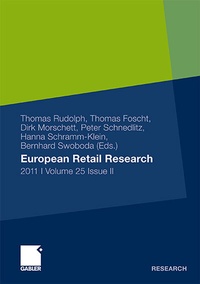
European Retail Research 2011, Volume 25 Issue II
Published on 17. December 2011
VII, 140 pages
978-3-8349-7144-9 (ISBN)
Description

The aim of EUROPEAN RETAIL RESEARCH is to publish interesting manuscripts of high quality and innovativeness with a focus on retail researchers, retail lecturers, retail students and retail executives. As it has always been, retail executives are part of the target group and the knowledge transfer between retail research and retail management remains a part of the publication's concept. EUROPEAN RETAIL RESEARCH welcomes manuscripts on original theoretical or conceptual contributions as well as empirical research - based either on large-scale empirical data or on the case-study method. Following the state of the art in retail research, articles on any major issues that concern the general field of retailing and distribution are welcome.
The review process will support the authors in enhancing the quality of their work and will offer the authors a reviewed publication outlet. Part of the concept of EUROPEAN RETAIL RESEARCH is an only short delay between manuscript submission and final publication, so it is intended to become a quick publication platform.
More details
Other editions
Additional editions
Book
12/2011
Springer Gabler
€59.99
Shipment within 7-9 days
Content
- Intro
- Preface
- Contents
- Several Aspects of Psychological Pricing: Empirical Evidence from some Austrian Retailers
- Abstract
- Keywords
- 1 Introduction
- 2 Conceptual outline of price perceptions
- 2.1 Price endings
- 2.2 First non-zero digit in a price
- 2.3 Symbolic meanings of price endings
- 2.4 Eye-catching Sequnces of digits in a price
- 2.5 Framing of price cuts in percentage versus euro terms
- 3 Research design
- 4 Results
- 4.1 Price endings
- 4.1.1. Grocery stores
- 4.1.2. Furniture stores
- 4.1.3. Clothes stores
- 4.1.4. Hardware stores
- 4.2 First non-zero digit in a price
- 4.3 Symbolic meanings of price endings
- 4.4 Eye-catching Sequnces of digits in a price
- 4.5 Framing of price cuts in percentage versus euro terms
- 5 Conclusions and further research
- References
- The Application of the Convenience Concept to the Retail Format Vending
- Abstract
- Keywords
- 1 Introduction
- 2 Theoretical Background and Research Hypotheses
- 3 Methodology
- 3.1 Qualitative Preliminary Study
- 3.2 Quantitative Main Study
- 4 Hypotheses Testing and Discussion
- 5 Conclusions and Implications
- Appendi x
- References
- Standardization of Front-end Offers and Back-end Processes of International Store Retailers
- Abstract
- Keywords
- 1. Introduction
- 2. Hypotheses Development
- 2.1. Conceptualisations
- 2.2. Relationship hetween Marketing Instruments and Marketing Proeesses
- 2.3. Relationship between Marketing Instruments and Supply Chain Processes
- 2.4. The Role of Psychic Distance
- 3. Empirical Study
- 3.1. Sample
- 3.2. Measnrements
- 4. Results
- 5. Discussion
- 6. Conclusions
- Acknowledgement
- References
- Creating. developing and managing the dimensions of the own brand:A study of UK fashion retailing
- Abstract
- Keywords
- 1 Introduction
- 2 Review of the literature
- 2.1 Defining the brand
- 2.2 Product brands to corporate brands
- 2.3 Branding in the retall sector
- 2.4 Retailer own brands
- 3 Methodology
- 4 Results and analysis
- 4.1 The corporate brand
- 4.2 The product
- 4.2.1 Function
- 4.2.2 Design
- 4.3 Pricing
- 4.4 Visual communication
- 4.5 Advertising and public relations
- 4.6 The in-store experience
- 4.7 Customer service
- 4.8 Psychological value
- 4.9 Management of the own brand dimensions
- 5 Discussion
- 5.1 The management processes which support own brand creation and development
- 6 Conclusion and contribution
- 7 Limitations of the study and future research
- References
- Disintermediation in Distribution Channels -A Transaction Cost-based Analysis of Wholesalers
- Abstract
- Keywords
- 1 Introduction
- 2 Theoretical Approaches to Explain Disintermediation
- 3 Hypotheses
- 3.1 Concentration
- 3.2 Assortment Activities
- 3.3 Logistics Activities
- 3.4 Marketing Activities
- 3.5 Procurement Activities
- 3.6 Other Value-added Activities of Wholesalers
- 4 Empirical Study
- 4.1 Sample and Measurement
- 4.2 Results
- 4.3 Dlscussion
- 4.4 Limitations
- 5 Summary and Implications
- Appendix
- References
- The Retail Industry in Hungary
- Abstract
- Keywords
- Introdnction
- 1 The Economic and Social Background of Hungary
- 2 Retail Industry in Hungary
- 2.1 The Hungarian Retall Sector before the Transition
- 2.2 The Development of the Retail Sector after the Transition
- 2.3 Retail Industry Trends 2011
- 3 Detailed Characterization of the Actors in the Food Retail Sector
- 3.1 Brand Awereness of Retail Chains
- 3.2 Type of Store and Chain Preferences
- 3.3 Evaluation of the individual Chains
- 3.4 Impacts of the Crisis
- 4 Purchasing Behavior
- 4.1 Exceptionally rapid changes caused by the crisis
- 4.2 Attitude towards new products
- 4.3 Brand Choice
- 4.4 The penetration of online shopping
- 4.5 Signs of recovery from the crisis already visible
- References
