

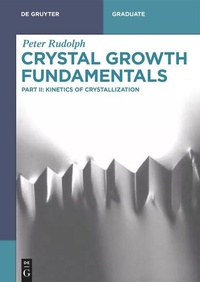
Crystal Growth Fundamentals
Description

More details
Other editions
Additional editions
Persons
Peter Rudolph, Professor Dr. habil, Dr. Ing., was born at July 1 st , 1945 in Gera (Germany). He received the Diploma of Electronic Technology at the Technical University of Lviv (Ukraina) in 1969. The PhD (Dr. Engineer) of Solid State Physics and Technology he obtainted at the same university in 1972. From 1973 to 1993 he was employed at the Institute of Crystallography and Material Science of the Humboldt University in Berlin. In 1985 he became University Professor. During that period he managed the laboratory of crystal growth and growth equipment engineering for IV-VI and II-VI materials. In 1978 and 1992 he prepared crystal growth experiments for manned space flights. From 1991 to 1993 he was member of the expert group of the ESA on melt growth experiments. From 1993 to 1994 and in 1998 he was employed as Guest Professor at the Tohoku University in Sendai (Japan). From 1994 up to 2011 he was employed at the Institute for Crystal Growth in Berlin as head of competence field technology developments (III-Vs and silicon crystallization under magnetic field for PV). After his retirement in 2011 until today he is still active as consultant for crystal growth fundamentals and technology. To date he acted as related lecturer in more than 30 countries. He was a Member of the Executive Committee of International Organisation of Crystal Growth (2004 - 2011) and the President of the German Association for Crystal Growth DGKK (2010 - 2011). In 2004 he was the co-organizer of the the twelfth International Summer School on Crystal Growth (ISSCG-12) in Berlin. In 1990 he was awarded by the Medal of the German Association of Crystallography (VFK). In 2001 and 2008 he was presented with the innovation prize of Berlin-Brandenburg. In 2023 he received the Laudise Prize, the IOCG's highest international award for crystal technology. His publication work comprises 2 monographs, 8 editions (including Vol IIA and IIB of Elsevier's Handbock of Crystal Growth 2015), 32 book contributions, about 230 original papers and 35 patent publications.
Content
- Intro
- About the author
- Contents
- Prologue
- Part II: Kinetics of crystallization
- 1 Introduction
- 1.1 The role of kinetics and some historical remarks
- 1.2 Overview of chronological process events at growing interfaces
- 1.3 General equation of kinetic crystal growth rate
- 2 Atomistic description of crystal faces
- 2.1 Overview on concepts used
- 2.2 Kossel-Stranski model
- 2.2.1 Half-crystal position
- 2.2.2 First approach to the face velocities of a Kossel crystal
- 2.3 Periodic bond chain (PBC) theory of Hartman and Perdok
- 2.4 Surface diffusion within adsorption layer
- 3 Atomistic approach to crystal nucleation
- 3.1 3D nucleation
- 3.1.1 Homogeneous formation of a cubic nucleus
- 3.1.2 Heterogeneous formation of a tetragonal nucleus
- 3.2 2D nucleation
- 3.2.1 Homogeneous formation of a square-shaped nucleus
- 3.2.2 Heterogeneous formation of a square-shaped nucleus
- 3.3 One-dimensional nucleus along a step edge
- 3.4 Statistic theory of thin film condensation of Walton
- 4 Growing interface models
- 4.1 Atomically smooth and rough interfaces - introductory remarks
- 4.2 The interface roughening transition according to the Ising model
- 4.3 The single-layer roughening model of Jackson
- 4.4 Multi-layered model of Temkin
- 4.5 Kinetic roughening
- 4.6 Use of face kinetics for the Czochralski growth of rectangular crystals
- 4.7 Diffuse interface
- 4.8 The influence of melt self-orientation on growth kinetics
- 5 Growth modes
- 5.1 Overview
- 5.2 The continuous growth of an atomically rough interface
- 5.3 Nucleation-forced growth of atomically smooth interface
- 5.3.1 Perfect singular interface
- 5.3.1.1 Introducing remarks
- 5.3.1.2 Growth velocity at mononuclear "born-to-spread" mechanism
- 5.3.1.3 Growth velocity at 2D multinuclear monolayer growth
- 5.3.1.4 Growth velocity at 3D multinuclear growth - kinetic roughening
- 5.3.1.5 Tensile stress generation via lateral island coalescence
- 5.3.1.6 Faceting and twinning probability
- 5.3.2 Vicinal face - step-by-step growth
- 5.3.2.1 Interkink distance along the step
- 5.3.2.2 Growth from vapor
- 5.3.2.3 Growth from solution
- 5.3.2.4 Growth from melt
- 5.3.2.5 Intentional step flow growth at epitaxial processes and interaction with threading dislocations
- 5.3.3 Spiral step flow around screw dislocations
- 5.3.3.1 Normal growth velocity
- 5.3.3.2 Spiral configuration
- 5.4 Summary of growth modes
- 6 Selected cases of step growth instabilities
- 6.1 Introductory remarks
- 6.2 Step bunching
- 6.2.1 Kinematic waves
- 6.2.2 Kinematic shock waves
- 6.2.3 Type II striations
- 6.2.4 Ehrlich-Schwoebel barrier
- 6.3 Step meandering
- 7 Kinetics of impurity and dopant incorporation
- 7.1 Introductory remarks
- 7.2 Trapping at atomically rough interfaces
- 7.3 Trapping at atomically smooth interfaces with flowing steps
- 7.4 Sectorial segregation at bulk growth with partially faceted interface
- 8 Conclusions
- References
- Abbreviations
- Spec boxes
- Index
