

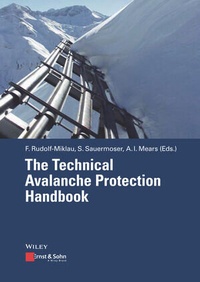
The Technical Avalanche Protection Handbook
Description

Avalanche defence structures and protection systems are used in most inhabited mountain regions worldwide. During the last decades, technical avalanche protection has evolved from a specialist field to an independent engineering branch that has gained importance in alpine countries such as Austria, Italy, France and Switzerland, as well as in other countries such as Canada, Iceland, Norway and USA.
This work is the first comprehensive, English-language overview of technical avalanche protection and establishes state-of-the-art best practices in the field. It covers the fundamentals of avalanche protection technology and includes plans, dimensions, construction and maintenance of defence structures. The editors have collaborated with an international team of experts from Austria, Canada, France, Iceland, Italy, Japan, Norway, Switzerland and USA to produce this landmark handbook.
More details
Other editions
Additional editions
Persons
Dipl.-Ing. Dr. Florian Rudolf-Miklau is an expert on torrent and avalanche control. In 2002 he became an advisor for technical protection and project financing at the Federal Ministry of Agriculture, Forestry, Environment and Water Management in Vienna. He is Chair of the Austrian standards committee ON-K 256 "Protection against natural hazards" and member of the advisory board of the INTERPRAEVENT research society as well as lecturer at the University of Natural Resources and Life Sciences and Vienna Technical University. He also acts as a court-certified expert.
Dipl.-Ing. Siegfried Sauermoser is director of the Tyrolean Section of the Forest Engineering Service in Torrent and Avalanche Control in Innsbruck, Austria. He has 12 years of work experience as project manager for avalanche barriers. He acts as Lecturer at the University of Vienna, University of Innsbruck and University Center Svalbard in Spitzbergen, Norway. He is a juridical certified expert for torrent and avalanche protection structures and a member of the Austrian Board for Alpine Safety.
Arthur I. Mears, P.E., has a B.S. in Civil Engineering and an M.S. in Geology from the University of Colorado in Boulder, USA. Based in Gunnison, he founded Arthur I. Mears, P.E., Inc. in 1981, specializing in avalanche, rockfall and debris-flow analysis and mitigation. He has been a consultant for over 1000 projects in 9 states and 8 countries.
The contributors to the handbook are leading European and American experts in avalanche protection.
Content
Avalanches: formation and effects
Basics and models for avalanche dynamics and effects
Analysis and evaluation and representation of avalanche risks
Planning of permanent avalanche protection measures
Protection systems and construction types
Design of permanent avalanche protection
Execution and maintenance management
Protection of buildings
Temporary avalanche protection and operation
Avalanche monitoring and event documentation
Summary, Outlook
References
1
Introduction
Siegfried Sauermoser, Florian Rudolf-Miklau and Stefan Margreth
1.1 Avalanche Hazards
1.1.1 Overview and Terminology
Avalanches are defined as large masses of snow or ice that move rapidly down a mountainside or over a precipice. The term snow avalanche is more accurate to make the conceptual demarcation from other types of avalanches such as rock avalanches or mud flows. According to ONR 24 805, 3.34 [202], snow avalanches are characterized by rapid movement of snow masses that were triggered from the snow cover. Snow avalanches that cause human losses as well as severe property and environmental damage are classified as natural catastrophes.
Throughout history, avalanches have had a major impact on the development of settlements in mountain regions (Figure 1.1). This influence is obvious from the location and structure of historical villages and traffic routes. Typical toponyms like Lähn or Lavin indicate old avalanche paths and are probably derived from the Latin terms labi (gliding down) and labes (falling) [7]. For many centuries, humans were not able to protect themselves effectively from avalanche hazards and resorted to simplistic solutions such as avoiding areas at risk. Despite the sparse population in Alpine regions, major avalanche disasters with numerous victims occurred repeatedly in history, as people were not able to assess the risk of these infrequent but catastrophic events.
Fig. 1.1 Alpine living space, shaped by avalanches (© Sauermoser)
In the last century, increasing populations in the Alps (1870: 7.8 million; 2010: 13.6 million) in combination with growing demands for mobility and leisure activities in Alpine terrain have increased avalanche risk significantly. Traditionally, Alpine valleys were scarcely populated apart from mountain farms, whereas today there are a wide range of competing interests in land use such as settlement developments, traffic, trade and industry, tourism and recreation facilities. This has created progressive consumption of land and use of higher risk areas for building. Some Alpine valleys in well-developed regions are subject to urban sprawl and in areas where tourism is the only profitable economic branch, intensive development of higher elevation areas has occurred, especially for skiing. Though depopulation has been reported in infrastructure-poor mountain regions (mountain escape), the Alps will be subject to intensive land use in the future as well since mountains are a sustainable source of natural resources (timber, water, renewable energy and mining).
Increasing traffic density and volume of transportation have resulted in a growing demand for efficient and safe transit corridors across the Alps (e.g. Tenda, Fréjus, Mont Blanc tunnel, Simplon pass, Lötschberg tunnel, St. Gotthard, San Bernadino, Arlberg, Reschen pass, Brenner, Felbertauern, Tauern and Katschberg tunnel, Tauern railway Böckstein/Mallnitz, Gesäuse railway). Outdoor leisure activities and sports (mountaineering, mountain biking, skiing, hunting) have increased human activity in higher elevation areas. In the last decades, the majority of avalanche victims have been skiers off marked slopes as well as ski tourers and free riders.
Increased human impact is noticeable in the European Alps and can be expected in the future in other mountain regions around the world. Avalanche risk and safety expectations have increased significantly while the risk acceptance of a modern society is constantly decreasing. Consequently, the demand for technical avalanche protection in the Alps increased within a short time and prompted rapid development in defense technology. The diverse technological innovations included both new types of avalanche defense structures with permanent protection effects and high-tech systems with temporary protection effects, especially for monitoring and detection of descent or artificial release of avalanches. The establishment of the field of technical avalanche defense as a stand-alone engineering discipline shows the central role avalanches play in mountain regions.
1.1.2 Avalanche Hazards: Historical and Geographical Relevance
An avalanche hazard refers simply to a source of potential harm, and is a function of the likelihood of triggering and the destructive size of an avalanche. The different dimensions of avalanche hazards are expressed in the five-point European Avalanche Hazard Scale [79] (Table 4.1). Avalanche risk must relate to a specific element at risk, for example people, buildings, vehicles, or infrastructure. Avalanche risk is determined by the exposure of that element and its vulnerability to the avalanche hazard. Avalanche hazards are not necessarily related to catastrophic events. Most of the avalanche accidents causing loss of human life occur in unsecured areas where the people involved actually triggered the avalanche. These so-called tourist avalanches happen frequently but generally do not affect settlement areas, traffic routes or infrastructure and thus are not considered target areas for permanent technical defense structures (also for economic reasons). As avalanche size increases, the probability of occurrence decreases but settlements and traffic routes may also be affected. For example, a so-called hundred-year avalanche represents an event that occurs - from a statistical point of view - on average once every 100 years.
Snow avalanches can occur anywhere where sufficient snowfall occurs within a short time on slopes with an inclination of more than 30 degrees. Avalanches occur throughout the Alps and many other mountain ranges in the world including the Pyrenees, Apennines, Norwegian Fjordland, Iceland (Figure 1.2), Rocky Mountains, Andes, Japanese and New Zealand Alps, Elbrus mountains, Hindu Kusch, Pamir mountain range, Russian Altai and Baikal mountains, Chinese Tianshan or Himalayas (Figure 1.3). In ancient times, the Greek geographer Strabon (63 BC to 23 AC) documented avalanche events in the Caucasus Mountains in his scriptures 'Geographica'. In Austria, more than 6000 avalanche paths have a potential impact on settlement areas [35] and countless other avalanches occur in undeveloped mountain areas or remote, seasonally used regions. In Switzerland, more than 20 000 dangerous avalanches are known. The capital of Alaska, Juneau, is an example of an urban area at high-risk from avalanches [60] (Figure 4.5).
Fig. 1.2 The Icelandic village Seydisfjördur is a high-risk area for avalanches (© Sauermoser)
Fig. 1.3 Global overview of mountain regions with potential avalanche hazards (originally elaborated by Glazovszkaya [78]) (The map is only a rough presentation, as no exact survey was carried out)
1.2 Technical Avalanche Defense: Classification
1.2.1 Classification Scheme of Defense Measures and Their Effects
An avalanche hazard is not absolute, but is relative to an element at risk. Avalanche defense measures are also designed relative to a specific scenario, and several such measures are presented in this book. In countries where avalanche risk is considered substantial, avalanche defense should use a holistic approach that considers various relevant protection goals and possible measures.
Avalanche defense refers to any measure in the catchment area of an avalanche used to achieve the targeted protection goal [202], and is classified as follows [161]:
- - Active defense measures prevent avalanches from starting or act directly on the flow process, and
- - Passive defense measures mitigate the consequences of a potential avalanche hazard.
Active measures are appropriate to reduce the frequency of hazardous avalanches or directly decrease the intensity of the avalanche process. In contrast, passive measures reduce either the damage potential or the vulnerability of objects at risk.
Avalanche defense measures provide either permanent (constantly effective) or temporary (time-limited effect, adjusted to a specific situation) protection [222]. Table 1.1 gives an overview of the classification scheme of avalanche defense measures.
Table 1.1 Classification scheme of avalanche defense measures
Defense measure Permanent effect Temporary effect Active Precautionary effect Reducing the disposition for an event Forest and bioengineering measures (protection forest, high-altitude afforestation)Avalanche defense structures: snow supporting structures, snowdrift control structures Artificial release of avalanches Acting directly on the avalanche process Avalanche defense structures: dams, breakers, tunnels, galleries Closure for roads Evacuation (of buildings at acute risk) Reaction to an event Emergency measures (after an event)
Catastrophe management Passive Precautionary effect Legal measures (regulations, prohibitions)
Hazard mapping
Planning measures (land use planning)
Administrative measures (building permission, relocation of buildings at risk)
Structural building (object) protection
Catastrophe...
