

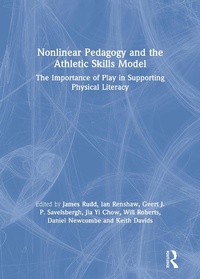
Nonlinear Pedagogy and the Athletic Skills Model
The Importance of Play in Supporting Physical Literacy
1st Edition
Published on 27. June 2021
194 pages
978-1-000-40245-2 (ISBN)
Description

This book offers an ecological conceptualisation of physical literacy. Re-embracing our ancestry as hunter gatherers we gain a new appreciation and understanding of the importance of play, not only in terms of how children learn, but also in showing us as educators how we can lay the foundations for lifelong physical activity. The concept of physical literacy has been recognised and understood throughout history by different communities across the globe. Today, as governments grapple with the multiple challenges of urban life in the 21st century, we can learn from our forebears how to put play at the centre of children's learning in order to build a more enduring physically active society.
This book examines contemporary pedagogical approaches, such as constraints-led teaching, nonlinear pedagogy and the athletic skills model, which are underpinned by the theoretical framework of Ecological Dynamics. It is suggested that through careful design, these models, aimed at children, as well as young athletes, can (i) encourage play and facilitate physical activity and motor learning in children of different ages, providing them with the foundational skills needed for leading active lives; and (ii), develop young athletes in elite sports programmes in an ethical, enriching and supportive manner.
Through this text, scientists, academics and practitioners in the sub-disciplines of motor learning and motor development, physical education, sports pedagogy and physical activity and exercise domains will better understand how to design programmes that encourage play and thereby develop the movement skills, self-regulating capacities, motivation and proficiency of people, so that they can move skilfully, effectively and efficiently while negotiating changes throughout the human lifespan.
This book examines contemporary pedagogical approaches, such as constraints-led teaching, nonlinear pedagogy and the athletic skills model, which are underpinned by the theoretical framework of Ecological Dynamics. It is suggested that through careful design, these models, aimed at children, as well as young athletes, can (i) encourage play and facilitate physical activity and motor learning in children of different ages, providing them with the foundational skills needed for leading active lives; and (ii), develop young athletes in elite sports programmes in an ethical, enriching and supportive manner.
Through this text, scientists, academics and practitioners in the sub-disciplines of motor learning and motor development, physical education, sports pedagogy and physical activity and exercise domains will better understand how to design programmes that encourage play and thereby develop the movement skills, self-regulating capacities, motivation and proficiency of people, so that they can move skilfully, effectively and efficiently while negotiating changes throughout the human lifespan.
More details
Edition
1. Auflage
Language
English
Place of publication
London
United Kingdom
Publishing group
Taylor & Francis Ltd
Target group
College/higher education
Professional and scholarly
Product notice
Reflowable
Illustrations
10 Tables, color; 21 Line drawings, color; 32 Halftones, color; 53 Illustrations, color
ISBN-13
978-1-000-40245-2 (9781000402452)
Copyright in bibliographic data and cover images is held by Nielsen Book Services Limited or by the publishers or by their respective licensors: all rights reserved.
Schweitzer Classification
Other editions
Additional editions
James Rudd | Ian Renshaw | Geert Savelsbergh
Nonlinear Pedagogy and the Athletic Skills Model
The Importance of Play in Supporting Physical Literacy
Book
06/2021
1st Edition
Routledge
€192.21
Shipment within 15-20 days
James Rudd | Ian Renshaw | Geert Savelsbergh
Nonlinear Pedagogy and the Athletic Skills Model
The Importance of Play in Supporting Physical Literacy
Book
06/2021
1st Edition
Routledge
€57.50
Shipment within 15-20 days
Persons
James Rudd is a senior lecturer in Physical Education at Liverpool John Moores University, UK; his research interests are in the areas of pedagogy, child development and motor learning.
Ian Renshaw is an associate professor of Human Movement and Sports Science at Queensland University of Technology, Autralia.
Geert J.P. Savelsbergh is head of the Motor Learning & Performance section of the Amsterdam Movement Sciences & Institute for Brain and Behaviour at the Vrije Universteit, Netherlands.
Jia Yi Chow is currently the Associate Dean, Programme and Student Development, with the Office of Teacher Education (OTE), National Institute of Education (NIE), Nanyang Technological University (NTU), Singapore.
Will Roberts is a senior lecturer in Sport and Exercise Science, and Academic Course Lead for the MSci/BSc in Sport Coaching Science at the University of Gloucestershire, UK.
Daniel Newcombe is a senior lecturer on the Sport, Coaching & PE degree at Oxford Brookes University, UK.
Keith Davids is professor of Motor Learning in the Sport & Human Performance research group at Sheffield Hallam University, UK (2014 onwards), investigating skill acquisition, expertise and talent development in sport.
Ian Renshaw is an associate professor of Human Movement and Sports Science at Queensland University of Technology, Autralia.
Geert J.P. Savelsbergh is head of the Motor Learning & Performance section of the Amsterdam Movement Sciences & Institute for Brain and Behaviour at the Vrije Universteit, Netherlands.
Jia Yi Chow is currently the Associate Dean, Programme and Student Development, with the Office of Teacher Education (OTE), National Institute of Education (NIE), Nanyang Technological University (NTU), Singapore.
Will Roberts is a senior lecturer in Sport and Exercise Science, and Academic Course Lead for the MSci/BSc in Sport Coaching Science at the University of Gloucestershire, UK.
Daniel Newcombe is a senior lecturer on the Sport, Coaching & PE degree at Oxford Brookes University, UK.
Keith Davids is professor of Motor Learning in the Sport & Human Performance research group at Sheffield Hallam University, UK (2014 onwards), investigating skill acquisition, expertise and talent development in sport.
Content
Section 1: Theoretical Positioning of Physical Literacy
1. Time for a Rethink: Why a New Approach to Physical Literacy is Needed
2. Understanding the Ecological Roots of Physical Literacy and How We Can Build on this to Move Forward
3. What Physical Literacy in the Community Can Teach Us: Learning Designs in Natural Settings
Section 2: Contemporary Approaches for Operationalising Physical Literacy
4. Motor Learning and Why It Matters: How We Teach Physical Literacy
5. Nonlinear Pedagogy: A New Framework for Designing Learning Environments for Sport, Physical Education and Recreational Activities
6. Practitioners as Architects of the Environment: How We Can Use Environmental Design Principles to Support Physical Literacy
7. The Athletic Skills Model: Enhancing Physical Literacy across the Life-span
Section 3: Further Considerations and Future Direction of Research and Practice in Physical Literacy
8. A More Holistic Way of Measuring Physical Literacy
9. What We Have Learned and the way Forward
Section 4: Exploring New Avenues of Research to Understand Physical Literacy
10. Physical Education: Combining Movement Education and Nonlinear Pedagogy to Provide Meaningful Physical Education Experiences
11. Boing and Physical Literacy: A Play Based Movement Programme for Community, School and Sport
12. High Performers: Physical Literacy is Still an Important Consideration
13. Measuring Physical Literacy: A Fresh Approach
14. Development of Creative Movement through Enriched Game Design
1. Time for a Rethink: Why a New Approach to Physical Literacy is Needed
2. Understanding the Ecological Roots of Physical Literacy and How We Can Build on this to Move Forward
3. What Physical Literacy in the Community Can Teach Us: Learning Designs in Natural Settings
Section 2: Contemporary Approaches for Operationalising Physical Literacy
4. Motor Learning and Why It Matters: How We Teach Physical Literacy
5. Nonlinear Pedagogy: A New Framework for Designing Learning Environments for Sport, Physical Education and Recreational Activities
6. Practitioners as Architects of the Environment: How We Can Use Environmental Design Principles to Support Physical Literacy
7. The Athletic Skills Model: Enhancing Physical Literacy across the Life-span
Section 3: Further Considerations and Future Direction of Research and Practice in Physical Literacy
8. A More Holistic Way of Measuring Physical Literacy
9. What We Have Learned and the way Forward
Section 4: Exploring New Avenues of Research to Understand Physical Literacy
10. Physical Education: Combining Movement Education and Nonlinear Pedagogy to Provide Meaningful Physical Education Experiences
11. Boing and Physical Literacy: A Play Based Movement Programme for Community, School and Sport
12. High Performers: Physical Literacy is Still an Important Consideration
13. Measuring Physical Literacy: A Fresh Approach
14. Development of Creative Movement through Enriched Game Design
