

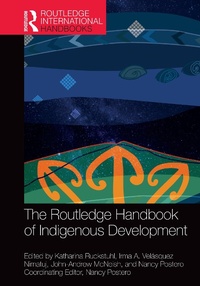
The Routledge Handbook of Indigenous Development
1st Edition
Published on 30. November 2022
538 pages
978-1-000-77033-9 (ISBN)
Description

This Handbook inverts the lens on development, asking what Indigenous communities across the globe hope and build for themselves. In contrast to earlier writing on development, this volume focuses on Indigenous peoples as inspiring theorists and potent political actors who resist the ongoing destruction of their livelihoods. To foster their own visions of development, they look from the present back to Indigenous pasts and forward to Indigenous futures.
Key questions:
How do Indigenous theories of justice, sovereignty, and relations between humans and non-humans inform their understandings of development?
How have Indigenous people used Rights of Nature, legal pluralism, and global governance systems to push for their visions?
How do Indigenous relations with the Earth inform their struggles against natural resource extraction?
How have native peoples negotiated the dangers and benefits of capitalism to foster their own life projects?
How do Indigenous peoples in diaspora and in cities around the world contribute to Indigenous futures?
How can Indigenous intellectuals, artists, and scientists control their intellectual property and knowledge systems and bring into being meaningful collective life projects?
The book is intended for Indigenous and non-Indigenous activists, communities, scholars, and students. It provides a guide to current thinking across the disciplines that converge in the study of development, including geography, anthropology, environmental studies, development studies, political science, and Indigenous studies.
Key questions:
How do Indigenous theories of justice, sovereignty, and relations between humans and non-humans inform their understandings of development?
How have Indigenous people used Rights of Nature, legal pluralism, and global governance systems to push for their visions?
How do Indigenous relations with the Earth inform their struggles against natural resource extraction?
How have native peoples negotiated the dangers and benefits of capitalism to foster their own life projects?
How do Indigenous peoples in diaspora and in cities around the world contribute to Indigenous futures?
How can Indigenous intellectuals, artists, and scientists control their intellectual property and knowledge systems and bring into being meaningful collective life projects?
The book is intended for Indigenous and non-Indigenous activists, communities, scholars, and students. It provides a guide to current thinking across the disciplines that converge in the study of development, including geography, anthropology, environmental studies, development studies, political science, and Indigenous studies.
More details
Series
Edition
1. Auflage
Language
English
Place of publication
London
United Kingdom
Publishing group
Taylor & Francis Ltd
Target group
College/higher education
Professional and scholarly
Product notice
Reflowable
Illustrations
7 Tables, black and white; 5 Line drawings, black and white; 17 Halftones, black and white; 22 Illustrations, black and white
ISBN-13
978-1-000-77033-9 (9781000770339)
Copyright in bibliographic data and cover images is held by Nielsen Book Services Limited or by the publishers or by their respective licensors: all rights reserved.
Schweitzer Classification
Other editions
Additional editions
Katharina Ruckstuhl | Irma A. Velasquez Nimatuj | John-Andrew McNeish
The Routledge Handbook of Indigenous Development
Book
03/2025
1st Edition
Routledge
€71.80
Shipment within 15-20 days
Katharina Ruckstuhl | Irma A. Velasquez Nimatuj | John-Andrew McNeish
The Routledge Handbook of Indigenous Development
Book
11/2022
1st Edition
Routledge
€306.60
Shipment within 15-20 days
Persons
Katharina Ruckstuhl is a Maori (Ngai Tahu and Rangitane) Associate Professor at the Otago Business School, University of Otago, Aotearoa New Zealand.
Irma A. Velasquez Nimatuj is a Maya-K'iche' Guatemalan journalist, social anthropologist, and international spokeswoman who has been at the forefront in struggles for respect for Indigenous cultures.
John-Andrew McNeish is Professor of International Environment and Development Studies at the Norwegian University of Life Sciences (NMBU) in Oslo, Norway.
Nancy Postero is a Professor of Sociocultural Anthropology at the University of California San Diego in the United States.
Irma A. Velasquez Nimatuj is a Maya-K'iche' Guatemalan journalist, social anthropologist, and international spokeswoman who has been at the forefront in struggles for respect for Indigenous cultures.
John-Andrew McNeish is Professor of International Environment and Development Studies at the Norwegian University of Life Sciences (NMBU) in Oslo, Norway.
Nancy Postero is a Professor of Sociocultural Anthropology at the University of California San Diego in the United States.
Content
Part I - Retheorizing Development Chapter 1 - Indigenous Development as Flourishing Intergenerational Relationships Chapter 2 - Violent Colonialism: The Doctrine of Discovery and its Historical Continuity Chapter 3 - Capitalism and Development Chapter 4 - Refusing Development and the Death of Indigenous Life Chapter 5 - Two-Spirit Issues in Development Chapter 6 - The struggles of Tseltal women and Caring for the Earth: reflections on sustaining life-existence in times of the pandemic Chapter 7 - Towards a Plurinational State in Guatemala Chapter 8 - Pluck the Stars from the Sky: The Pluriverse of Adivasi Health in India Part II - Law, Self-Governance, and Security Chapter 9 - The Inca and Indigenous Development: Recalling A Native American Empire in South America Chapter 10 - Indians and the State: Negotiating Progress, Modernity, and Development in Bolivia Chapter 11 - The Constituent Process in Chile (2019-2022) from the Perspective of Indigenous Peoples Chapter 12 - Negotiating Legal Pluralism and Indigenous Development: Lessons From BoliviaChapter 13 - Sami Political Shifts - from assimilation, via invisibility to indigenization? Chapter 14 - Reflections on a career in Indigenous Intellectual Property Nga Taonga Tuku Iho Chapter 15 - Maya K'iche' community responses to gender violence in Santa Cruz del Quiche, Guatemala Chapter 16 - Reconceptualizing Gendered Violence: Indigenous Women's Life Projects and Solutions Chapter 17 - Indigenous Autonomy: Opportunities and Pitfalls Chapter 18 - The implementation paradox: Ambiguities of prior consultation and free, prior, and informed consent (FPIC) for Indigenous peoples' agency in resource extraction in Latin America Chapter 19 - Indigenous-led spaces in environmental governance: Implications for self-determined development Part III - Relations with the Earth Chapter 20 - The Role of Traditional Environmental Knowledge in Planetary Well-Being Chapter 21 - Building Kia?i Futures: Pu?uhonua o Pu?uhuluhulu and Protecting Mauna Kea Chapter 22 - Place attachment, sacred geography, and solidarity: Indigenous conceptions of development as meaningful life in Mongolia and Norway Chapter 23 - Development & Territorial Control Chapter 24 - Indigenous Peoples: Extraction and Extractivism Chapter 25 - Rights of Nature: Law as a Tool for Indigenous-led Development Chapter 26 - Indigenous Peoples and International Institutions: Indigenous Peoples' Diplomacies at the United Nations Chapter 27 - Science, Technology and Indigenous Development Part IV - Engaging with Capitalism Chapter 28 - Colonial Potosi: Setting the stage for global capitalist development Chapter 29 - Mapuche's disagreements with development: a critical perspective from local spaces Chapter 30 - Nga Whai Take: Reframing Indigenous Development Chapter 31 - Chickasaw Spring: Economic Development and Resurgent Sovereignty Chapter 32 - Ser Camaleon: Indigenous Community-Based Tourism for Emancipatory Futures Chapter 33 - Indigenous Development: The Role of Indigenous Values and Traditions for Restoring Indigenous Food Sovereignty Chapter 34 - External Facilitators, Tourism, and Indigenous Development: Insights from Bangladesh Part V - Migration and City Life Chapter 35 - Indigenous Mobilities Chapter 36 - From Runas to Universal Travelers: The Case of the Kichwa Nationality-Otavalo Pueblo. A Liberating Experience of Development Chapter 37 - Imazighen of France: Developing Indigeneity in Diaspora Chapter 38 - Communal Labor and Sharing Systems Chapter 39 - Miskitu Migrants Facing the Pandemic Together in Panama Chapter 40 - Fighting and Surviving in Oaxacalifornia Chapter 41 - Lessons from Cahokia: Indigeneity and the Future of the Settler City Chapter 42 - Designing Decolonization? Architecture and Indigenous Development Chapter 43 - Urban Futurities: Identity, Place and Property Development by Indigenous Communities in the City Part VI - Looking to the Future Chapter 44 - Literatures in Indigenous Languages and Education as Development Chapter 45 - Giving Form to Indigenous Futures Through Monumental Architecture, Art, and Technology Chapter 46 - Fourth World Filmic Interventions Chapter 47 - Indigenous Online Chapter 48 - Indigenous Youth in Intercultural Universities: New Sites of Knowledge Production and Leadership Training in Mexico and Latin America Chapter 49 - Indigenous Data Futures: Empowering the Next One-Hundred Generations Chapter 50 - Climate change and sustainable development in the Pacific: the case of Samoa Part VII - Concluding Voices Chapter 51 - The Power of Our Present Futures Chapter 52 - In Canamomo Lomaprieta, We Grow Life
