

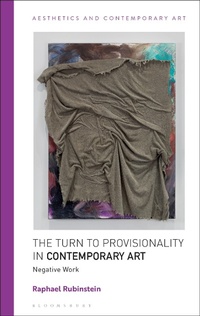
The Turn to Provisionality in Contemporary Art
Negative Work
1st Edition
Published on 12. January 2023
168 pages
978-1-350-24372-9 (ISBN)
Description

In his influential essay "Provisional Painting," Raphael Rubinstein applied the term "provisional" to contemporary painters whose work looked intentionally casual, dashed-off, tentative, unfinished or self-cancelling; who appeared to have deliberately turned away from "strong" painting for something that seemed to constantly risk failure or inconsequence.
In this collection of essays, Rubinstein expands the scope of his original article by surveying the historical and philosophical underpinnings of provisionality in recent visual art, as well as examining the works of individual artists in detail. He also engages crucial texts by Samuel Beckett and philosopher Gianni Vattimo.
Re-examining several decades of painting practices, Rubinstein argues that provisionality, in all its many forms, has been both a foundational element in the history of modern art and the encapsulation of an attitude that is profoundly contemporary.
In this collection of essays, Rubinstein expands the scope of his original article by surveying the historical and philosophical underpinnings of provisionality in recent visual art, as well as examining the works of individual artists in detail. He also engages crucial texts by Samuel Beckett and philosopher Gianni Vattimo.
Re-examining several decades of painting practices, Rubinstein argues that provisionality, in all its many forms, has been both a foundational element in the history of modern art and the encapsulation of an attitude that is profoundly contemporary.
More details
Series
Edition
1. Auflage
Language
English
Place of publication
London
United Kingdom
Publishing group
Bloomsbury Publishing PLC
Target group
College/higher education
Illustrations
5 bw illus
ISBN-13
978-1-350-24372-9 (9781350243729)
Copyright in bibliographic data and cover images is held by Nielsen Book Services Limited or by the publishers or by their respective licensors: all rights reserved.
Schweitzer Classification
Other editions
Additional editions
Book
07/2024
Bloomsbury Academic
€55.89
Shipment within 15-20 days
Book
01/2023
Bloomsbury Academic
€117.10
Shipment within 15-20 days
Person
Raphael Rubinstein is Professor of Critical Studies at the University of Houston, USA. He is a New York based art critic and in 2002, the French government presented him with the award of Chevalier in the Order of Arts and Letters. In 2010, his blog The Silo won a Creative Capital/Warhol Foundation Arts Writers Grant. In 2014 The Silo was given a Best Blog Award of Excellence by the International Association of Art Critics. In April 2017, The Miraculous: Houston, a public-art installation by artist and wife Heather Bause Rubinstein, based on his book The Miraculous, debuted as part of the CounterCurrent Festival.
Content
List of Figures
Acknowledgements
Introduction
Part I: What is Provisional Painting?
1. Provisional Painting (2009)
2. To Rest Lightly on the Earth (2011)
3. Painting the Stuckness: Samuel Beckett, Bram Van Velde, Georges Duthuit
4. Weak Thought, Strong Painting (Gianni Vattimo)
5. A Precarious Chain of Signifiers
Part II: Varieties of the Provisional
6. Some Precursors: Dorothea Rockburne, Pat Steir, Joan Snyder, Chris Reinecke, Sigmar Polke, Carmengloria Morales, Suh Se-ok, Nahum Tevet, Gérard Gasiorowski, Pierre Buraglio
7. Varieties of the Provisional: Michael Krebber, Albert Oehlen, Rachel Hecker, Amy Feldman
8. Painting As Is (Luca Bertolo and Co.)
9. In Glimpses: David Hammons's Tarp Paintings
Conclusion: After Provisional Painting
Notes
Bibliography
Index
Acknowledgements
Introduction
Part I: What is Provisional Painting?
1. Provisional Painting (2009)
2. To Rest Lightly on the Earth (2011)
3. Painting the Stuckness: Samuel Beckett, Bram Van Velde, Georges Duthuit
4. Weak Thought, Strong Painting (Gianni Vattimo)
5. A Precarious Chain of Signifiers
Part II: Varieties of the Provisional
6. Some Precursors: Dorothea Rockburne, Pat Steir, Joan Snyder, Chris Reinecke, Sigmar Polke, Carmengloria Morales, Suh Se-ok, Nahum Tevet, Gérard Gasiorowski, Pierre Buraglio
7. Varieties of the Provisional: Michael Krebber, Albert Oehlen, Rachel Hecker, Amy Feldman
8. Painting As Is (Luca Bertolo and Co.)
9. In Glimpses: David Hammons's Tarp Paintings
Conclusion: After Provisional Painting
Notes
Bibliography
Index
