

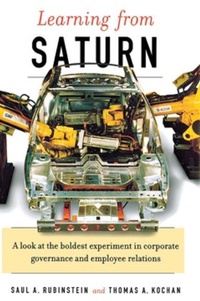
Learning From Saturn
Possibilities for Corporate Governance and Employee Relations
1st Edition
Published on 18. October 2018
176 pages
978-1-5017-1860-1 (ISBN)
Description

The last two decades of the twentieth century were a tumultuous time of innovation for business and labor. Perhaps the boldest and most far-reaching experiment in industry was the creation of the Saturn Corporation. Working together as partners, the UAW and General Motors built a new small car in Spring Hill, Tennessee, with American suppliers and American workers. Saturn's locally designed manufacturing system featured self-directed teams and the integration of union representatives into management's strategic and operational decision-making processes. Saul A. Rubinstein and Thomas A. Kochan have followed the Saturn story since its beginning in 1983. Through surveys as well as hundreds of interviews with company managers, union representatives, and employees, and with leaders of GM and the UAW, they trace the history of, and the lessons to be learned from, this "Different Kind of Company." The Saturn experiment embodied a new concept of labor-management relations, management, and organizational governance. Has it been a success or a failure? Is it relevant in the current industrial environment? What effect has it had on GM and the UAW? The authors resist overly simplistic conclusions; Saturn's strengths and limitations must be fairly assessed before the company's experience can provide lessons on the future of unions, labor-management relations, work organization, and corporate governance.
More details
Other editions
Additional editions
Saul A. Rubinstein | Thomas A. Kochan
Learning from Saturn
Possibilities for Corporate Governance and Employee Relations
Book
03/2001
ILR Press
€63.14
Shipment within 10-20 days
Persons
RubinsteinSaul A.:
Saul A. Rubinstein is Assistant Professor in the School of Management and Labor Relations at Rutgers University.KochanThomas A.:
Thomas A. Kochan is the George M. Bunker Professor of Management at MIT's Sloan School of Management. He is coeditor of Negotiations and Change and After Lean Production and coauthor with Saul A. Rubinstein of Learning from Saturn, all from Cornell.
Saul A. Rubinstein is Assistant Professor in the School of Management and Labor Relations at Rutgers University.KochanThomas A.:
Thomas A. Kochan is the George M. Bunker Professor of Management at MIT's Sloan School of Management. He is coeditor of Negotiations and Change and After Lean Production and coauthor with Saul A. Rubinstein of Learning from Saturn, all from Cornell.
Content
- Cover
- LEARNING FROM SATURN: POSSIBILITIES FOR CORPORATE GOVERNANCE AND EMPLOYEE RELATIONS
- Title
- Copyright
- Dedication
- Contents
- Acknowledgments
- Chapter 1 What's at Stake Here?
- Chapter 2 Walter Reuther's Legacy: The Ideas behind Saturn
- Chapter 3 The Partnership in Action
- Chapter 4 Reinventing the Local Union
- Chapter 5 Boundary Management and Learning Disabilities
- Chapter 6 What Have We Learned?
- Notes
- Index
