

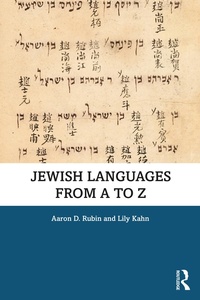
Jewish Languages from A to Z
1st Edition
Published on 13. September 2020
246 pages
978-1-351-04343-4 (ISBN)
Description

Jewish Languages from A to Z provides an engaging and enjoyable overview of the rich variety of languages spoken and written by Jews over the past three thousand years.
The book covers more than 50 different languages and language varieties. These include not only well-known Jewish languages like Hebrew, Yiddish, and Ladino, but also more exotic languages like Chinese, Esperanto, Malayalam, and Zulu, all of which have a fascinating Jewish story to be told. Each chapter presents the special features of the language variety in question, a discussion of the history of the associated Jewish community, and some examples of literature and other texts produced in it. The book thus takes readers on a stimulating voyage around the Jewish world, from ancient Babylonia to 21st-century New York, via such diverse locations as Tajikistan, South Africa, and the Caribbean. The chapters are accompanied by numerous full-colour photographs of the literary treasures produced by Jewish language-speaking communities, from ancient stone inscriptions to medieval illuminated manuscripts to contemporary novels and newspapers.
This comprehensive survey of Jewish languages is designed to be accessible to all readers with an interest in languages or history, regardless of their background-no prior knowledge of linguistics or Jewish history is assumed.
The book covers more than 50 different languages and language varieties. These include not only well-known Jewish languages like Hebrew, Yiddish, and Ladino, but also more exotic languages like Chinese, Esperanto, Malayalam, and Zulu, all of which have a fascinating Jewish story to be told. Each chapter presents the special features of the language variety in question, a discussion of the history of the associated Jewish community, and some examples of literature and other texts produced in it. The book thus takes readers on a stimulating voyage around the Jewish world, from ancient Babylonia to 21st-century New York, via such diverse locations as Tajikistan, South Africa, and the Caribbean. The chapters are accompanied by numerous full-colour photographs of the literary treasures produced by Jewish language-speaking communities, from ancient stone inscriptions to medieval illuminated manuscripts to contemporary novels and newspapers.
This comprehensive survey of Jewish languages is designed to be accessible to all readers with an interest in languages or history, regardless of their background-no prior knowledge of linguistics or Jewish history is assumed.
Reviews / Votes
'Finally! A book for the general public about Jewish languages that's as informative as it is enjoyable... This book is a must-read for anyone interested in languages, Jewish history, or both.'- Sarah Bunin Benor, Director of the Jewish Language Project and co-editor of the Journal of Jewish Languages
'At last a book on Jewish languages worldwide for curious readers beyond the academy! This book tells us all about not only Hebrew, Yiddish, Ladino and Jewish Persian, but Jewish Provencal and a dictionary in Yiddish of pidgin Zulu for Jews working in early 20th-century South Africa! A buffet in book form.'
- John H McWhorter, Professor of Linguistics, Columbia University
'From Amharic to Zulu, Aaron Rubin and Lily Kahn's delightful new book looks at the linguistic heritage of Jews across the world... Such examples of English written in Hebrew are notably few, particularly considering the language is the most common now spoken among diaspora Jews. For as Aaron D Rubin and Lily Kahn show in their new book, Jewish Languages From A to Z, Jewish communities in the past often transcribed the language of their countries of residence into Hebrew characters.'
- Simon Rocker, How Maimonides is linked to the first mention of pizza, The Jewish Chronicle, www.thejc.com, October 26, 2020
More details
Edition
1. Auflage
Language
English
Place of publication
London
United Kingdom
Publishing group
Taylor & Francis Ltd
Target group
College/higher education
Illustrations
9 Tables, black and white; 52 Halftones, color; 52 Illustrations, color
ISBN-13
978-1-351-04343-4 (9781351043434)
Copyright in bibliographic data and cover images is held by Nielsen Book Services Limited or by the publishers or by their respective licensors: all rights reserved.
Schweitzer Classification
Other editions
Additional editions
Aaron D. Rubin | Lily Kahn
Jewish Languages from A to Z
Book
09/2020
1st Edition
Routledge
€73.60
Shipment within 10-20 days
Aaron D. Rubin | Lily Kahn
Jewish Languages from A to Z
Book
09/2020
1st Edition
Routledge
€215.41
Shipment within 10-20 days
Persons
Aaron D. Rubin is Malvin E. and Lea P. Bank Professor of Classics and Ancient Mediterranean Studies, Jewish Studies, and Linguistics at Penn State University.
Lily Kahn is Professor of Hebrew and Jewish Languages at University College London.
Lily Kahn is Professor of Hebrew and Jewish Languages at University College London.
Content
Contents
Acknowledgements
Introduction
Amharic
Arabic, Medieval
Arabic, Modern
Aramaic, Ancient and Medieval
Aramaic, Modern
Armenian
Catalan
Chinese
English
Esperanto
French
Georgian
German
Greek
Hebrew, Inscriptional
Hebrew, Biblical
Hebrew, Rabbinic and Medieval
Hebrew, Enlightenment
Hebrew, Modern
Hungarian
Israeli Sign Language
Italian
Karaim (and Krymchak)
Ladino (and Spanish)
Latin
Malay
Malayalam
Maltese
Papiamentu (and Other Creoles)
Persian
Polish (and Czech)
Portuguese
Provencal
Russian
Tajik (Bukhari)
Tat (Juhuri)
Turkish (and Uzbek)
Urdu (and Marathi)
Yiddish, Old and Early Modern
Yiddish, Modern Standard
Yiddish, Modern Hasidic
Zulu (Fanagalo)
Bibliography
Acknowledgements
Introduction
Amharic
Arabic, Medieval
Arabic, Modern
Aramaic, Ancient and Medieval
Aramaic, Modern
Armenian
Catalan
Chinese
English
Esperanto
French
Georgian
German
Greek
Hebrew, Inscriptional
Hebrew, Biblical
Hebrew, Rabbinic and Medieval
Hebrew, Enlightenment
Hebrew, Modern
Hungarian
Israeli Sign Language
Italian
Karaim (and Krymchak)
Ladino (and Spanish)
Latin
Malay
Malayalam
Maltese
Papiamentu (and Other Creoles)
Persian
Polish (and Czech)
Portuguese
Provencal
Russian
Tajik (Bukhari)
Tat (Juhuri)
Turkish (and Uzbek)
Urdu (and Marathi)
Yiddish, Old and Early Modern
Yiddish, Modern Standard
Yiddish, Modern Hasidic
Zulu (Fanagalo)
Bibliography
