

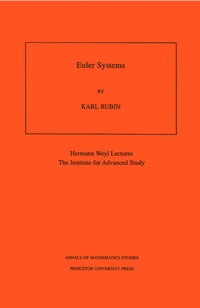
Euler Systems
1st Edition
Published on 8. September 2014
240 pages
978-1-4008-6520-8 (ISBN)
Description

One of the most exciting new subjects in Algebraic Number Theory and Arithmetic Algebraic Geometry is the theory of Euler systems. Euler systems are special collections of cohomology classes attached to p-adic Galois representations. Introduced by Victor Kolyvagin in the late 1980s in order to bound Selmer groups attached to p-adic representations, Euler systems have since been used to solve several key problems. These include certain cases of the Birch and Swinnerton-Dyer Conjecture and the Main Conjecture of Iwasawa Theory. Because Selmer groups play a central role in Arithmetic Algebraic Geometry, Euler systems should be a powerful tool in the future development of the field.
Here, in the first book to appear on the subject, Karl Rubin presents a self-contained development of the theory of Euler systems. Rubin first reviews and develops the necessary facts from Galois cohomology. He then introduces Euler systems, states the main theorems, and develops examples and applications. The remainder of the book is devoted to the proofs of the main theorems as well as some further speculations.
The book assumes a solid background in algebraic Number Theory, and is suitable as an advanced graduate text. As a research monograph it will also prove useful to number theorists and researchers in Arithmetic Algebraic Geometry.
Here, in the first book to appear on the subject, Karl Rubin presents a self-contained development of the theory of Euler systems. Rubin first reviews and develops the necessary facts from Galois cohomology. He then introduces Euler systems, states the main theorems, and develops examples and applications. The remainder of the book is devoted to the proofs of the main theorems as well as some further speculations.
The book assumes a solid background in algebraic Number Theory, and is suitable as an advanced graduate text. As a research monograph it will also prove useful to number theorists and researchers in Arithmetic Algebraic Geometry.
More details
Other editions
Additional editions
Karl Rubin
Euler Systems
Book
05/2000
Princeton University Press
€75.10
Article not available at the moment
Person
Karl Rubin, Professor of Mathematics at Stanford University, was awarded the Cole Prize of the American Mathematical Society in 1992. He has been a Guggenheim Fellow, a Sloan Fellow, and a National Science Foundation Presidential Young Investigator.
Content
Acknowledgments xi
Introduction 3
Notation 6
Chapter 1. Galois Cohomology of p-adic Representations 9
1.1. p-adic Representations 9
1.2. Galois Cohomology 11
1.3. Local Cohomology Groups 12
1.4. Local Duality 18
1.5. Global Cohomology Groups 21
1.6. Examples of Selmer Groups 23
1.7. Global Duality 28
Chapter 2. Euler Systems: Definition and Main Results 33
2.1. Euler Systems 33
2.2. Results over K 36
2.3. Results over K, 40
2.4. Twisting by Characters of Finite Order 43
Chapter 3. Examples and Applications 47
3.1. Preliminaries 47
3.2. Cyclotomic Units 48
3.3. Elliptic Units 55
3.4. Stickelberger Elements 55
3.5. Elliptic Curves 63
3.6. Symmetric Square of an Elliptic Curve 73
Chapter 4. Derived Cohomology Classes 75
4.1. Setup 75
4.2. The Universal Euler System 78
4.3. Properties of the Universal Euler System 80
4.4. Kolyvagin's Derivative Construction 83
4.5. Local Properties of the Derivative Classes 90
4.6. Local Behavior at Primes Not Dividing pr 92
4.7. Local Behavior at Primes Dividing r 98
4.8. The Congruence 102
Chapter 5. Bounding the Selmer Group 105
5.1. Preliminaries 105
5.2. Bounding the Order of the Selmer Group 106
5.3. Bounding the Exponent of the Selmer Group 114
Chapter 6. Twisting 119
6.1. Twisting Representations 119
6.2. Twisting Cohomology Groups 121
6.3. Twisting Euler Systems 122
6.4. Twisting Theorems 125
6.5. Examples and Applications 125
Chapter 7. Iwasawa, Theory 129
7.1. Overview 129
7.2. Galois Groups and the Evaluation Map 135
7.3. Proof of Theorem 2.3.2 141
7.4. The Kernel and Cokernel of the Restriction Map 145
7.5. Galois Equivariance of the Evaluation Maps 147
7.6. Proof of Proposition 7.1.7 151
7.7. Proof of Proposition 7.1.9 154
Chapter 8. Euler Systems and p-adic L-functions 163
8.1. The Setting 164
8.2. Perrin-Riou's p-adic L-function and Related Conjectures 166
8.3. Connection with Euler Systems when d- = 1 168
8.4. Example: Cyclotomic Units 171
8.5. Connection with Euler Systems when d- > 1 173
Chapter 9. Variants 175
9.1. Rigidity 175
9.2. Finite Primes Splitting Completely in K,IK 178
9.3. Euler Systems of Finite Depth 179
9.4. Anticyclotomic Euler Systems 180
9.5. Additional Local Conditions 183
9.6. Varying the Euler Factors 185
Appendix A. Linear Algebra 189
A.1. Herbrand Quotients 189
A.2. p-adic Representations 191
Appendix B. Continuous Cohomology and Inverse Limits 195
B.1. Preliminaries 195
B.2. Continuous Cohomology 195
B.3. Inverse Limits 198
B.4. Induced Modules 201
B.5. Semilocal Galois Cohomology 202
Appendix C. Cohomology of p-adic Analytic Groups 205
C.1. Irreducible Actions of Compact Groups 205
C.2. Application to Galois Representations 207
Appendix D. p-adic Calculations in Cyclotomic Fields 211
D.1. Local Units in Cyclotomic Fields 211
D.2. Cyclotomic Units 216
Bibliography 219
Index of Symbols 223
Subject Index 227
Introduction 3
Notation 6
Chapter 1. Galois Cohomology of p-adic Representations 9
1.1. p-adic Representations 9
1.2. Galois Cohomology 11
1.3. Local Cohomology Groups 12
1.4. Local Duality 18
1.5. Global Cohomology Groups 21
1.6. Examples of Selmer Groups 23
1.7. Global Duality 28
Chapter 2. Euler Systems: Definition and Main Results 33
2.1. Euler Systems 33
2.2. Results over K 36
2.3. Results over K, 40
2.4. Twisting by Characters of Finite Order 43
Chapter 3. Examples and Applications 47
3.1. Preliminaries 47
3.2. Cyclotomic Units 48
3.3. Elliptic Units 55
3.4. Stickelberger Elements 55
3.5. Elliptic Curves 63
3.6. Symmetric Square of an Elliptic Curve 73
Chapter 4. Derived Cohomology Classes 75
4.1. Setup 75
4.2. The Universal Euler System 78
4.3. Properties of the Universal Euler System 80
4.4. Kolyvagin's Derivative Construction 83
4.5. Local Properties of the Derivative Classes 90
4.6. Local Behavior at Primes Not Dividing pr 92
4.7. Local Behavior at Primes Dividing r 98
4.8. The Congruence 102
Chapter 5. Bounding the Selmer Group 105
5.1. Preliminaries 105
5.2. Bounding the Order of the Selmer Group 106
5.3. Bounding the Exponent of the Selmer Group 114
Chapter 6. Twisting 119
6.1. Twisting Representations 119
6.2. Twisting Cohomology Groups 121
6.3. Twisting Euler Systems 122
6.4. Twisting Theorems 125
6.5. Examples and Applications 125
Chapter 7. Iwasawa, Theory 129
7.1. Overview 129
7.2. Galois Groups and the Evaluation Map 135
7.3. Proof of Theorem 2.3.2 141
7.4. The Kernel and Cokernel of the Restriction Map 145
7.5. Galois Equivariance of the Evaluation Maps 147
7.6. Proof of Proposition 7.1.7 151
7.7. Proof of Proposition 7.1.9 154
Chapter 8. Euler Systems and p-adic L-functions 163
8.1. The Setting 164
8.2. Perrin-Riou's p-adic L-function and Related Conjectures 166
8.3. Connection with Euler Systems when d- = 1 168
8.4. Example: Cyclotomic Units 171
8.5. Connection with Euler Systems when d- > 1 173
Chapter 9. Variants 175
9.1. Rigidity 175
9.2. Finite Primes Splitting Completely in K,IK 178
9.3. Euler Systems of Finite Depth 179
9.4. Anticyclotomic Euler Systems 180
9.5. Additional Local Conditions 183
9.6. Varying the Euler Factors 185
Appendix A. Linear Algebra 189
A.1. Herbrand Quotients 189
A.2. p-adic Representations 191
Appendix B. Continuous Cohomology and Inverse Limits 195
B.1. Preliminaries 195
B.2. Continuous Cohomology 195
B.3. Inverse Limits 198
B.4. Induced Modules 201
B.5. Semilocal Galois Cohomology 202
Appendix C. Cohomology of p-adic Analytic Groups 205
C.1. Irreducible Actions of Compact Groups 205
C.2. Application to Galois Representations 207
Appendix D. p-adic Calculations in Cyclotomic Fields 211
D.1. Local Units in Cyclotomic Fields 211
D.2. Cyclotomic Units 216
Bibliography 219
Index of Symbols 223
Subject Index 227
