

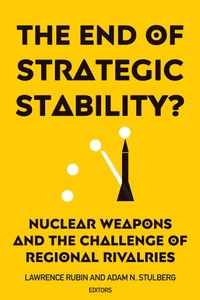
The End of Strategic Stability?
Description

During the Cold War, many believed that the superpowers shared a conception of strategic stability, a coexistence where both sides would compete for global influence but would be deterred from using nuclear weapons. In actuality, both sides understood strategic stability and deterrence quite differently. Today's international system is further complicated by more nuclear powers, regional rivalries, and nonstate actors who punch above their weight, but the United States and other nuclear powers still cling to old conceptions of strategic stability.
The purpose of this book is to unpack and examine how different states in different regions view strategic stability, the use or non-use of nuclear weapons, and whether or not strategic stability is still a prevailing concept. The contributors to this volume explore policies of current and potential nuclear powers including the United States, Russia, China, India, Iran, Israel, Pakistan, and Saudi Arabia. This volume makes an important contribution toward understanding how nuclear weapons will impact the international system in the twenty-first century and will be useful to students, scholars, and practitioners of nuclear weapons policy.
More details
Other editions
Additional editions
Persons
Lawrence Rubin is an associate professor at the Sam Nunn School of International Affairs, Georgia Institute of Technology. He is the author and editor of three books, including Islam in the Balance: Ideational Threats in Arab Politics.
Adam N. Stulberg is Neal Family Chair and CoDirector of the Center for International Strategy, Technology, and Policy at the Sam Nunn School, Georgia Institute of Technology. He is the author and editor of five books including, the co-edited volume The Nuclear Energy Renaissance and International Security.
Content
Contents
Acknowledgments
Introduction
Adam N. Stulberg and Lawrence Rubin
Part I: General Approaches to Regional Stability
1. Sources of Instability in the Second Nuclear Age: An American Perspective
Evan Braden Montgomery
2. The Russian Approach to Strategic Stability: Preserving a Classical Formula in a Turbulent World
Andrey Pavlov and Anastasia Malygina
3. Pakistan's View of Strategic Stability: A Struggle between Theory and Practice
Sadia Tasleem
4. Strategic Stability in the Middle East: Through the Transparency Lens
Emily B. Landau
5. Beyond Strategic Stability: Deterrence, Regional Balance, and Iranian National Security
Annie Tracy Samuel
Conclusion to Part I: Regional Approaches to Strategic Stability
Rajesh Basrur
Part II: Cross-Domain Deterrence and Strategic Stability
6. Strategic Stability and Cross-Domain Coercion: The Russian Approach to Information (Cyber) Warfare
Dmitry "Dima" Adamsky
7. Conventional Challenges to Strategic Stability: Chinese Perceptions of Hypersonic Technology and the Security Dilemma
Tong Zhao
8. The India-Pakistan Nuclear Dyad: Strategic Stability and Cross-Domain Deterrence
Happymon Jacob
9. The Road Not Taken: Defining Israel's Approach to Strategic Stability
Ilai Z. Saltzman
10. Maintaining Sovereignty and Preserving the Regime: How Saudi Arabia Views Strategic Stability
Ala' Alrababa'h
Conclusion to Part II: Regional Variations on Deterrence and Stability
Jeffrey W. Knopf
Part III: Findings and Implications
11. Foreign Views of Strategic Stability and US Nuclear Posture: The Need for Tailored Strategies
Matthew Kroenig
12. Implications for US Policy: Defending a Stable International System
Adam Mount
Conclusion to the Book
Lawrence Rubin and Adam N. Stulberg
List of Contributors
Index
