

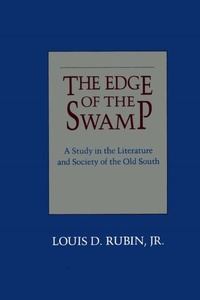
The Edge of the Swamp
Description

The flowering of literary imagination known as the American Renaissance had few roots in the South. While Hawthorne, Emerson, Melville, Thoreau, and Whitman were creating a body of work that would endure, the only southern writer making a lasting contribution was Edgar Allan Poe. This failure on the part of antebellum southern writers has long been a subject of debate among students of southern history and literature. Now one of the region's most distinguished men of letters offers a cogently argued and gracefully written account of the circumstances that prevented early southern writers from creating transcendent works of art.
Louis D. Rubin, Jr., brings forty years of critical integrity and imaginative involvement with the history and literature of the South to his informal inquiry into the foundations of the southern literary imagination. His exploration centers on the lives and works of three of the most important writers of the pre-Civil War South: Poe, William Gilmore Simms, and Henry Timrod.
In a close and highly original reading of Poe's poetry and fiction, Rubin shows just how profoundly growing up in Richmond, Virginia, influenced that writer. The sole author of the Old South whose work has endured did not use southern settings or concern himself with his region's history or politics. Poe was, according to Rubin, in active rebellion against the middle-class community of Richmond and its materialistic values.
Simms, on the other hand, aspired to the plantation society ideal of his native Charleston, South Carolina. He was not the most devoted and energetic of southern writers and one of the country's best-known and most respected literary figures before the Civil War. Rubin finds an explanation for much of the lost promise of antebellum southern literature in Simms's career. Here was a talented man who got caught up in the politically obsessed plantation community of Charleston, becoming an apologist for the system and an ardent defender of slavery.
Timrod, also a Charlestonian native, was a highly gifted poet whose work attained the stature of literature when the Civil War gave him a theme. He was known as the poet laureate of the Confederacy. Only when his region was locked in a desperate military struggle for the right to exist did he suddenly find his enduring voice.
Anyone interested in southern life and literature will welcome his provocative and engaging new look at southern writing from one of the region's most perceptive critics.
More details
Other editions
Additional editions

Person
Louis D. Rubin, Jr., University Distinguished Professor Emeritus of English at the University of North Carolina at Chapel Hill, is editor of the Southern Literary Studies series of LSU Press. He is the author of many books, including A Gallery of Southerners, and is senior editor of The History of Southern Literature.
