

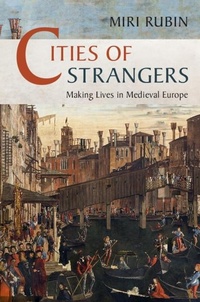
Cities of Strangers
Making Lives in Medieval Europe
Published on 11. March 2020
978-1-108-63225-6 (ISBN)
Description

Cities of Strangers illuminates life in European towns and cities as it was for the settled, and for the 'strangers' or newcomers who joined them between 1000 and 1500. Some city-states enjoyed considerable autonomy which allowed them to legislate on how newcomers might settle and become citizens in support of a common good. Such communities invited bankers, merchants, physicians, notaries and judges to settle and help produce good urban living. Dynastic rulers also shaped immigration, often inviting groups from afar to settle and help their cities flourish. All cities accommodated a great deal of difference - of language, religion, occupation - in shared spaces, regulated by law. But when, from around 1350, plague began regularly to occur within European cities, this benign cycle began to break down. High mortality rates led eventually to demographic crises and, as a result, less tolerant and more authoritarian attitudes emerged, resulting in violent expulsions of even long-settled groups. Tracing the development of urban institutions and using a wide range of sources from across Europe, Miri Rubin recreates a complex picture of urban life for settled and migrant communities over the course of five centuries and offers an innovative vantage point on Europe's past with insights for its present.
Reviews / Votes
'In Cities of Strangers, Miri Rubin takes us deep into the practices of inclusion and exclusion in medieval cities across Europe. Introducing us to the variety of newcomers who sustained urban life, she also shows us how long-domiciled groups of Jews and even native-born women were marked by the taint of strangeness. Her compelling narrative reminds us how needy are the migrants at our gates and how universal is our quest to belong.' Natalie Zemon Davis, University of Toronto 'It is inspiring and troubling to learn from Miri Rubin's engaging book that a twelfth-century Parisian or a thirteenth-century Londoner would find their cities in the twenty-first century more familiar than those whose dreams of purity blinds them to the truth that diverse cities are where history is made.' Engin Isin, Queen Mary University of London 'The great medievalist Miri Rubin reminds us how diverse European cities have always been. This timely, fascinating book traces how a migrant, Jew, bride from another town, or foreign merchant could become less a stranger and more a trusted neighbour, but also how fragile that hard-won trust could be.' Edward Muir, Northwestern University 'A thoughtful and pioneering book.' David Abulafia, Times Literary Supplement 'The narrative portion of this book is, for general readers and undergraduates, a wonderful introduction ... Scholars, however, will more deeply appreciate that almost half of the book is bibliography and endnotes, the latter a nice admixture of primary and secondary sources.' R. T. Ingoglia, Choice 'Miri Rubin weaves together stories with an enormous contemporary resonance that recall the unavoidable correlation between everyone's well-being, and the well-being of strangers.' Beatriz E. Salamanca, Journal of Early Modern History '... Cities of Strangers is a thought-provoking and learned examination of how strangers made the medieval city a place of vibrant difference and opportunity, dependent on trust and a sense of the 'common good.' Tanya Stabler Miller, Medieval Encounters 'Rubin's book provides a method of comparison between European cities based on regulatory frameworks for those deemed different. She draws a common thread through her four chapters that demonstrates how various categories of strangeness change over time. It offers insight into future attempts to define 'strangers' or 'foreigners' across different political and social realities.' Angela Zhang, Renaissance and Reformation / Renaissance et Reforme 'Written with insight and charm, the exposition is attractive in itself and moves beyond the political management of the cities to open up a new understanding of the variety of life in different places and different periods.' Sybil Jack, ParergonMore details
Series
Language
English
Place of publication
Cambridge
United Kingdom
Target group
Professional and scholarly
College/higher education
Illustrations
Worked examples or Exercises; 2 Maps; 5 Halftones, black and white
File size
98,82 MB
ISBN-13
978-1-108-63225-6 (9781108632256)
Copyright in bibliographic data and cover images is held by Nielsen Book Services Limited or by the publishers or by their respective licensors: all rights reserved.
Schweitzer Classification
Other editions
Additional editions
Book
03/2020
Cambridge University Press
€28.50
Shipment within 15-20 days
Book
03/2020
Cambridge University Press
€82.00
Shipment within 15-20 days
Person
Content
1. Cities and their strangers; 2. Strangers into neighbours; 3. Jews: familiar strangers; 4. Women: sometimes strangers in their cities; Conclusion.
