

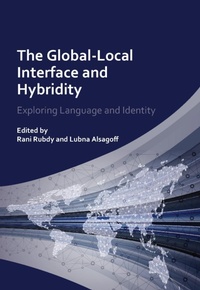
The Global-Local Interface and Hybridity
Exploring Language and Identity
Published on 2. December 2013
320 pages
978-1-78309-087-7 (ISBN)
Description

The chapters in this volume seek to bring hybrid language practices to the center of discussions about English as a global language. They demonstrate how local linguistic resources and practices are involved in the refashioning of identities in a variety of cross-cultural and geographical contexts, and illustrate hybridity as an enactment of resistance and creativity. Drawing on a variety of disciplines and ideological perspectives, the authors use contexts as diverse as social media, Bollywood films, workplaces and kindergartens to explore the ways in which English has become a part of localities and social relations in ways that are of significant sociolinguistic interest in understanding the dynamics of mobile cultures and transcultural flows.
Reviews / Votes
Linguistic and cultural landscapes in our global society are changing so much and so fast as to render existing sociolinguistic theories hopelessly inadequate. In response, this book problematizes several concepts including hybridity and bilingualism, shedding critical light on metrolingual, transglossic, and transcultural phenomena. Voices from around the world present a compelling piece of analysis that our profession cannot afford to ignore. * B. Kumaravadivelu, San Jose State University, USA * This book is an important and valuable contribution to the growing literature on linguistic globalization. It offers a thoughtful reassessment of the nature and significance of the concept of hybridity, illustrating the key role it plays in the relationship between language-related issues and the process of globalization. * Philip Seargeant, The Open University, UK * Covering diverse locations in the world, The Global-Local Interface and Hybridity: Exploring Language and Identity highlights how global linguistic flows produce local innovations of linguistic practices, requiring us to reconceptualize the notion of language. Yet, the book also pushes us to scrutinize the contested nature of hybridity arising from cultural and economic complexities. * Ryuko Kubota, University of British Columbia, Canada *More details
Language
English
Place of publication
Bristol
United Kingdom
Publishing group
Channel View Publications Ltd
Target group
Professional and scholarly
ISBN-13
978-1-78309-087-7 (9781783090877)
Copyright in bibliographic data and cover images is held by Nielsen Book Services Limited or by the publishers or by their respective licensors: all rights reserved.
Schweitzer Classification
Other editions
Additional editions
Book
12/2013
Multilingual Matters
€55.70
Shipment within 10-20 days
Persons
Rani Rubdy is an Associate Professor of English Language and Literature at Nanyang Technological University, Singapore. She has published widely on World Englishes, including Language as Commodity: Global Structures, Local Marketplaces (2008, edited with Peter Tan) and English in the World: Global Rules, Global Roles (2006, edited with Mario Saraceni).
Lubna Alsagoff is an Associate Professor of English Language and Literature at Nanyang Technological University, Singapore. She has published widely on Singapore English and language and identity, including Principles and Practices for Teaching English as an International Language (2012, edited with Sandra Lee McKay, Guangwei Hu and Willy Renandya). Both authors are co-editors with Lawrence Jun Zhang of the volume Asian Englishes: Changing Perspectives in a Globalised World (2011).
Lubna Alsagoff is an Associate Professor of English Language and Literature at Nanyang Technological University, Singapore. She has published widely on Singapore English and language and identity, including Principles and Practices for Teaching English as an International Language (2012, edited with Sandra Lee McKay, Guangwei Hu and Willy Renandya). Both authors are co-editors with Lawrence Jun Zhang of the volume Asian Englishes: Changing Perspectives in a Globalised World (2011).
Content
Introduction
1. Rani Rubdy and Lubna Alsagoff: The Cultural Dynamics of Globalization: Problematizing Hybridity
Part I: Interrogating the Canon
2. Christina Higgins: When Scapes Collide: Reterritorializing English in East Africa
3. Rani Rubdy: Hybridity in the Linguistic Landscape: Democratizing English in India
4. Beatriz P. Lorente and T. Ruanni F. Tupas: (Un)Emancipatory Hybridity: Selling English in an Unequal World
5. Emi Otsuji and Alastair Pennycook: Unremarkable Hybridities and Metrolingual Practices
6. Ofelia Garcia: Countering the Dual: Transglossia, Dynamic Bilingualism and Translanguaging in Education
Part II: Hybridized Discourses of Identity in the Media
7. Rakesh Mohan Bhatt: Reading Gender in Indian English Newspapers: Global, Local, or Liminal?
8. Elizabeth Martin: Linguistic and Cultural Hybridity in French Web Advertising
9. Anjali Gera Roy: What's Punjabi Doing in an English Film? Bollywood's New Transnational Tribes
10. Jamie Shinhee Lee: Hybridizing Medialect and Entertaining TV: Changing Korean Reality
Part III: Multilingual Diaspora and the Internet
11. Mario Saraceni: The Language of Malaysian and Indonesian Users of Social Networks: Practice vs. System
12. Tope Omoniyi: Constructing Local and Global in the E-Borderland
13. Vincent B Y Ooi and Peter K W Tan: Facebook, Linguistic Identity and Hybridity in Singapore
Part IV: Performing Hybrid Cultural Identities
14. Laurel D. Kamada: Contested and Celebrated Glocal Hybrid Identities of Mixed-Ethnic Girls in Japan
15. Lubna Alsagoff: Singlish and Hybridity: The Dialogic of Outer-Circle Teacher Identities
16. Corazon D. Villareal: Enacting Hybridity in the Philippine Diaspora
17. Rani Rubdy and Lubna Alsagoff: Reframing the Global-Local Dialectic and Hybridized Textual Practices
1. Rani Rubdy and Lubna Alsagoff: The Cultural Dynamics of Globalization: Problematizing Hybridity
Part I: Interrogating the Canon
2. Christina Higgins: When Scapes Collide: Reterritorializing English in East Africa
3. Rani Rubdy: Hybridity in the Linguistic Landscape: Democratizing English in India
4. Beatriz P. Lorente and T. Ruanni F. Tupas: (Un)Emancipatory Hybridity: Selling English in an Unequal World
5. Emi Otsuji and Alastair Pennycook: Unremarkable Hybridities and Metrolingual Practices
6. Ofelia Garcia: Countering the Dual: Transglossia, Dynamic Bilingualism and Translanguaging in Education
Part II: Hybridized Discourses of Identity in the Media
7. Rakesh Mohan Bhatt: Reading Gender in Indian English Newspapers: Global, Local, or Liminal?
8. Elizabeth Martin: Linguistic and Cultural Hybridity in French Web Advertising
9. Anjali Gera Roy: What's Punjabi Doing in an English Film? Bollywood's New Transnational Tribes
10. Jamie Shinhee Lee: Hybridizing Medialect and Entertaining TV: Changing Korean Reality
Part III: Multilingual Diaspora and the Internet
11. Mario Saraceni: The Language of Malaysian and Indonesian Users of Social Networks: Practice vs. System
12. Tope Omoniyi: Constructing Local and Global in the E-Borderland
13. Vincent B Y Ooi and Peter K W Tan: Facebook, Linguistic Identity and Hybridity in Singapore
Part IV: Performing Hybrid Cultural Identities
14. Laurel D. Kamada: Contested and Celebrated Glocal Hybrid Identities of Mixed-Ethnic Girls in Japan
15. Lubna Alsagoff: Singlish and Hybridity: The Dialogic of Outer-Circle Teacher Identities
16. Corazon D. Villareal: Enacting Hybridity in the Philippine Diaspora
17. Rani Rubdy and Lubna Alsagoff: Reframing the Global-Local Dialectic and Hybridized Textual Practices
