

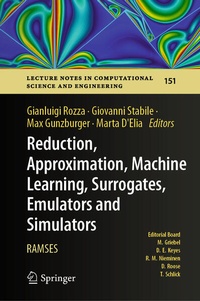
Reduction, Approximation, Machine Learning, Surrogates, Emulators and Simulators
Description

This volume is focused on the review of recent algorithmic and mathematical advances and the development of new research directions for Mathematical Model Approximations via RAMSES (Reduced order models, Approximation theory, Machine learning, Surrogates, Emulators, Simulators) in the setting of parametrized partial differential equations also with sparse and noisy data in high-dimensional parameter spaces.
The book is a valuable resource for researchers, as well as masters and Ph.D students.
More details
Other editions
Additional editions
Persons
Marta D'Elia is a Principal Scientist at Pasteur Labs and an Adjunct Professor at Stanford University (ICME). She previously worked at Meta as a Research Scientist and at Sandia National Laboratories (NM and CA) as a Principal Member of the Technical Staff. She holds a PhD in Applied Mathematics from Emory University. As a computational scientist, her work deals with the design and analysis of machine-learning models and data-driven algorithms for the simulation of complex, multiscale and multiphysics problems. In addition, she is an expert in nonlocal modeling and simulation, optimization, and uncertainty quantification.
Max Gunzburger
is the Robert Lawton and Marie Krafft Emeritus Professor and Founding Chair of the Department of Scientific Computing at Florida State University and is currently a Senior Researcher at the University of Texas at Austin. His research interests spans the areas of numerical analysis, uncertainty quantification, nonlocal modeling, optimization and control, computational geometry, and partial differential equations with applications in diverse areas including fluid and solid mechanics, climate, materials, subsurface flows, image processing, diffusion processes, superconductivity, acoustics, and electromagnetics.
Gianluigi Rozza received his Ph.D. in Applied Mathematics at EPF Lausanne, Switzerland, in 2006 and he is currently full professor in Numerical Analysis and Scientific Computing at SISSA, Scuola Internazionale Superiore di Studi Avanzati, Trieste, Italy, where he coordinated SISSA mathLab. His research focuses on reduced order methods in computational mechanics, including uncertainty quantification, automatic learning, optimal control, inverse problems and emerging technologies like digital twin in industry.
Giovanni Stabile is assistant professor (RTD-B) in numerical analysis at the Department of Pure and Applied Sciences, Universityof Urbino, Italy. From 2016 to 2022, he was assistant professor (RTD-A) and previously postDoc at SISSA, in Trieste, Italy. He received his Ph.D. in 2016 from a joint Ph.D. school between the TU Braunschweig in Germany and the University of Florence in Italy. He is recipient of the ERC Starting Grant "Data Aware efficient models of the urbaN microclimaTE (DANTE)".
