

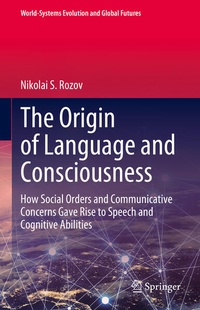
The Origin of Language and Consciousness
Description

This book presents an evolutionary theory of the origin and step-by-step development of linguistic structures and cognitive abilities from the early stages of anthropogenesis to the Upper Paleolithic. Emphasizing the social nature of the human mind and using an extended version of C.Hempel's explanatory logic, the author proves that language and consciousness emerged and evolved through the daily efforts of our ancestors to overcome mutual misunderstandings in increasingly complex social orders with increasing tasks on memory, thinking, and normative regulation of behavior, with the addition of new and new communicative concerns.
The book addresses questions such as the following:
- What unique social conditions led to the emergence of the first protosyllables and protowords?
- What steps enabled the crossing of the "linguistic Rubicon" (between animal communication and human speech)?
- Why were syllables and phonemes needed?
- How did ourancestors overcome the difficulties of misunderstanding?
- How, when, and why did ancient people learn to speak in turns? Why did they begin to talk about past and distant events?
- What is consciousness and how did it evolve along with language?
- How many original languages were there and why are there roughly 200 philas (language macrofamilies)?
- How and why did the number of languages and the degree of their complexity change in pre-written history?
- Did the Romance languages really evolve from Latin?
Accordingly, the book will appeal to scholars in various disciplines who are interested in a better understanding of the cognitive aspects of anthropogenesis and the ancient origins of language and consciousness.
More details
Other editions
Additional editions
Person
Nikolai S. Rozov is the Chief researcher of the Institute of Philosophy and Law, Siberian Branch of the Russian Academy of Science, Novosibirsk Akademgorodok, Russia. He conducts research in the philosophy of history, humanistic ethics, macrosociology, theory of revolutions, anthropogenesis, and early cultural evolution. In 1995 he interned at the Fernand Braudel Center with I.Wallerstein. For several years he coordinated the network "Macrohistorical Dynamics" at the Social Science History Association (SSHA). He is the author of 10 monographs and more than 370 research papers. He also compiled the translated almanac "The World Time" and the book series "Theoretical History and Macrosociology."
Content
Chapter 1. Structuring the conceptual field: Typologies, paradigms, and results.- Chapter 2. Basic concepts and principles of cognitive evolution.- Chapter 3. Explanatory fundamentals: From niches to interactive rituals.- Chapter 4. Self-domestication and normativity: Conditions for the breakthrough to speech.- Chapter 5. Crossing the "language Rubicon": From signal multiplication to distinguishing protowords.- Chapter 6. The childhood of language: Rephrasing rituals and reactive protophrases.- Chapter 7. "Managing imagination" of interlocutors and the phases of protolanguage development.- Chapter 8. The need for syntax and illusion of the consciousness totality.- Chapter 9. Bridging the Pre-language gap.- Chapter 10. Linguistic complexity and simplicity: The socioevolutionary roots.- Chapter 11. The nature of the affinity of modern languages.- Chapter 12. Conclusion.
