

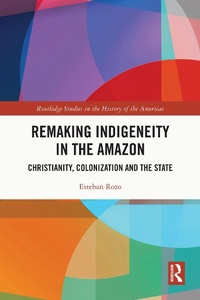
Remaking Indigeneity in the Amazon
Christianity, Colonization and the State
1st Edition
Published on 28. September 2023
182 pages
978-1-000-96311-3 (ISBN)
Description

Drawing on archival and ethnographic work, this book analyzes how indigeneity, Christianity and state-making became intertwined in the Colombian Amazon throughout the 20th century.
At the end of the 19th century, the state gave Catholic missionaries tutelage over Indigenous groups and their territories, but, in the case of the Colombian Amazon, this tutelage was challenged by evangelical missionaries that arrived in the region in the 1940s with different ideas of civilization and social change. Indigenous conversion to evangelical Christianity caused frictions with other actors, while Indigenous groups perceived conversion as way of leverage with settlers. This book shows how evangelical Christianity shaped new forms of indigeneity that did not coincide entirely with the ideas of civilization or development that Catholic missionaries and the state promoted in the region. Since the 1960s, the state adapted development policies and programs to Indigenous realities and practices, while Indigenous societies appropriated evangelical Christianity in order to navigate the changes brought on by colonization, modernity and state-formation.
This study demonstrates that not all projects of civilization were the same in Amazonia, nor was missionization of Indigenous groups always subordinate to the state or resource extraction.
At the end of the 19th century, the state gave Catholic missionaries tutelage over Indigenous groups and their territories, but, in the case of the Colombian Amazon, this tutelage was challenged by evangelical missionaries that arrived in the region in the 1940s with different ideas of civilization and social change. Indigenous conversion to evangelical Christianity caused frictions with other actors, while Indigenous groups perceived conversion as way of leverage with settlers. This book shows how evangelical Christianity shaped new forms of indigeneity that did not coincide entirely with the ideas of civilization or development that Catholic missionaries and the state promoted in the region. Since the 1960s, the state adapted development policies and programs to Indigenous realities and practices, while Indigenous societies appropriated evangelical Christianity in order to navigate the changes brought on by colonization, modernity and state-formation.
This study demonstrates that not all projects of civilization were the same in Amazonia, nor was missionization of Indigenous groups always subordinate to the state or resource extraction.
Reviews / Votes
"Valuable corrective to contemporary political discourse about settler colonialism, which is usually framed in binary terms. In contrast, Esteban Rozo shows how indigeneity in the Colombian Amazon emerged in relation to state formation, evangelization, and economic interests, as well as choices made by indigenous peoples themselves."Stuart Kirsch, University of Michigan, USA
"Esteban Rozo offers a powerful intervention in the ways that states, Christian missionaries, and industries of capitalist extraction impinge on indigenous life in the Colombian Amazon. Pushing against the figuration of indigenous groups as passive victims of outside encroachments, Rozo shows how indigenas selectively appropriated Catholic and then evangelical Christianities to define their own identities and advance their own interests."
Paul Christopher Johnson, University of Michigan, USA
"This outstanding historical ethnography analyzes the relational construction of indigeneity in the Colombian Amazon frontier. With interpretative fluidity, the study looks at the social and cultural processes that linked indigenous peoples to Christianity, the nation-state, narratives of modernity, and development politics."
Cesar Ceriani Cernadas, CONICET- UBA, Argentina
More details
Series
Edition
1. Auflage
Language
English
Place of publication
London
United Kingdom
Publishing group
Taylor & Francis Ltd
Target group
Professional and scholarly
Product notice
Reflowable
Illustrations
16 Halftones, black and white; 16 Illustrations, black and white
ISBN-13
978-1-000-96311-3 (9781000963113)
Copyright in bibliographic data and cover images is held by Nielsen Book Services Limited or by the publishers or by their respective licensors: all rights reserved.
Schweitzer Classification
Other editions
Additional editions
Book
12/2024
1st Edition
Routledge
€62.80
Shipment within 10-20 days
Book
09/2023
1st Edition
Routledge
€205.90
Shipment within 10-20 days
Person
Esteban Rozo is a Professor of Anthropology at Universidad Nacional de Colombia in Bogota. His research focuses on how conversion to Christianity in the Colombian Amazon relates to processes of colonization, state-formation and the emergence of new forms of indigeneity.
Content
Introduction 1. The Making of an Amazonian Frontier 2. Conversion Under Dispute: Evangelical Christianity and the State 3. Between Rupture and Continuity: The Politics of Conversion 4. Christianity, Materiality, and the Critique of Modernity 5. Indigeneity, Development and Extractivism. Conclusions
