

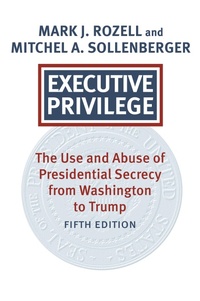
Executive Privilege
Description

The definitive resource on the topic of executive privilege, now in a revised and updated fifth edition that includes the Biden presidency.
Executive Privilege?called ?the definitive contemporary work on the subject? by the Journal of Politics?is widely considered the best in-depth history and analysis of executive privilege and its relation to the proper scope and limits of presidential power.
The expanded fifth edition picks up where the fourth edition left off in 2019, with President Donald Trump's bold assertion of a ?protective executive privilege? that recognizes no balancing powers against the executive branch. In addition to an expanded analysis of the battle over the Mueller Report, the controversy surrounding the citizenship question on the 2020 census, and the White House security clearances dispute, new sections examine the conflict over the report on steel and aluminum tariffs and the investigation into missing presidential records stored at Trump's Mar-a-Lago residence, some of which were marked as classified.
Mark J. Rozell and Mitchel A. Sollenberger have also added a new chapter on President Joe Biden, whom the authors regard as taking a measured approach to questions of secrecy and privilege. This chapter recounts how Biden handled former President Trump's executive privilege claims during the January 6th investigation, while also managing the controversy surrounding his own classified documents dispute and the investigations into his son, Hunter Biden.
With its thorough and authoritative analysis of the many controversies regarding presidential privilege and accountability from the founding of the nation to Trump and beyond, Executive Privilege remains an essential resource.
More details
Other editions
Additional editions
Previous edition
Persons
Mark J. Rozell is the Founding Dean of the Schar School of Policy and Government at George Mason University, where he holds the Ruth D. and John T. Hazel Faculty Chair in Public Policy. He is the coauthor with Jeffrey Crouch and Mitchel A. Sollenberger of The Unitary Executive Theory: A Danger to Constitutional Government, also from Kansas.
Content
Preface and Acknowledgments
Introduction: The Dilemma of Secrecy and Democratic Accountability
1. The Arguments against Executive Privilege
2. The Arguments in Favor of Executive Privilege
3. Undermining a Constitutional Doctrine: Richard Nixon and the Abuse of Executive Privilege
4. The Post-Watergate Years I: The ?Open? Presidencies of Gerald Ford and Jimmy Carter
5. The Post-Watergate Years II: Ronald Reagan, George H. W. Bush, and the Era of Divided Government
6. Beyond the Watergate Taint I: Bill Clinton and the Effort to Restore Executive Privilege
7. Beyond the Watergate Taint II: George W. Bush and the Growing Discord over Executive Privilege
8. Barack Obama, Donald J. Trump, and the Era of Intensified Polarization and Investigations
9. Joe Biden: A Measured Approach to Secrecy Disputes
Conclusion: Resolving the Dilemma
Notes
Index
