

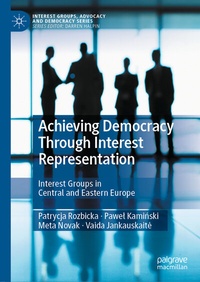
Achieving Democracy Through Interest Representation
Description

Reviews / Votes
"This book brings added value to the already rich literature on interest groups, representation and democracy. The most important contribution is that the detailed analysis of the growth, role and importance of the interest group system in Lithuania, Poland and Slovenia is put in a comparative perspective. It provides a deep understanding of the similarities and, above all, the differences between the three countries which is furthered by extending the comparative analysis to Western Europe. Last, not least, the book addresses a most pertinent question - the influence of an unsupportive environment on interest group participation in the democratic policy creation process." (Beate Kohler, Centre for European Social Research (MZES), University of Mannheim, Germany)"At a time when the prospects for democratic politics are coming under question in some post-communist countries, and interest groups are commonly described as weak, this book provides a very timely explorationof interest group politics in Central and Eastern Europe. Drawing on detailed research on three contrasting CEE countries, Lithuania, Poland and Slovenia, it provides a more detailed and comprehensive approach than most previous research, locating interest group development in a wider context of the political and ecological factors that affect its strength and character." (Terry Cox, Emeritus Professor in Central and East European Studies, University of Glasgow, UK)More details
Other editions
Additional editions
Persons
Pawel Kaminski is Adjunct Professor in the Institute of Political Studies at the Polish Academy of Sciences. His main research interests include political parties and civil society in Central Eastern Europe; and the relationships between political parties and interest groups.
Meta Novak is Assistant Professor in the Faculty of Social Sciences at the University of Ljubljana, Slovenia, and a researcher at the Centre for Political Science Research in the same faculty. Her research interests include interest groups; lobbying; civil society; political knowledge and opinion gaps.
Vaida Jankauskaite is a researcher in the Faculty of Social Sciences, Arts and Humanities at Kaunas University of Technology, Lithuania. Her main research interests include interest groups; lobbying; party-interest group relationship; and political financing.
Content
Chapter 1: Introduction.- Chapter 2: Interest organizations in Central and Eastern Europe - evaluating population ecology.- Chapter 3: Organized interest in the policy-making process.- Chapter 4: Drivers behind relations between interest organizations and political parties in the CEE countries.- Chapter 5: The organizational development of non-governmental organizations in CEE.- Chapter 6: Significance of trade unions in the CEE counties - beyond corporatism and pluralism?.- Chapter 7: Seeking access to policy stakeholders: business 'lobbying' vs others.- Chapter 8: Interest organizations in CEE and European policy process.- Chapter 9: Conclusions. The future of 'lobbying' in the CEE countries.
