

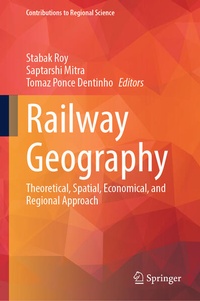
Railway Geography
Description

This book comprehensively explores the design and use of railway systems through theoretical, spatial, economic, and regional lenses. Bridging disciplines such as geography, economics, and planning, it examines railway infrastructure's role in shaping regional development, urbanisation, and connectivity. Featuring interdisciplinary case studies from diverse global contexts, the book integrates historical perspectives with forward-looking analyses to address contemporary challenges in transport planning and policy. It serves as an essential resource for graduate students, researchers, and practitioners seeking to understand the dynamic interplay between railways, spatial organisation, and economic growth.
More details
Other editions
Additional editions
Persons
Stabak Roy is an assistant professor at the Department of Geography and Disaster Management, Techno India University, Tripura, and adjunct faculty at the Institute of Geography, Spatial Management Division, University of Gdansk, Poland. He researches railway geography, railway infrastructure planning and management, transport planning and tourism.
Saptarshi Mitra is an associate professor at the Department of Geography and Disaster Management, Tripura University in Agartala, India, coordinating a Regional Planning Lab that focuses on understanding, planning, developing, and managing regional, rural, and urban phenomena. It also undertakes advisory projects from the field of planning and development. Presently, he is the editor of the Indian Journal of Regional Science.
Tomaz Ponce Dentinho is a Professor at the University of the Azores, Portugal, in the domains of Regional, Environmental and Agricultural Economics, since 2011. He is the Executive Director of the Regional Science Association International (RSAI) and, since 2017, the Editor-in-Chief of the Journal Regional Science Policy and Practice.
Content
Chapter 1. Introduction (Tomaz Ponce Dentinho).- Chapter 2. Railway Infrastructure of Czechia and its Effect on Land Use (Stabak Roy).- Chapter 3. Howrah Railway Station: A Catalyst for Regional Growth and Development in India (Saptarshi Mitra).- Chapter 4. Connecting New Horizons and Frontiers: the Indo-Bangla Trans Railway Project on Regional Community and Peripheral Development, paving the Path to Sustainable Planning (Anik Singha).- Chapter 5. A Way Forward to Sustainable Railway Transport System in Bangladesh: Experience from One Belt One Road (OBOR) Project (Kazi Humayun Kabir).- Chapter 6. Dhaka Metro Rail: Geographical Details, Economic Perspective and Perception of People in Dhaka City (Mallika De).- Chapter 7. The Konkan Railway & its Impact on Ecological Sustenance: A Case Study of Infrastructure Development in Coastal Areas (Chitresh Shrivastva).- Chapter 8. The Role of Railway Transport in Tourism Development in Poland: A Geographical Perspective (Malgorzata Jasnoch).- Chapter 9. Railway Transportation in Turkey: Historical Development and its Impact on Transportation Economy (Muzaffer BAKIRCI).- Chapter 10. The Role of Railways in the Economic and Social Development of Sudan (Bakri M Abdul Karim).- Chapter 11. Capital, Diplomacy, and Empire: The sociotechnical construction of the Portuguese imperial railway system (1870s-1910s) (Hugo Silveira Pereira).- Chapter 12. Promoting Cooperation in Railways in the Indo-Pacific Region: A Study of Indo-Japanese Cooperation in the Railway Sector (Chitresh Shrivastva).- Chapter 13. High Speed Railways in Portugal - Geopolitics or Economics (Tomaz Ponce Dentinho).
