

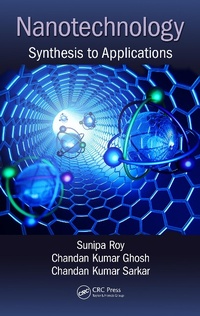
Nanotechnology
Synthesis to Applications
1st Edition
Published on 18. September 2017
350 pages
978-1-351-64282-8 (ISBN)
Description

Nano particles have created a high interest in recent years by virtue of their unusual mechanical, electrical, optical and magnetic properties and find wide applications in all fields of engineering. This edited volume aims to present the latest trends and updates in nanogenerators, thin film solar cells and green synthesis of metallic nanoparticles with a focus on nanostructured semiconductor devices. Exclusive chapter on electrical transport of nanostructure explains device physics for material properties for reduced dimensions. Additionally, the text describes the functionality of metallic nanoparticles and their application in molecular imaging and optical metamaterials. Piezoelectric nanogenerators has been touched upon from the energy perspective as well.
Key Features:
* Organized contents on Nanogenerators, VOC sensing, nanoelectronics, and NEMS.
* Discusses eco-friendly green synthesis methods for metallic nanoparticles.
* Touches upon low power nano devices (e.g. nanogenerators) for energy harvesting with quantum mechanical study.
* Thin film/heterojunction based high efficiency solar cell addressed aimed at reducing global energy consumption.
Key Features:
* Organized contents on Nanogenerators, VOC sensing, nanoelectronics, and NEMS.
* Discusses eco-friendly green synthesis methods for metallic nanoparticles.
* Touches upon low power nano devices (e.g. nanogenerators) for energy harvesting with quantum mechanical study.
* Thin film/heterojunction based high efficiency solar cell addressed aimed at reducing global energy consumption.
More details
Language
English
Place of publication
London
United Kingdom
Publishing group
Taylor & Francis Ltd
Target group
College/higher education
Product notice
Reflowable
Illustrations
120 Line drawings, black and white; 17 Illustrations, black and white
File size
6,40 MB
ISBN-13
978-1-351-64282-8 (9781351642828)
Copyright in bibliographic data and cover images is held by Nielsen Book Services Limited or by the publishers or by their respective licensors: all rights reserved.
Schweitzer Classification
Other editions
New editions
E-Book
12/2017
2nd Edition
CRC Press
€89.99
Available for download
Additional editions
Book
06/2020
1st Edition
CRC Press
€75.20
Shipment within 15-20 days
Book
09/2017
1st Edition
CRC Press
€244.10
Shipment within 10-20 days
Persons
Sunipa Roy received her M.Tech degree in VLSI and microelectronics from West Bengal University of Technology in 2009 and her PhD in engineering from Jadavpur University, ETCE Dept in 2014. She has served as a senior research fellow of the Council of Scientific and Industrial Research, Govt of India. She is a Chartered Engineer of Institution of Engineers (India) and a member of IEEE. Presently she is Head in the Electronics and Telecommunication Engg. Department at Guru Nanak Institute of Technology (JIS Group). Her research interests include MEMS, nanocrystalline metal oxide, graphene and its application as a gas sensor. She has authored one book (CRC Press) and published several research papers in referred international journals and national/international conferences. She also supervises PhD students.
Dr. Chandan Kumar Ghosh is an Assistant Professor at School of Materials Science and Nanotechnology, Jadavpur University. He received Ph.D. from Department of Physics, Jadavpur University in the year 2010. His main scientific interest includes: synthesis and study of optical properties of nanomaterials, green synthesis of noble metal nanoparticles, antibacterial activity of nanomaterials and electronic structure calculation by density functional theory. He has published more than 45 papers in different peer reviewed international journals.
C K Sarkar (SM'87) received the M.Sc. degree in Physics from the Aligarh Muslim University, Aligarh, India, in 1975, the Ph.D. degree from Calcutta University, Kolkata, India, in 1979, and the D.Phil. degree from the University of Oxford, Oxford, U.K., in 1983. He was also Postdoctoral Research Fellow of the Royal Commission for the Exhibition of 1851 at the Clarendon Laboratory, University of Oxford, from 1983 to 1985. He was a fellow of Wolfson College, Oxford. He held graduate award at Wolfson College. He was also a tutor and lab instructor at Clarendon Laboratory. He was also a Visiting Fellow with the Linkoping University, Linkoping, Sweden; Max Planck Institute at Stuttgart, Germany. He joined Jadavpur University, Kolkata, in 1987 as a Reader in Electronics and Telecommunication Engineering. Subsequently, he became a Professor and the Head of the Department of Physics, and Dean of Faculty of Science Bengal Engineering Science University (BESU) during 1996-99. Later he once again joined Jadavpur University ETCE Department as a Professor. He has served as a Visiting Professor in many universities such as Tokyo Institute of Technology, Japan and Hong Kong University, Hong Kong. Since 1999, he has been a Professor with the Department of Electronics and Telecommunication and has published more than 300 papers in journals of repute and in well-known International Conferences. He has guided more than twenty Ph.D. candidates. Dr. Sarkar is the Chair of the IEEE Electron Devices Society (EDS), Calcutta Chapter and former Vice Chair of IEEE Section. He serves as a Distinguished Lecturer of the IEEE, EDS and was invited to several countries. He is a fellow of IE (India) Chartered Engineer, IETE and WBAST. Currently he is an associate of Third World Academy of Science at National University La Plata Argentina. Previously he was associated with Shanghai Institute Metallurgy, Shanghai. He has been awarded INSA-Royal Society (UK) fellowship to visit several UK universities.
Dr. Chandan Kumar Ghosh is an Assistant Professor at School of Materials Science and Nanotechnology, Jadavpur University. He received Ph.D. from Department of Physics, Jadavpur University in the year 2010. His main scientific interest includes: synthesis and study of optical properties of nanomaterials, green synthesis of noble metal nanoparticles, antibacterial activity of nanomaterials and electronic structure calculation by density functional theory. He has published more than 45 papers in different peer reviewed international journals.
C K Sarkar (SM'87) received the M.Sc. degree in Physics from the Aligarh Muslim University, Aligarh, India, in 1975, the Ph.D. degree from Calcutta University, Kolkata, India, in 1979, and the D.Phil. degree from the University of Oxford, Oxford, U.K., in 1983. He was also Postdoctoral Research Fellow of the Royal Commission for the Exhibition of 1851 at the Clarendon Laboratory, University of Oxford, from 1983 to 1985. He was a fellow of Wolfson College, Oxford. He held graduate award at Wolfson College. He was also a tutor and lab instructor at Clarendon Laboratory. He was also a Visiting Fellow with the Linkoping University, Linkoping, Sweden; Max Planck Institute at Stuttgart, Germany. He joined Jadavpur University, Kolkata, in 1987 as a Reader in Electronics and Telecommunication Engineering. Subsequently, he became a Professor and the Head of the Department of Physics, and Dean of Faculty of Science Bengal Engineering Science University (BESU) during 1996-99. Later he once again joined Jadavpur University ETCE Department as a Professor. He has served as a Visiting Professor in many universities such as Tokyo Institute of Technology, Japan and Hong Kong University, Hong Kong. Since 1999, he has been a Professor with the Department of Electronics and Telecommunication and has published more than 300 papers in journals of repute and in well-known International Conferences. He has guided more than twenty Ph.D. candidates. Dr. Sarkar is the Chair of the IEEE Electron Devices Society (EDS), Calcutta Chapter and former Vice Chair of IEEE Section. He serves as a Distinguished Lecturer of the IEEE, EDS and was invited to several countries. He is a fellow of IE (India) Chartered Engineer, IETE and WBAST. Currently he is an associate of Third World Academy of Science at National University La Plata Argentina. Previously he was associated with Shanghai Institute Metallurgy, Shanghai. He has been awarded INSA-Royal Society (UK) fellowship to visit several UK universities.
Content
Preface
Editors
Authors
Contributors
1. Introduction: Motivation for Nanotechnology
2. Introductory Quantum Mechanics for Nanoscience
3. Crystallography, Band Structure, and Density of States at Nanoscale
4. Growth Techniques and Characterization Tools of Nanomaterials
5. Electrical Transport in Nanostructures
6. Synthesis of Noble Metal Nanoparticles: Chemical and Physical Routes
7. Biological Synthesis of Metallic Nanoparticles: A Green Alternative
8. Environmental and Biological Applications of Nanoparticles
9. Nanogenerator: A Self-Powered Nanodevice
10. Solar Photovoltaic: From Materials to System
11. Volatile Organic Compound-Sensing with Different Nanostructures
12. Nanoscience with Graphene
13. Nanoscale Silicon MOS Transistors
14. Nanotechnology Applications in Electron Devices
15. Micro/Nanoelectromechanical Systems
Index
Editors
Authors
Contributors
1. Introduction: Motivation for Nanotechnology
2. Introductory Quantum Mechanics for Nanoscience
3. Crystallography, Band Structure, and Density of States at Nanoscale
4. Growth Techniques and Characterization Tools of Nanomaterials
5. Electrical Transport in Nanostructures
6. Synthesis of Noble Metal Nanoparticles: Chemical and Physical Routes
7. Biological Synthesis of Metallic Nanoparticles: A Green Alternative
8. Environmental and Biological Applications of Nanoparticles
9. Nanogenerator: A Self-Powered Nanodevice
10. Solar Photovoltaic: From Materials to System
11. Volatile Organic Compound-Sensing with Different Nanostructures
12. Nanoscience with Graphene
13. Nanoscale Silicon MOS Transistors
14. Nanotechnology Applications in Electron Devices
15. Micro/Nanoelectromechanical Systems
Index
