

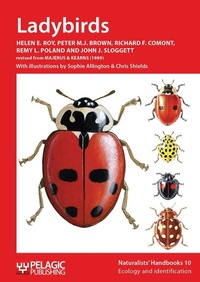
Ladybirds
2nd Edition
Published on 15. April 2013
142 pages
978-1-907807-37-4 (ISBN)
Description

This revised and updated edition of Ladybirds provides a succinct but comprehensive and accessible overview of the biology of ladybirds and their parasites, focusing on ecology in an evolutionary context. It provides the latest information, coverage of recent additions to the British list including the harlequin ladybird, and makes suggestions for further research, both short and long term, highlighting gaps in knowledge and showing readers how to get involved with recording and studying ladybirds. It includes updated keys for the identification of ladybirds at late-instar larval and adult stages, and techniques for studying ladybirds and their parasites in both laboratory and field.
The authors hope that this book will be a valuable resource, not only for students, from school to university and beyond, but also for anyone with an interest in natural history, whether professional or recreational.
The authors hope that this book will be a valuable resource, not only for students, from school to university and beyond, but also for anyone with an interest in natural history, whether professional or recreational.
Reviews / Votes
A lovely book and if I had it when I was six I would have burst with joy! It's all you need as a thorough introduction to the UK's Ladybirds and all you need to identify them. It's got ecology, behaviour, evolution and physiology alongside a great ID guide and up-to-date distribution maps. Once again the Pelagic team produce an invaluable treatise which fills the gaps for serious naturalists. And schoolboys with a fascination for brightly coloured beetles! -- Chris Packham Many of us have watched this book emerge from the Cambridge University stable as the key reference work to the identi?cation and study of ladybirds in the UK. Life before this was dull, with only a rather over-complex, black and white illustrated Royal Entomological Society Handbook on Coccinellidae (Pope, 1953) widely available for use (excellent diagrams, but a bit like describing the colour of snooker balls to those watching a snooker competition on black and white TV, for those who remember those happy days). Life became a bit more exciting with colour plates with the publication of the now sadly little-referred to Wayside & Woodland Beetles of the British Isles by Linssen (1959). Indeed all the ingredients were there for a fabulous book by the 1980s, and Mike Majerus and Peter Kearns ?nally achieved this with their publication of a proper colour guide to British ladybirds in 1989. This resulted in a massive increase in recording of ladybirds and a greater understanding of the species' distributions in the UK.With the untimely death of Mike Majerus, the new team under lead author Helen Roy has accumulated a wealth of new information about the biology of our native ladybirds - in this case an extra 39 pages since the ?rst edition. The book covers the 47 species now resident in Britain and focuses on the 26 species most frequently encountered. Chapters cover the life history and distribution of ladybirds, colour variation, population and evolutionary biology and methods of sampling and recording. This book contains just about everything you need to know when trying to identify British ladybirds as well as providing interesting information about the biology of each species. Readers who wish to know more about the distribution and status of our coccinellids should refer to the recent atlas by Roy et al. (2011). By now you may have guessed this book is a must for anyone interested in entomology and Coleoptera. -- John Badmin * British Journal of Entomology & Natural History * It seems to me that no aspect of ladybird life has been neglected in this publication. This book is packed with fascinating information presented in a very readable form and I found it hard to put down. From the plagues of ladybirds occasionally reported in the press to chromosome numbers and male-killing parasitic bacteria such as Rickettsia and Wolbachia I found it all interesting stuff. Highly recommended for both the expert and casual reader interested in insects. -- Colin Hart * Amateur Entomological Society Bulletin * "...quite excellent..." -- Simon Barnes * The Times * It's pretty much the only book you'll ever need if you want to get into ladybirds. It covers everything from life history, evolutionary biology, population and more. It also has a key to help you identify and a section on how and where to collect ladybirds for recording. If you like ladybirds, you'll like this book! -- Suffolk Naturalist * Suffolk Naturalist *
More details
Series
Edition
2nd edition
Language
English
Place of publication
Exeter
United Kingdom
Target group
Young adult
Professional and scholarly
US School Grade: From Third Grade to Twelfth Grade
Illustrations
8 farbige Bildtafeln, 50 s/w Abbildungen, 12 s/w Tabellen
12 Tables, black and white; 50 Illustrations, black and white; 8 Plates, color
ISBN-13
978-1-907807-37-4 (9781907807374)
Copyright in bibliographic data and cover images is held by Nielsen Book Services Limited or by the publishers or by their respective licensors: all rights reserved.
Schweitzer Classification
Other editions
Additional editions
Helen E. Roy | Peter M. J. Brown | Richard Comont
Ladybirds
Book
04/2013
2nd Edition
Pelagic Publishing
€32.00
Shipment within 10-15 days
Persons
Helen Roy completed her PhD (on the ecology of ladybirds, Pandora neoaphidis (fungal insect pathogen) and other aphid natural enemies) at Rothamsted Research (linked with Nottingham University) in 1997. She combined research with teaching for 10 years before taking up a position (research scientist) with the Biological Records Centre (Centre for Ecology & Hydrology) where she is responsible for zoological data and research and works extensively with national zoological schemes and societies. Her research focuses on the effects of environmental change on insect populations and communities.
Peter Brown is a senior lecturer in the Department of Animal & Environmental Biology at Anglia Ruskin University. His research focuses on understanding the spread distribution of the invasive harlequin species of ladybird, both in the UK and worldwide. Peter monitors the effects of the harlequin's spread on our native ladybird species and is involved in genetic work to detect predation of ladybirds and other prey by the harlequin.
Richard Comont joined the Bumblebee Conservation Trust as Science Manager in 2013 after six years at the Centre for Ecology & Hydrology, mainly spent monitoring and analysing ladybirds.
Remy Poland is a biology teacher at Clifton College, Bristol. Her research focuses on the evolutionary ecology of ladybirds. Current interests include the ecological impacts of the invasive 'harlequin ladybird', Harmonia axyridis, on British aphidophagous insects, particularly native coccinellids, through the processes of resource competition and intraguild predation.
Peter Brown is a senior lecturer in the Department of Animal & Environmental Biology at Anglia Ruskin University. His research focuses on understanding the spread distribution of the invasive harlequin species of ladybird, both in the UK and worldwide. Peter monitors the effects of the harlequin's spread on our native ladybird species and is involved in genetic work to detect predation of ladybirds and other prey by the harlequin.
Richard Comont joined the Bumblebee Conservation Trust as Science Manager in 2013 after six years at the Centre for Ecology & Hydrology, mainly spent monitoring and analysing ladybirds.
Remy Poland is a biology teacher at Clifton College, Bristol. Her research focuses on the evolutionary ecology of ladybirds. Current interests include the ecological impacts of the invasive 'harlequin ladybird', Harmonia axyridis, on British aphidophagous insects, particularly native coccinellids, through the processes of resource competition and intraguild predation.
Content
1. Introduction
2. Life history
3. Ladybirds in their environment
4. Ladybirds and their natural enemies
5. Variation in ladybirds
6. Population and evolutionary biology
7. Ladybird distribution
8. Identification of British ladybirds
I: Field key to adult British ladybirds
II: Key to all the adult British Coccinellidae
III: Field key to the larvae of British ladybirds
9. Study techniques and materials
References
Index
2. Life history
3. Ladybirds in their environment
4. Ladybirds and their natural enemies
5. Variation in ladybirds
6. Population and evolutionary biology
7. Ladybird distribution
8. Identification of British ladybirds
I: Field key to adult British ladybirds
II: Key to all the adult British Coccinellidae
III: Field key to the larvae of British ladybirds
9. Study techniques and materials
References
Index
