

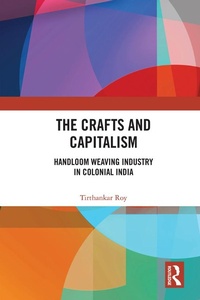
The Crafts and Capitalism
Handloom Weaving Industry in Colonial India
1st Edition
Published on 28. January 2020
200 pages
978-1-000-02338-1 (ISBN)
Description

This book presents a comprehensive history of handloom weaving industry in India to challenge and revise the view that competition from machine-produced textiles destroyed the country's handicrafts as claimed by historians until recently. It shows that skill-intensive handmade textiles survived the competition on a large scale, and that handmade goods and high-quality manual labour played a positive role in the making of modern India. Rich in archival material, The Crafts and Capitalism explores themes such as the historiography of craft technologies; statistical work on nineteenth-century cotton cloth production trends; narratives of merchants, the social leaders, the factory-owners; tools and techniques; and, shift from handloom to power loom. The book argues that changes in the handloom industry were central to the consolidation of new forms of capitalism in India.
An important intervention in Indian economic history, this book will be useful to scholars and researchers of Indian history, economic history, colonial history, modern history, political history, labour history and political economy. It will also interest nongovernmental organizations, textile historians, and design specialists.
An important intervention in Indian economic history, this book will be useful to scholars and researchers of Indian history, economic history, colonial history, modern history, political history, labour history and political economy. It will also interest nongovernmental organizations, textile historians, and design specialists.
Reviews / Votes
'The literature on decline and survival of the handloom sector in India in the nineteenth century had been ideological, focusing on the British policies of deliberate destruction of the industry. This book, based on data and quantitative estimation rather than preconceived assertions, is a much-needed contribution to the literature. A leading contributor to Indian economic history, Roy more than anybody else is well positioned to write this narrative.'Bishnupriya Gupta, Professor of Economics, University of Warwick, UK
'Given the continued importance of artisanship generally and handloom weaving particularly, both in cultural and economic terms, the book would be likely to find a wide audience among development workers, those interested in cultural heritage, as well as anyone interested in economic history more broadly.'
Abigail McGowan, Associate Professor of History & Associate Dean of the College of Arts and Sciences, University of Vermont, USA 'The literature on decline and survival of the handloom sector in India in the nineteenth century had been ideological, focusing on the British policies of deliberate destruction of the industry. This book, based on data and quantitative estimation rather than preconceived assertions, is a much-needed contribution to the literature. A leading contributor to Indian economic history, Roy more than anybody else is well positioned to write this narrative.'
Bishnupriya Gupta, Professor of Economics, University of Warwick, UK
'Given the continued importance of artisanship generally and handloom weaving particularly, both in cultural and economic terms, the book would be likely to find a wide audience among development workers, those interested in cultural heritage, as well as anyone interested in economic history more broadly.'
Abigail McGowan, Associate Professor of History & Associate Dean of the College of Arts and Sciences, University of Vermont, USA
More details
Edition
1. Auflage
Language
English
Place of publication
London
United Kingdom
Publishing group
Taylor & Francis Ltd
Target group
College/higher education
Illustrations
21 Tables, black and white; 8 Line drawings, black and white; 6 Halftones, black and white; 14 Illustrations, black and white
ISBN-13
978-1-000-02338-1 (9781000023381)
Copyright in bibliographic data and cover images is held by Nielsen Book Services Limited or by the publishers or by their respective licensors: all rights reserved.
Schweitzer Classification
Other editions
Additional editions
Book
09/2021
1st Edition
Routledge India
€64.80
Shipment within 10-20 days
Book
03/2020
Routledge
€148.80
No shipping information available
Book
02/2020
1st Edition
Routledge India
€192.21
Shipment within 15-20 days
Person
Tirthankar Roy is Professor of Economic History, London School of Economics and Political Science, UK where he teaches South Asia and Global History. He is the author of India in the World Economy: From Antiquity to the Present (2012); Law and the Economy in Colonial India (with Anand V. Swamy, 2016); and The Economy of South Asia from 1950 to the Present (2017). His research interests are history and development of South Asia, global history, empires, and environmental history.
Content
List of Figures, Maps, Tables. Preface 1. Introduction 2. Scale and Composition, 1795-1940 3. Consumption and Market 4. Capital and Labour 5. Tools and Techniques 6. Towns and Regions 7. Handlooms and Powerlooms, 1920-1990 8. Handloom after Independence. Glossary. Selected Biographies. References. Index
