

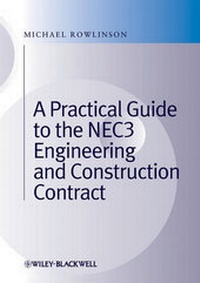
A Practical Guide to the NEC3 Engineering and Construction Contract
Published on 6. April 2011
320 pages
978-1-4443-4017-4 (ISBN)
Available for download
Description

Launched in 1991, the New Engineering Contract (NEC) has become oneof the UK's leading standard forms of contract for majorconstruction and civil engineering projects. Currently in the thirdedition, popularly known as NEC 3, it is a process basedconstruction contract embodying project management best practice,and thus the basic philosophy behind the contract is different tothe more adversarial principles and approach of other standardconstruction contracts.
Written as a practical guide to the application of theprocedures contained in NEC 3, this book will aid users in thetransition from their use and understanding of the other standardconstruction contracts to the collaborative project managementbased approach of the ECC.
Written for anyone working in the construction industry workingon a project under the ECC, it will be of interest to the completeconstruction supply chain including employers, constructionprofessions, contractors and sub-contractors. It will also be ofinterest to consultants and lawyers advising any of these parties,either in the preparation of contract documentation or theresolution of problem situations which may arise.
* A practical guide to the application of the procedurescontained in the NEC Engineering and Construction Contracts
* Written specifically for people actually using andadministering the NEC contracts - rather than lawyers
* Covers all the variations created by the Main and SecondaryOptions
Written as a practical guide to the application of theprocedures contained in NEC 3, this book will aid users in thetransition from their use and understanding of the other standardconstruction contracts to the collaborative project managementbased approach of the ECC.
Written for anyone working in the construction industry workingon a project under the ECC, it will be of interest to the completeconstruction supply chain including employers, constructionprofessions, contractors and sub-contractors. It will also be ofinterest to consultants and lawyers advising any of these parties,either in the preparation of contract documentation or theresolution of problem situations which may arise.
* A practical guide to the application of the procedurescontained in the NEC Engineering and Construction Contracts
* Written specifically for people actually using andadministering the NEC contracts - rather than lawyers
* Covers all the variations created by the Main and SecondaryOptions
More details
Other editions
Additional editions
Michael Rowlinson
A Practical Guide to the NEC3 Engineering and Construction Contract
Book
03/2011
Wiley-Blackwell
€105.00
Article exhausted; check for reprint
Person
Michael Rowlinson MSc, DipArb, MRICS, FCIOB, FCIA, FCICES, is a director of Alway Associates, Construction Contracts & Commercial Consultants based in Banbury, Oxfordshire. He is an experienced construction professional, having qualified initially as a Chartered Quantity Surveyor and later as a Chartered Builder. After over 20 years with private practice and contractors Michael joined Alway Associates in 1998, specialising in Construction Contracts and Law. As part of his work Michael has lectured extensively for the Construction Study Centre and direct for his own clients, predominantly on the NEC suite of Contracts. He has written a number of articles on this suite of contracts which have been published in the Civil Engineering Surveyor and the NEC User Group's Newsletter, as well as on Alway Associates website.
Content
1 - A Practical Guide to the NEC3 Engineering and Construction Contract [Seite 5]
1.1 - Contents [Seite 7]
1.2 - 1 Introduction [Seite 13]
1.2.1 - 1.1 General [Seite 13]
1.2.2 - 1.2 Mechanics not law [Seite 14]
1.2.3 - 1.3 A simple formula for understanding a contract [Seite 14]
1.2.4 - 1.4 Mandatory or discretionary [Seite 15]
1.2.5 - 1.5 Conditions precedent [Seite 16]
1.2.6 - 1.6 Note on use of upper case in key words and phrases [Seite 16]
1.3 - 2 Background to the NECECC [Seite 17]
1.3.1 - 2.1 The background: First edition [Seite 17]
1.3.2 - 2.2 The second edition [Seite 18]
1.3.3 - 2.3 The third edition [Seite 19]
1.3.4 - 2.4 Endorsement of NEC3 by the Office of Government Commerce [Seite 19]
1.3.5 - 2.5 General philosophy: Aims and objectives [Seite 20]
1.3.6 - 2.6 Flexibility [Seite 20]
1.3.7 - 2.7 Clarity and simplicity [Seite 21]
1.3.8 - 2.8 Stimulus to good management [Seite 21]
1.3.9 - 2.9 Other characteristics [Seite 22]
1.4 - 3 The Options: An Overview [Seite 25]
1.4.1 - 3.1 General arrangement of the ECC [Seite 25]
1.4.2 - 3.2 Other documents referred to [Seite 27]
1.4.3 - 3.3 Contract Data [Seite 28]
1.4.4 - 3.4 The published documents [Seite 28]
1.4.5 - 3.5 Main Options: General outline [Seite 29]
1.5 - 4 'Spirit of Mutual Trust and Cooperation' [Seite 31]
1.5.1 - 4.1 Introduction [Seite 31]
1.5.2 - 4.2 Core clause 10.1 [Seite 31]
1.5.3 - 4.3 What does it mean? [Seite 33]
1.5.4 - 4.4 Practical issues [Seite 34]
1.6 - 5 The Cast of Characters [Seite 37]
1.6.1 - 5.1 Introduction [Seite 37]
1.6.2 - 5.2 The Employer [Seite 37]
1.6.3 - 5.3 The Project Manager [Seite 39]
1.6.4 - 5.4 The Supervisor [Seite 41]
1.6.5 - 5.5 The Contractor [Seite 42]
1.6.6 - 5.6 The Adjudicator [Seite 43]
1.6.7 - 5.7 Subcontractors [Seite 44]
1.6.8 - 5.8 'Others' [Seite 44]
1.6.9 - 5.9 Designers [Seite 45]
1.6.10 - 5.10 CDM Coordinator [Seite 46]
1.6.11 - 5.11 Principal Contractor [Seite 46]
1.6.12 - 5.12 Practical issues [Seite 47]
1.7 - 6 Communications, Early Warnings and other General Matters [Seite 49]
1.7.1 - 6.1 Introduction [Seite 49]
1.7.2 - 6.2 Communications: The clause [Seite 49]
1.7.3 - 6.3 Communications: Practical issues [Seite 50]
1.7.4 - 6.4 Early warnings: The clause [Seite 52]
1.7.5 - 6.5 Early warnings: Practical issues [Seite 54]
1.7.6 - 6.6 Other matters: The clauses [Seite 56]
1.7.7 - 6.7 Other matters: Practical issues [Seite 59]
1.8 - 7 The Contractor's Main Responsibilities [Seite 61]
1.8.1 - 7.1 Introduction [Seite 61]
1.8.2 - 7.2 Providing the Works [Seite 61]
1.8.3 - 7.3 Contractor's design [Seite 63]
1.8.4 - 7.4 Other matters [Seite 64]
1.8.5 - 7.5 Practical issues [Seite 67]
1.9 - 8 Subcontracting [Seite 71]
1.9.1 - 8.1 Introduction [Seite 71]
1.9.2 - 8.2 Definition of a Subcontractor [Seite 71]
1.9.3 - 8.3 The core clauses [Seite 72]
1.9.4 - 8.4 Provisions in the Main Options [Seite 73]
1.9.5 - 8.5 Practical issues [Seite 73]
1.9.6 - 8.6 Options for forms of subcontract in the NEC3 family [Seite 74]
1.10 - 9 Testing and Defects [Seite 77]
1.10.1 - 9.1 Introduction [Seite 77]
1.10.2 - 9.2 Tests and inspections [Seite 77]
1.10.3 - 9.3 What is a Defect? [Seite 79]
1.10.4 - 9.4 The Defect procedure [Seite 80]
1.10.5 - 9.5 The Defects Certificate [Seite 82]
1.10.6 - 9.6 Uncorrected Defects [Seite 82]
1.10.7 - 9.7 Practical issues [Seite 83]
1.11 - 10 Title [Seite 85]
1.11.1 - 10.1 Introduction [Seite 85]
1.11.2 - 10.2 The core clauses [Seite 85]
1.11.3 - 10.3 Practical issues [Seite 86]
1.12 - 11 Risks and Insurance [Seite 89]
1.12.1 - 11.1 Introduction [Seite 89]
1.12.2 - 11.2 The core clauses [Seite 89]
1.12.3 - 11.3 Practical issues [Seite 92]
1.13 - 12 Time [Seite 97]
1.13.1 - 12.1 Introduction [Seite 97]
1.13.2 - 12.2 The programme: Contents [Seite 98]
1.13.3 - 12.3 The programme: Submitting, accepting and revising [Seite 103]
1.13.4 - 12.4 The programme: Practical issues [Seite 105]
1.13.5 - 12.5 Starting and finishing [Seite 114]
1.13.6 - 12.6 Other matters [Seite 117]
1.13.7 - 12.7 Secondary Options related to Time [Seite 120]
1.13.8 - 12.8 Practical issues [Seite 122]
1.14 - 13 Payment [Seite 125]
1.14.1 - 13.1 Introduction [Seite 125]
1.14.2 - 13.2 The payment process [Seite 125]
1.14.3 - 13.3 Payments in multiple currencies [Seite 128]
1.14.4 - 13.4 The amount due and the Price for Work Done to Date [Seite 128]
1.14.5 - 13.5 Supporting documents and records [Seite 138]
1.14.6 - 13.6 The Contractor's share [Seite 141]
1.14.7 - 13.7 The Contractor's share: Practical issues [Seite 143]
1.14.8 - 13.8 Special provisions for the UK [Seite 144]
1.14.9 - 13.9 Related Secondary Options [Seite 146]
1.14.10 - 13.10 Practical issues [Seite 148]
1.15 - 14 The Schedules of Cost Components [Seite 151]
1.15.1 - 14.1 Introduction [Seite 151]
1.15.2 - 14.2 The Schedule of Cost Components [Seite 151]
1.15.3 - 14.3 The Shorter Schedule of Cost Components [Seite 156]
1.15.4 - 14.4 Application to Subcontractors [Seite 157]
1.15.5 - 14.5 Practical issues [Seite 158]
1.16 - 15 Compensation Events: Theory and Events [Seite 163]
1.16.1 - 15.1 Introduction [Seite 163]
1.16.2 - 15.2 The theory [Seite 163]
1.16.3 - 15.3 The events [Seite 165]
1.16.4 - 15.4 Practical issues [Seite 180]
1.17 - 16 Compensation Events: Procedures [Seite 183]
1.17.1 - 16.1 Introduction [Seite 183]
1.17.2 - 16.2 Notification by the Project Manager [Seite 184]
1.17.3 - 16.3 Notification by the Contractor and the Project Manager's reply [Seite 187]
1.17.4 - 16.4 Other matters associated with notifying compensation events [Seite 190]
1.17.5 - 16.5 Quotations: Substance [Seite 192]
1.17.6 - 16.6 Quotations: Submission and reply [Seite 194]
1.17.7 - 16.7 Assessments by the Project Manager [Seite 198]
1.17.8 - 16.8 Implementing compensation events [Seite 200]
1.17.9 - 16.9 Practical issues [Seite 201]
1.18 - 17 Compensation Events: Assessment [Seite 207]
1.18.1 - 17.1 Introduction [Seite 207]
1.18.2 - 17.2 Changes to the Prices [Seite 208]
1.18.3 - 17.3 Changes to the Completion Date and any Key Dates [Seite 212]
1.18.4 - 17.4 Project Manager's assumptions [Seite 215]
1.18.5 - 17.5 Other related matters [Seite 216]
1.18.6 - 17.6 Practical issues [Seite 218]
1.19 - 18 Termination [Seite 221]
1.19.1 - 18.1 Introduction [Seite 221]
1.19.2 - 18.2 Reasons for termination [Seite 221]
1.19.3 - 18.3 Implementing termination [Seite 225]
1.19.4 - 18.4 Procedures after termination [Seite 226]
1.19.5 - 18.5 Assessing the amount due after termination [Seite 227]
1.19.6 - 18.6 Practical issues [Seite 229]
1.20 - 19 Dispute Resolution [Seite 231]
1.20.1 - 19.1 Introduction [Seite 231]
1.20.2 - 19.2 Option W1 [Seite 232]
1.20.3 - 19.3 Option W2 [Seite 235]
1.20.4 - 19.4 Practical issues [Seite 240]
1.21 - 20 Secondary Options [Seite 243]
1.21.1 - 20.1 Introduction [Seite 243]
1.21.2 - 20.2 X2: Changes in the law [Seite 243]
1.21.3 - 20.3 X4: Parent company guarantee [Seite 244]
1.21.4 - 20.4 X12: Partnering [Seite 244]
1.21.5 - 20.5 X13: Performance bond [Seite 249]
1.21.6 - 20.6 X17: Low performance damages [Seite 250]
1.21.7 - 20.7 X18: Limitation of liability [Seite 250]
1.21.8 - 20.8 X20: Key Performance Indicators [Seite 251]
1.21.9 - 20.9 Y(UK)3: The Contracts (Rights of Third Parties) Act 1999 [Seite 252]
1.21.10 - 20.10 Z: Additional conditions of contract [Seite 252]
1.21.11 - 20.11 Practical issues [Seite 253]
1.22 - 21 Completing the Contract Data [Seite 255]
1.22.1 - 21.1 Introduction [Seite 255]
1.22.2 - 21.2 Purpose and form of the Contract Data [Seite 255]
1.22.3 - 21.3 Part One: Data for the core clauses [Seite 256]
1.22.4 - 21.4 Part One: Data for the Main Option clauses [Seite 260]
1.22.5 - 21.5 Part One: Data for the Secondary Option clauses [Seite 261]
1.22.6 - 21.6 Part Two: Data for the core clauses [Seite 264]
1.22.7 - 21.7 Part Two: Data for the optional statements [Seite 265]
1.22.8 - 21.8 Part Two: Data for Main Options A or B [Seite 267]
1.22.9 - 21.9 Part Two: Data for Main Options C, D or E [Seite 268]
1.22.10 - 21.10 Practical issues [Seite 269]
1.23 - 22 The Supporting Documents: Need and Content [Seite 273]
1.23.1 - 22.1 Introduction [Seite 273]
1.23.2 - 22.2 Works Information [Seite 273]
1.23.3 - 22.3 Site Information [Seite 282]
1.23.4 - 22.4 Practical issues [Seite 283]
1.24 - Bibliography [Seite 285]
1.25 - Appendix 1 Tables of Clause Numbers, Case Law and Statutes [Seite 287]
1.26 - Appendix 2 Tables of Employer's, Project Manager's, Supervisor's, Contractor's and Adjudicator's Actions [Seite 297]
1.1 - Contents [Seite 7]
1.2 - 1 Introduction [Seite 13]
1.2.1 - 1.1 General [Seite 13]
1.2.2 - 1.2 Mechanics not law [Seite 14]
1.2.3 - 1.3 A simple formula for understanding a contract [Seite 14]
1.2.4 - 1.4 Mandatory or discretionary [Seite 15]
1.2.5 - 1.5 Conditions precedent [Seite 16]
1.2.6 - 1.6 Note on use of upper case in key words and phrases [Seite 16]
1.3 - 2 Background to the NECECC [Seite 17]
1.3.1 - 2.1 The background: First edition [Seite 17]
1.3.2 - 2.2 The second edition [Seite 18]
1.3.3 - 2.3 The third edition [Seite 19]
1.3.4 - 2.4 Endorsement of NEC3 by the Office of Government Commerce [Seite 19]
1.3.5 - 2.5 General philosophy: Aims and objectives [Seite 20]
1.3.6 - 2.6 Flexibility [Seite 20]
1.3.7 - 2.7 Clarity and simplicity [Seite 21]
1.3.8 - 2.8 Stimulus to good management [Seite 21]
1.3.9 - 2.9 Other characteristics [Seite 22]
1.4 - 3 The Options: An Overview [Seite 25]
1.4.1 - 3.1 General arrangement of the ECC [Seite 25]
1.4.2 - 3.2 Other documents referred to [Seite 27]
1.4.3 - 3.3 Contract Data [Seite 28]
1.4.4 - 3.4 The published documents [Seite 28]
1.4.5 - 3.5 Main Options: General outline [Seite 29]
1.5 - 4 'Spirit of Mutual Trust and Cooperation' [Seite 31]
1.5.1 - 4.1 Introduction [Seite 31]
1.5.2 - 4.2 Core clause 10.1 [Seite 31]
1.5.3 - 4.3 What does it mean? [Seite 33]
1.5.4 - 4.4 Practical issues [Seite 34]
1.6 - 5 The Cast of Characters [Seite 37]
1.6.1 - 5.1 Introduction [Seite 37]
1.6.2 - 5.2 The Employer [Seite 37]
1.6.3 - 5.3 The Project Manager [Seite 39]
1.6.4 - 5.4 The Supervisor [Seite 41]
1.6.5 - 5.5 The Contractor [Seite 42]
1.6.6 - 5.6 The Adjudicator [Seite 43]
1.6.7 - 5.7 Subcontractors [Seite 44]
1.6.8 - 5.8 'Others' [Seite 44]
1.6.9 - 5.9 Designers [Seite 45]
1.6.10 - 5.10 CDM Coordinator [Seite 46]
1.6.11 - 5.11 Principal Contractor [Seite 46]
1.6.12 - 5.12 Practical issues [Seite 47]
1.7 - 6 Communications, Early Warnings and other General Matters [Seite 49]
1.7.1 - 6.1 Introduction [Seite 49]
1.7.2 - 6.2 Communications: The clause [Seite 49]
1.7.3 - 6.3 Communications: Practical issues [Seite 50]
1.7.4 - 6.4 Early warnings: The clause [Seite 52]
1.7.5 - 6.5 Early warnings: Practical issues [Seite 54]
1.7.6 - 6.6 Other matters: The clauses [Seite 56]
1.7.7 - 6.7 Other matters: Practical issues [Seite 59]
1.8 - 7 The Contractor's Main Responsibilities [Seite 61]
1.8.1 - 7.1 Introduction [Seite 61]
1.8.2 - 7.2 Providing the Works [Seite 61]
1.8.3 - 7.3 Contractor's design [Seite 63]
1.8.4 - 7.4 Other matters [Seite 64]
1.8.5 - 7.5 Practical issues [Seite 67]
1.9 - 8 Subcontracting [Seite 71]
1.9.1 - 8.1 Introduction [Seite 71]
1.9.2 - 8.2 Definition of a Subcontractor [Seite 71]
1.9.3 - 8.3 The core clauses [Seite 72]
1.9.4 - 8.4 Provisions in the Main Options [Seite 73]
1.9.5 - 8.5 Practical issues [Seite 73]
1.9.6 - 8.6 Options for forms of subcontract in the NEC3 family [Seite 74]
1.10 - 9 Testing and Defects [Seite 77]
1.10.1 - 9.1 Introduction [Seite 77]
1.10.2 - 9.2 Tests and inspections [Seite 77]
1.10.3 - 9.3 What is a Defect? [Seite 79]
1.10.4 - 9.4 The Defect procedure [Seite 80]
1.10.5 - 9.5 The Defects Certificate [Seite 82]
1.10.6 - 9.6 Uncorrected Defects [Seite 82]
1.10.7 - 9.7 Practical issues [Seite 83]
1.11 - 10 Title [Seite 85]
1.11.1 - 10.1 Introduction [Seite 85]
1.11.2 - 10.2 The core clauses [Seite 85]
1.11.3 - 10.3 Practical issues [Seite 86]
1.12 - 11 Risks and Insurance [Seite 89]
1.12.1 - 11.1 Introduction [Seite 89]
1.12.2 - 11.2 The core clauses [Seite 89]
1.12.3 - 11.3 Practical issues [Seite 92]
1.13 - 12 Time [Seite 97]
1.13.1 - 12.1 Introduction [Seite 97]
1.13.2 - 12.2 The programme: Contents [Seite 98]
1.13.3 - 12.3 The programme: Submitting, accepting and revising [Seite 103]
1.13.4 - 12.4 The programme: Practical issues [Seite 105]
1.13.5 - 12.5 Starting and finishing [Seite 114]
1.13.6 - 12.6 Other matters [Seite 117]
1.13.7 - 12.7 Secondary Options related to Time [Seite 120]
1.13.8 - 12.8 Practical issues [Seite 122]
1.14 - 13 Payment [Seite 125]
1.14.1 - 13.1 Introduction [Seite 125]
1.14.2 - 13.2 The payment process [Seite 125]
1.14.3 - 13.3 Payments in multiple currencies [Seite 128]
1.14.4 - 13.4 The amount due and the Price for Work Done to Date [Seite 128]
1.14.5 - 13.5 Supporting documents and records [Seite 138]
1.14.6 - 13.6 The Contractor's share [Seite 141]
1.14.7 - 13.7 The Contractor's share: Practical issues [Seite 143]
1.14.8 - 13.8 Special provisions for the UK [Seite 144]
1.14.9 - 13.9 Related Secondary Options [Seite 146]
1.14.10 - 13.10 Practical issues [Seite 148]
1.15 - 14 The Schedules of Cost Components [Seite 151]
1.15.1 - 14.1 Introduction [Seite 151]
1.15.2 - 14.2 The Schedule of Cost Components [Seite 151]
1.15.3 - 14.3 The Shorter Schedule of Cost Components [Seite 156]
1.15.4 - 14.4 Application to Subcontractors [Seite 157]
1.15.5 - 14.5 Practical issues [Seite 158]
1.16 - 15 Compensation Events: Theory and Events [Seite 163]
1.16.1 - 15.1 Introduction [Seite 163]
1.16.2 - 15.2 The theory [Seite 163]
1.16.3 - 15.3 The events [Seite 165]
1.16.4 - 15.4 Practical issues [Seite 180]
1.17 - 16 Compensation Events: Procedures [Seite 183]
1.17.1 - 16.1 Introduction [Seite 183]
1.17.2 - 16.2 Notification by the Project Manager [Seite 184]
1.17.3 - 16.3 Notification by the Contractor and the Project Manager's reply [Seite 187]
1.17.4 - 16.4 Other matters associated with notifying compensation events [Seite 190]
1.17.5 - 16.5 Quotations: Substance [Seite 192]
1.17.6 - 16.6 Quotations: Submission and reply [Seite 194]
1.17.7 - 16.7 Assessments by the Project Manager [Seite 198]
1.17.8 - 16.8 Implementing compensation events [Seite 200]
1.17.9 - 16.9 Practical issues [Seite 201]
1.18 - 17 Compensation Events: Assessment [Seite 207]
1.18.1 - 17.1 Introduction [Seite 207]
1.18.2 - 17.2 Changes to the Prices [Seite 208]
1.18.3 - 17.3 Changes to the Completion Date and any Key Dates [Seite 212]
1.18.4 - 17.4 Project Manager's assumptions [Seite 215]
1.18.5 - 17.5 Other related matters [Seite 216]
1.18.6 - 17.6 Practical issues [Seite 218]
1.19 - 18 Termination [Seite 221]
1.19.1 - 18.1 Introduction [Seite 221]
1.19.2 - 18.2 Reasons for termination [Seite 221]
1.19.3 - 18.3 Implementing termination [Seite 225]
1.19.4 - 18.4 Procedures after termination [Seite 226]
1.19.5 - 18.5 Assessing the amount due after termination [Seite 227]
1.19.6 - 18.6 Practical issues [Seite 229]
1.20 - 19 Dispute Resolution [Seite 231]
1.20.1 - 19.1 Introduction [Seite 231]
1.20.2 - 19.2 Option W1 [Seite 232]
1.20.3 - 19.3 Option W2 [Seite 235]
1.20.4 - 19.4 Practical issues [Seite 240]
1.21 - 20 Secondary Options [Seite 243]
1.21.1 - 20.1 Introduction [Seite 243]
1.21.2 - 20.2 X2: Changes in the law [Seite 243]
1.21.3 - 20.3 X4: Parent company guarantee [Seite 244]
1.21.4 - 20.4 X12: Partnering [Seite 244]
1.21.5 - 20.5 X13: Performance bond [Seite 249]
1.21.6 - 20.6 X17: Low performance damages [Seite 250]
1.21.7 - 20.7 X18: Limitation of liability [Seite 250]
1.21.8 - 20.8 X20: Key Performance Indicators [Seite 251]
1.21.9 - 20.9 Y(UK)3: The Contracts (Rights of Third Parties) Act 1999 [Seite 252]
1.21.10 - 20.10 Z: Additional conditions of contract [Seite 252]
1.21.11 - 20.11 Practical issues [Seite 253]
1.22 - 21 Completing the Contract Data [Seite 255]
1.22.1 - 21.1 Introduction [Seite 255]
1.22.2 - 21.2 Purpose and form of the Contract Data [Seite 255]
1.22.3 - 21.3 Part One: Data for the core clauses [Seite 256]
1.22.4 - 21.4 Part One: Data for the Main Option clauses [Seite 260]
1.22.5 - 21.5 Part One: Data for the Secondary Option clauses [Seite 261]
1.22.6 - 21.6 Part Two: Data for the core clauses [Seite 264]
1.22.7 - 21.7 Part Two: Data for the optional statements [Seite 265]
1.22.8 - 21.8 Part Two: Data for Main Options A or B [Seite 267]
1.22.9 - 21.9 Part Two: Data for Main Options C, D or E [Seite 268]
1.22.10 - 21.10 Practical issues [Seite 269]
1.23 - 22 The Supporting Documents: Need and Content [Seite 273]
1.23.1 - 22.1 Introduction [Seite 273]
1.23.2 - 22.2 Works Information [Seite 273]
1.23.3 - 22.3 Site Information [Seite 282]
1.23.4 - 22.4 Practical issues [Seite 283]
1.24 - Bibliography [Seite 285]
1.25 - Appendix 1 Tables of Clause Numbers, Case Law and Statutes [Seite 287]
1.26 - Appendix 2 Tables of Employer's, Project Manager's, Supervisor's, Contractor's and Adjudicator's Actions [Seite 297]

