

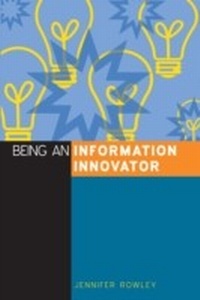
Being an Information Innovator
Description

Whilst there is no shortage of professional literature discussing the changing nature of libraries and information organizations in the digital age, words such as innovation, entrepreneurship and creativity make only occasional appearances. Considerable change and innovation has already been achieved, and a future in which all information resources, including books and archives, will be accessed in digital format poses even greater challenges for information professionals. The ability to move into uncharted territory, engage in and enjoy innovation, create radical new visions, and manage resources in risky environments will be essential.
This groundbreaking book is the first to discuss and apply the rhetoric and theories of innovation and entrepreneurship in information organizations. It both celebrates existing examples of good practice, and promotes the development of innovative and entrepreneurial behaviour at all organizational levels.
Key areas covered include:
- promoting innovation and entrepreneurship in information organizations
- the nature of innovation and entrepreneurship
- corporate and social entrepreneurship in public sector information services
- organizing for innovation: strategies, leadership and creative team-building
- innovation in practice and managing innovation projects
- collaborative and open innovation through networks and partnerships.
The text makes plentiful use of features such as learning objectives, challenges, reflections, group discussion topics, review questions and summaries, making it suitable both for individual reflection and learning, and for group learning situations such as professional development and training courses.
Readership: All information professionals and managers who wish to understand and engage creatively with innovation to achieve success, and to realise the professional and social benefits of entrepreneurial action in their organizations.
All prices
More details
Other editions
Additional editions
Person
Jennifer Rowley BA MSc MSc PhD FCLIP CEng MCMI MBCS is Professor of Information and Communications at the Department of Information and Communications, Manchester Metropolitan University.
Content
1. Innovation and entrepreneurship in information organizations
Learning objectives 1.1 Introduction 1.2 Innovation 1.3 Entrepreneurship 1.4 Creativity 1.5 What's new about innovation? 1.6 Promoting innovation in information organizations Summary and conclusions Review questions Challenges Group discussion topics References and additional reading
2. Innovation Co-authored by Anahita Baregheh
Learning objectives 2.1 Introduction 2.2 What is innovation? 2.3 Nature or degree of an innovation 2.4 Types of innovation 2.5 Information systems and innovation 2.6 Innovation orientation 2.7 Innovation management 2.8 Innovation diffusion and adoption Summary and conclusions Review questions Challenges Group discussion topics References and additional reading
3. Entrepreneurship Co-authored by Siwan Mitchelmore
Learning objectives 3.1 Introduction 3.2 The origins of the concept of entrepreneurship 3.3 Being an entrepreneur 3.4 Public sector corporate entrepreneurship 3.5 Social entrepreneurship 3.6 Entrepreneurial competencies Summary and conclusions Review questions Challenges Group discussion topics References and additional reading
4. Organizing for innovation
Learning objectives 4.1 Introduction 4.2 Innovativeness, innovation orientation and entrepreneurial orientation 4.3 The innovative organization 4.4 Leadership for innovation 4.5 Building innovative and creative teams 4.6 Innovation and entrepreneurship strategies 4.7 Launching an innovation and change management Summary and conclusions Review questions Challenges Group discussion topics References and additional reading
5. Innovation in practice
Learning objectives 5.1 Introduction 5.2 The innovation project 5.3 Capitalizing on customer/user innovation 5.4 Collaborative and open innovation through networks and partnerships 5.5 Knowledge, learning and innovation Summary and conclusions Review questions Challenges Group discussion topics References and additional reading
