

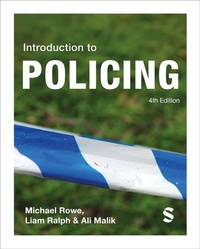
Introduction to Policing
4th Edition
Published on 29. November 2023
368 pages
978-1-5296-1783-2 (ISBN)
Description

"An extremely valuable source of reading, information, and guidance for my policing students. It covers all the topical issues."
Johannes Oosthuizen - Lecturer at Winchester University
Introducing the definitive guide for students and professionals alike who want to gain a comprehensive understanding of policing in the 21st century. This updated edition of Introduction to Policing reflects the latest developments in policing and offers a rigorous yet accessible overview of the historical origins and theories of policing, the functions of police organisations, and the challenges and controversies facing policing today.
With an emphasis on critical thinking and analysis, Rowe encourages readers to consider different perspectives and to engage with key debates around policing, such as 'who guards the guards' and 'the implications of police culture', helping them to develop a more nuanced understanding of this complex field. The clear writing style, engaging case studies, and helpful study aids make this book an invaluable resource for students and professionals alike.
Key features include:
* Revised and expanded discussion of racism and police culture, and new coverage of the development of antiracist policing
* Updated examples reflecting contemporary criticisms of policing, such as the cases of Sarah Everard and George Floyd
* Expanded discussion of key debates, including the 'defund the police' movement, and the use of technology and digital policing, including Smart Policing, drones, and body-worn cameras
* Learning objectives, key terms, review questions, and annotated further readings in every chapter will help you to engage with the material and consolidate your learning
Michael Rowe is Professor of Criminology at Northumbria University
Liam Ralph is Assistant Professor of Criminology at Northumbria University
Ali Malik is Lecturer in Criminal Justice at University of Leeds
Johannes Oosthuizen - Lecturer at Winchester University
Introducing the definitive guide for students and professionals alike who want to gain a comprehensive understanding of policing in the 21st century. This updated edition of Introduction to Policing reflects the latest developments in policing and offers a rigorous yet accessible overview of the historical origins and theories of policing, the functions of police organisations, and the challenges and controversies facing policing today.
With an emphasis on critical thinking and analysis, Rowe encourages readers to consider different perspectives and to engage with key debates around policing, such as 'who guards the guards' and 'the implications of police culture', helping them to develop a more nuanced understanding of this complex field. The clear writing style, engaging case studies, and helpful study aids make this book an invaluable resource for students and professionals alike.
Key features include:
* Revised and expanded discussion of racism and police culture, and new coverage of the development of antiracist policing
* Updated examples reflecting contemporary criticisms of policing, such as the cases of Sarah Everard and George Floyd
* Expanded discussion of key debates, including the 'defund the police' movement, and the use of technology and digital policing, including Smart Policing, drones, and body-worn cameras
* Learning objectives, key terms, review questions, and annotated further readings in every chapter will help you to engage with the material and consolidate your learning
Michael Rowe is Professor of Criminology at Northumbria University
Liam Ralph is Assistant Professor of Criminology at Northumbria University
Ali Malik is Lecturer in Criminal Justice at University of Leeds
Reviews / Votes
By considering recent internal, societal and technological challenges the police are facing this book offers important insights into how these issues impact on a number of key policing issues such as police culture, crime investigation and diversity. It covers a number of challenging issues relating to the use of data, technology and trustworthiness and how these impact on the police, providing an exciting update on several core police issues that have been debated over time. -- Emma Williams * Centre for Policing Research and Learning, The Open University * Rowe, Ralph and Malik's latest edition provide a robust, comprehensive and critically inclined introductory text for undergraduate students pursuing degrees in criminology and policing. The chapter summaries and review questions provide excellent opportunities for both student reflection on learning and inspiration to tutors for class-based discussion. This resource will be a welcome addition to our reading lists. -- Shane HorganMore details
Edition
Fourth Edition
Language
English
Place of publication
London
United Kingdom
Publishing group
Sage Publications Ltd (Digital)
Target group
College/higher education
ISBN-13
978-1-5296-1783-2 (9781529617832)
Copyright in bibliographic data and cover images is held by Nielsen Book Services Limited or by the publishers or by their respective licensors: all rights reserved.
Schweitzer Classification
Other editions
Additional editions
Michael Rowe | Liam Ralph | Ali Malik
Introduction to Policing
Book
12/2023
4th Edition
SAGE Publications Ltd
€149.80
Shipment within 3-4 weeks
Michael Rowe | Liam Ralph | Ali Malik
Introduction to Policing
Book
11/2023
4th Edition
SAGE Publications Ltd
€75.60
Shipment within 3-4 weeks
Persons
Professor Michael Rowe's research interests have tended to focus on accountability and governance in policing, and the changing organisation and delivery of policing in relation to diversity, professionalisation, the application of Evidence Based Policing and the challenges of policing in a digital age. A recent project has explored the changing nature of visible policing in relation to the impact of police buildings, material culture and social media on public perceptions of legitimacy and authority, as well as on police officer and staff professional culture and identity. Other projects have examined innovative police responses to domestic violence, organisational and cultural change in the policing of adult sexual assault investigations and the ethical and governance challenges of using scientific research and AI technology in contemporary policing. He is currently developing work exploring the policing of Anthropocentric climate change. He has published widely on these and related matters in the British Journal of Criminology, Policing and Society, Public Management Review, the Journal of Contemporary Ethnography, Criminology and Criminal Justice and many other journals. His books include Policing the Police (Policy Press, 2020) and Accountability in Policing: Contemporary Debates (Routledge, 2015, edited with Stuart Lister) and Introduction to Policing (Sage, 2018, third edition). He is editor of the International Journal of Police Science and Management.
Content
Chapter One: What is policing?
Chapter Two: Historical origins and development of the police in England and Wales
Chapter Three: Police Powers: the legal framework
Chapter Four: Who Guards the Guards?
Chapter Five: Community Policing
Chapter Six: Police Culture
Chapter Seven: Policing Diversity
Chapter Eight: Global and Transnational Policing
Chapter Nine: Criminal investigation and policing
Chapter Ten: Plural Policing
Chapter Eleven: Smart Policing, Surveillance, IT and the Future of Policing
Chapter Twelve: Conclusions: The Future of Policing
Chapter Two: Historical origins and development of the police in England and Wales
Chapter Three: Police Powers: the legal framework
Chapter Four: Who Guards the Guards?
Chapter Five: Community Policing
Chapter Six: Police Culture
Chapter Seven: Policing Diversity
Chapter Eight: Global and Transnational Policing
Chapter Nine: Criminal investigation and policing
Chapter Ten: Plural Policing
Chapter Eleven: Smart Policing, Surveillance, IT and the Future of Policing
Chapter Twelve: Conclusions: The Future of Policing
